

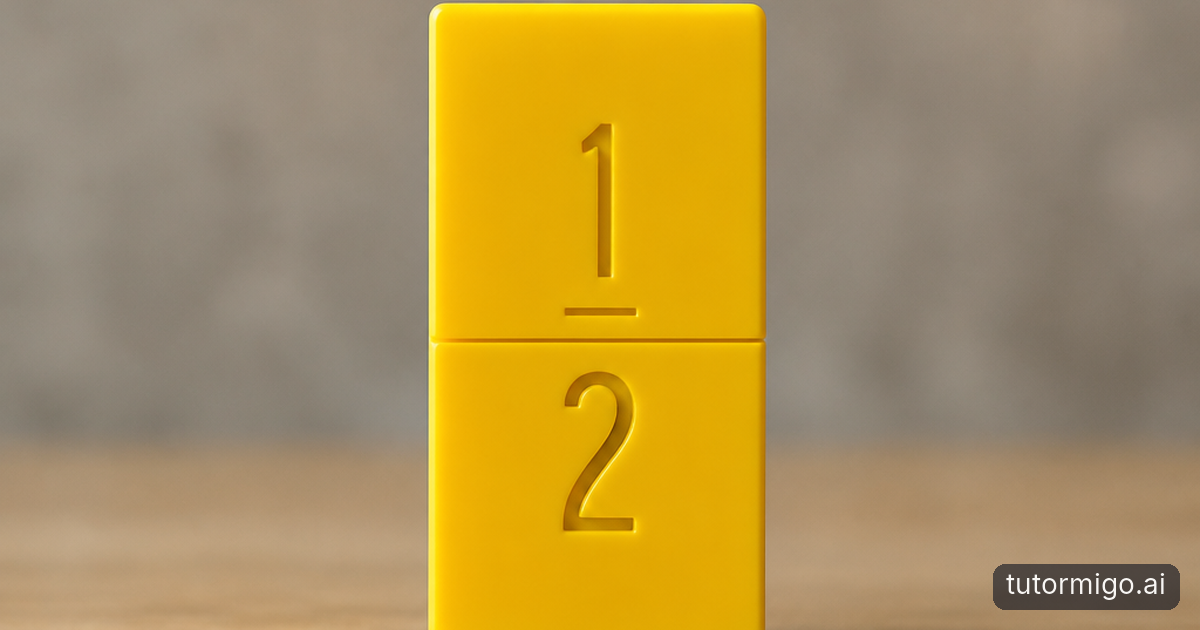
Why Adding Fractions Feels Like

If you have ever added the top numbers and bottom numbers of fractions and written , you are not making a random mistake. The answer feels reasonable because whole-number addition usually works that way: combine the quantities, then combine the labels. The trouble is that a fraction's bottom number is not another quantity to add. It tells you the size of each part.
In , the means the whole has been divided into two equal parts. In , the means the same whole has been divided into three equal parts. A half and a third are therefore measured in different-sized pieces. Adding the numerators gives you two pieces, but adding the denominators creates a new label that does not describe those pieces. There is no useful meaning for “fifths” in the original problem.
This is called an additive error: treating both parts of a fraction as if they behave like independent whole numbers. The correction is not simply to memorize “do not add denominators.” You need to see what the denominators mean, rename the fractions using equal-sized parts, and then combine those parts. That process makes the answer feel necessary rather than arbitrary.
Use a Visual Model to See the Mismatch

Draw one rectangle and divide it into six equal parts. Shade three of those parts to represent . Then shade two of the six parts to represent . The two fractions now use the same-sized pieces: is three sixths, and is two sixths. Together, the shaded regions cover five of the six parts, so the sum is .
A fraction strip makes the same idea easier to compare. Place a strip labeled “one whole” above strips divided into halves, thirds, and sixths. One half has the same length as three sixths, while one third has the same length as two sixths. When you place those lengths end to end, they reach five sixths. By contrast, is a different length: it would cover only two out of five equal parts, so it is not the combined amount shown by the model.
Ask yourself two questions whenever you see an addition problem: “What does one piece look like?” and “Are the pieces the same size?” If the denominators differ, the pieces are not yet ready to combine. A quick drawing can expose the issue before a written rule hides it. Visual models also help you notice that the answer should be less than one whole, but larger than one half, which satisfies.
Common Denominators Create Comparable Pieces
To add fractions accurately, rewrite them with a common denominator. For and , the least common denominator is because is the smallest number that both and divide evenly. Rename each fraction without changing its value:
Now both numerators count sixth-sized pieces. You can add them because the units match:
The important step is not the multiplication itself. It is preserving the value while changing the name of the fraction. Multiplying the numerator and denominator by the same nonzero number creates an equivalent fraction because you are subdividing each original piece equally. One half does not become a larger amount when it becomes three sixths; it is simply described with smaller pieces.
Try saying the calculation aloud: “Three sixths plus two sixths equals five sixths.” This language keeps the unit visible. Once the denominator matches, add only the numerators because you are counting the same kind of part. The denominator stays because the size of each part stays sixths.
Build the Rule Instead of Memorizing It
A reliable lesson sequence moves from meaning to procedure. First, have the learner estimate the answer. Since is about one half and is a little more than one quarter, the total should be somewhere around three quarters. That estimate makes suspicious because it is less than one half. Next, use a picture or fraction strip to show the unequal piece sizes. Only then introduce equivalent fractions and the common-denominator calculation.
For example, compare . A learner may write by adding straight across. Instead, ask how many fourths make one half. Since one half equals two fourths, the problem becomes:
After solving, reverse the process: give the learner and ask which parts came from and . This checks whether the common denominator was understood or merely copied.
Keep the language consistent. Say “same-sized parts” rather than only “same denominator,” and say “rename the fraction” rather than “change the fraction.” Those phrases connect the written steps to the model. If an error appears, do not erase it immediately. Ask what the proposed denominator means and whether the numerator is counting parts of that size. Explaining the error often builds more understanding than repeating the correct algorithm.
How Fraction Reasoning Prepares You for Algebra
Fractions are early training for a central algebra habit: you cannot combine quantities until you know they use compatible units. In , the issue is unequal fractional pieces. In algebra, a similar issue appears when combining like and unlike terms. You can combine and because both count the same unit, , giving . You cannot combine and into or because the units differ.
The same structure appears with algebraic fractions. Consider:
The denominators are not identical, but they can be rewritten using the common denominator :
So the sum is:
A student who understands why needs sixths is better prepared to ask the same question in algebra: “What unit do these terms use, and how can I express both with that unit?” This is why the fraction misconception matters beyond one worksheet. It is a small example of choosing a meaningful representation before performing an operation. For a deeper look at how unresolved fraction ideas can affect later algebra, explore Math Misconceptions: From Fractions to Algebra.
Practice the Thinking, Not Just the Answer
To make the idea stick, vary the representation and ask for a reason each time. Start with a prediction: is less than, equal to, or greater than one whole? Then draw sixths, rewrite the fractions, and calculate. Follow with a near example such as , where the common denominator is already visible. The answer is , which can simplify to . Next, use unlike denominators such as and look for twelfths:
After each problem, require a short explanation: “I used this denominator because...” A correct answer with no explanation may still hide the additive error. Also include a mistake-analysis prompt: “Someone says . What did they count, and what should they have counted instead?”
When you want guided practice with these exact moves, TutorMigo.ai can provide a personal workspace for asking follow-up questions and checking each step. Spaced-repetition flashcards can also help you revisit vocabulary such as numerator, denominator, equivalent fraction, and common denominator until the ideas become automatic.
Frequently asked questions
Once the fractions have a common denominator, the numerators count equal-sized parts. You add those counts while keeping the denominator, which names the shared unit. Before that step, the parts may have different sizes.
Six is the smallest positive number that both $2$ and $3$ divide evenly. It lets you rewrite $1/2$ as $3/6$ and $1/3$ as $2/6$.
No. The sum is greater than $1/2$, but $2/5$ is less than $1/2$. An estimate or number-line check can reveal the error before you finish the calculation.
Both fraction addition and algebra require compatible units. You combine terms or fractional parts only after expressing them with the same unit, such as sixths in fractions or the same variable term in algebra.
Related reading
Enjoyed this read?
Like, share, or comment below.



Comments
0Sign in required · respectful discussion · replies supported
Loading comments…