


Why a 15-Minute Study Routine Beats Cramming When You’re Short on Time

You know the problem: a test, lesson, or assignment is approaching, but a long study session feels impossible to start. A reliable 15-minute routine removes that barrier. Instead of waiting for a free evening, you return to important material often enough to notice gaps, retrieve ideas, and correct mistakes before they grow.
The greatest-impact habits are small but active: recall what you remember without looking, turn confusing points into flashcards, answer a few key questions, and choose tomorrow’s task before you stop. These actions are more useful than rereading a whole chapter while your attention drifts. For example, three short retrieval sessions across a week can reveal that you remember a definition but cannot explain its example.
Use the same basic structure each day: two minutes to choose a target, five minutes to recall and check notes, five minutes to practise, and three minutes to record the next step. The exact timing can move slightly, but the order keeps you from spending the whole session deciding what to do.
Keep the promise small: your goal is not to finish a unit in 15 minutes. Your goal is to make one useful memory stronger and leave a clear starting point for tomorrow.
Use Notes and Active Recall to Make the First Five Minutes Count
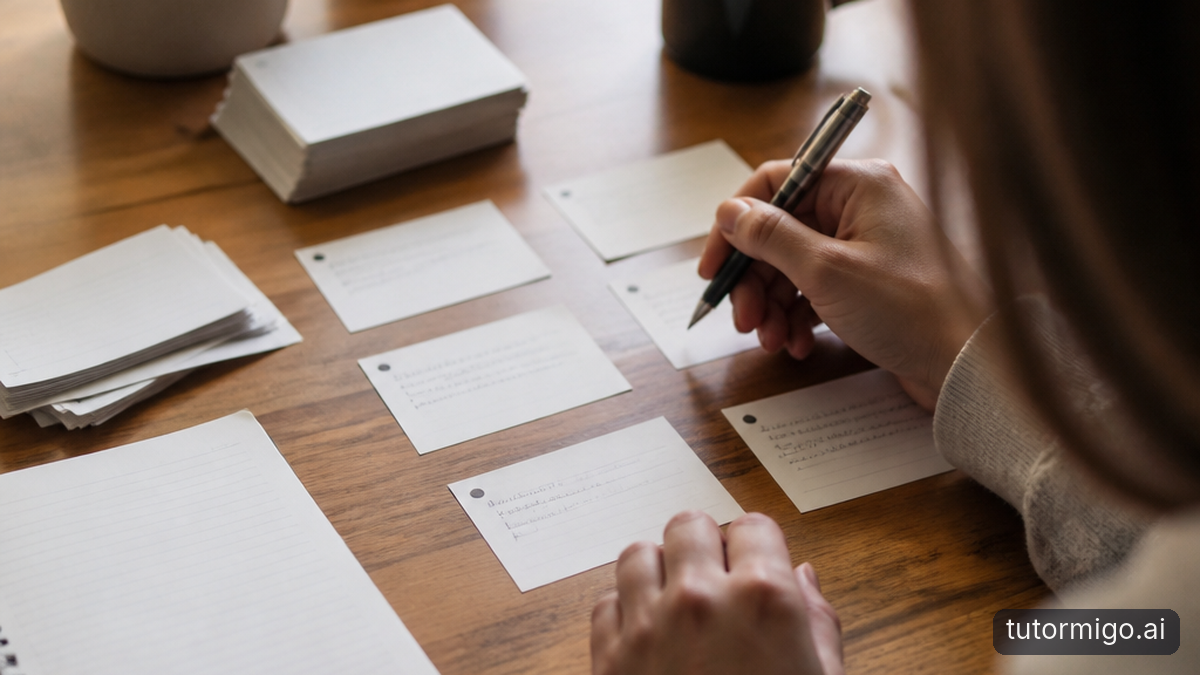
Begin with notes, but do not start by copying or highlighting everything. Spend the first two minutes covering the page and writing or saying what you remember about one narrow topic. If you studied photosynthesis, your prompt might be, “What happens to light energy, water, and carbon dioxide?” Try to answer from memory before checking the wording.
Next, compare your response with your notes. Mark only the missing or inaccurate parts, then rewrite one answer in your own words. This quick check turns notes into feedback. A student who writes “the process makes food” has a starting idea; a stronger version explains where the energy comes from and what the plant produces. That difference tells you what to practise next.
Teachers can model this by giving learners three retrieval prompts at the end of a lesson. Parents can ask, “What can you explain without looking?” rather than asking only whether homework is finished. Lifelong learners can use the same method for a new language, workplace concept, or practical skill.
If you need help turning an uncertain answer into understanding, an AI tutoring approach focused on real understanding can remind you to explain, compare, and apply instead of simply collecting answers.
Build a Flashcards Study Deck That Gets Better With Spaced Repetition
A flashcards study routine works best when each card tests one retrievable idea. Avoid a card with a whole paragraph on the front. For a biology topic, use “What is the function of the cell membrane?” rather than “Explain everything about cells.” The smaller question makes it easier to identify exactly what you know.
Build a deck from mistakes and high-value notes, not from every sentence in a chapter. During a five-minute review, create three to five cards: one definition, one process, one comparison, and one application question. Add a short example to the answer side so you can check whether you understand the idea in context. If a card feels vague, split it into two.
Spaced repetition then helps you revisit cards at useful intervals instead of treating every fact as equally urgent. A card you answer confidently can wait longer; a card you miss should return sooner. The important habit is honest grading. Marking a difficult card as “easy” saves seconds today but hides the gap you need to fix.
TutorMigo’s spaced-repetition flashcards support AI-assisted card creation and review scheduling, so your deck can become a practical record of what needs attention. Keep it manageable: a small deck reviewed consistently is more valuable than hundreds of cards you never revisit.
Choose the Right Daily Task by Reviewing Gaps, Assignments, and Key Questions
Choosing a task should take less than two minutes. Look at three sources: your recent recall mistakes, the next assignment or lesson, and the questions you expect to answer. Choose the overlap. If you missed two questions about balancing equations and tomorrow’s class continues that topic, practising two similar problems is a better choice than reviewing an easy vocabulary list.
Use a simple priority rule. First choose material you cannot retrieve and will need soon. Next choose material you can partly explain but still confuse. Leave familiar material for a quick maintenance review. This prevents your routine from becoming a comfort activity where you repeat only the facts you already know.
Plan the task as an observable action. “Study history” is too broad; “answer three questions about causes, then correct one weak explanation” fits 15 minutes. “Work on maths” is vague; “solve two problems and write why each step works” gives you evidence of progress. At the end, write one sentence: “Next time, review question two and make a card for the exception.”
For a wider look at building a repeatable habit, you can also compare these ideas with practical ways AI tutoring can support a study routine, while keeping your daily decision focused on one real gap.
How TutorMigo Supports Consistent Review Beyond a General-Purpose Chatbot
A general-purpose chatbot can respond to a prompt, but consistency depends on what happens before and after that response. TutorMigo’s AI Tutor Workspace provides personalized tutoring chat, expert personas, and session history. That continuity means you can return to an earlier explanation, ask a follow-up question, and keep working from the same learning thread instead of rebuilding the context each day.
That matters when your 15-minute routine exposes a gap. Suppose you cannot explain why a code sample fails. Rather than asking for a complete solution and moving on, use the AI Tutor to request a hint, explain the error in your own words, and try again. Session history gives you a useful place to continue tomorrow. The aim is guided practice, not passive answer collection.
TutorMigo also combines tutoring with purpose-built study tools. Flashcards handle scheduled retrieval, while the Study Tools Hub includes a whiteboard, code sandbox, and math step editor for practising the kind of thinking your subject requires. This is more structured than asking a general-purpose chatbot to imitate every tool in one conversation.
Students can show parents or teachers concrete evidence of the routine: the questions attempted, cards reviewed, and explanations they can now give. TutorMigo’s listed workspace and study tools do not replace a parent’s or teacher’s judgment; they give the learner clearer work to discuss and a more consistent place to practise.
Start Tomorrow’s 15-Minute Routine and Track What Helps You Remember
Set up tomorrow before today’s session ends. Write one target, select three to five flashcards or questions, and place the relevant notes where you can reach them. Then follow this plan: two minutes to choose the priority, five minutes of closed-notes recall, five minutes of flashcard or question practice, and three minutes to check answers and choose the next review.
Keep a tiny record after each session. Note the topic, the number of questions attempted, one mistake, and whether the next review should be soon or later. Do not judge the session by how many pages you covered. Judge it by whether you can now retrieve or explain something that was previously uncertain. A teacher can use these reflections to start a useful conversation; a parent can ask what changed rather than demanding a longer session.
After one week, look for patterns. Are you missing vocabulary, confusing similar processes, or skipping application questions? Adjust the deck and the task type. If flashcards are strong but explanations remain weak, spend part of the routine on the whiteboard, math step editor, or code sandbox when appropriate.
Start with one subject tomorrow, not every subject at once. A dependable 15-minute habit can expand later, but its first job is to make active recall and spaced repetition easy to repeat.
Frequently asked questions
Choose the assignment-related gap first. Spend two minutes identifying the required question, five minutes recalling the relevant method, five minutes practising one representative problem or answer, and three minutes checking the result and listing the next step.
Start with three to five focused cards. Make each card test one idea, and prioritise mistakes, confusing comparisons, and concepts you will need soon. A small deck that you review is more effective than a large deck you avoid.
Use questions when you need to prove that you can retrieve or apply an idea. Use notes briefly when your answer reveals a specific gap. Then close the notes and try the question again so the review remains active.
TutorMigo combines personalized tutoring chat and session history with spaced-repetition flashcards and interactive study tools. That gives you continuity, scheduled review, and places to practise rather than only one-off answers.
Related reading
Enjoyed this read?
Like, share, or comment below.



Comments
0Sign in required · respectful discussion · replies supported
Loading comments…