

Set the algebra learning goal and warm-up routine
Your students may solve a basic equation correctly yet struggle to explain why changing both sides keeps it true. This 10-minute warm-up makes that reasoning visible: students predict, watch a balance model, and explain what changes when you subtract the same amount from both sides—or from only one.
Learning goal: Students will explain that subtracting the same amount from two equal quantities preserves equality, while subtracting a nonzero amount from only one side does not. Keep the goal about the relationship between quantities, not simply remembering to “do the same thing to both sides.”
Minutes 0–2: classroom setup. Display and give students a place to record a prediction, an explanation, and a final reflection. Paper, an existing classwork routine, or a shared board will work. You do not need a particular device arrangement or a new assignment workflow.
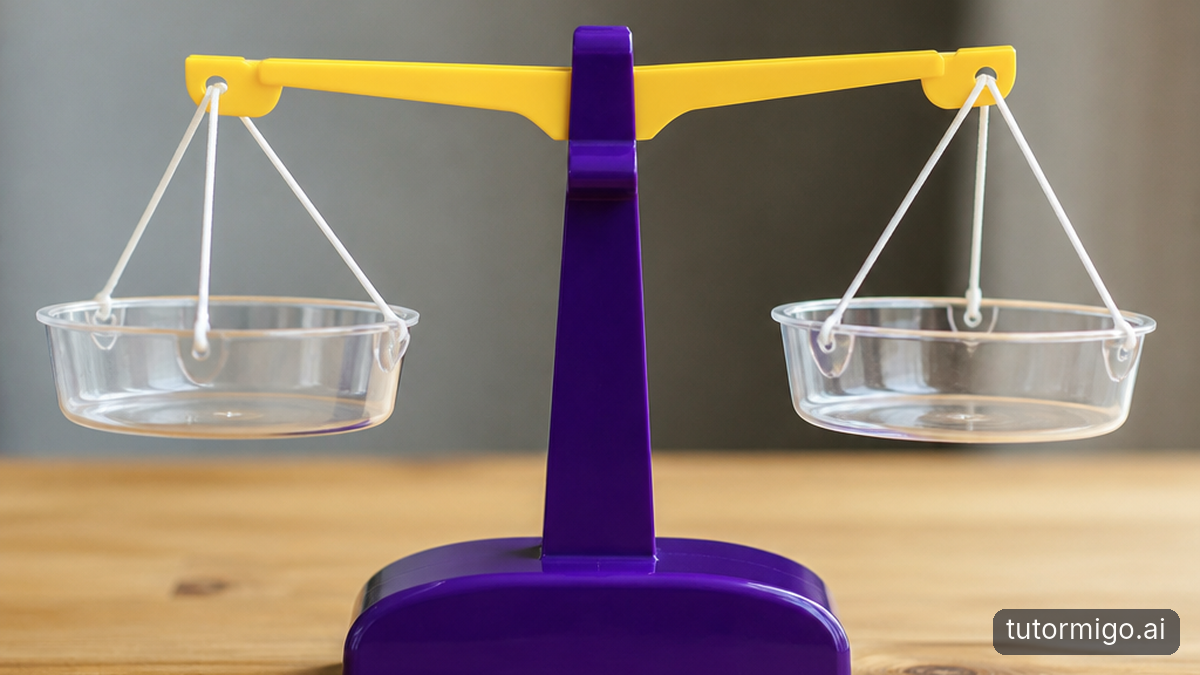
Prepare a teacher-made balance drawing or a suitable physical balance. Represent the unknown with a pouch or box and each unit with an identical counter. Show the unknown and three counters on one side, with seven counters on the other. Explain that the model starts balanced because both sides represent equal quantities. Keep this representation visible throughout the warm-up so students can point to evidence rather than rely on a memorized rule.
Minutes 2–3: predict before moving anything

Ask students to predict two outcomes before you demonstrate either one: “What happens if we subtract three from both sides? What happens if we subtract three from only the left side?” Give everyone a short, silent thinking window. Students who calculate quickly should still describe what they expect to happen to the relationship between the sides.
Have students write one sentence for each prediction. A useful starting frame is, “I think the sides will stay equal because…” For the second case, ask them to name which side will become smaller. Specifying the left side prevents students from discussing different changes while appearing to disagree.
Invite two contrasting predictions without immediately identifying the correct one. One student might say that removing the counters “gets the unknown alone,” while another says that removing counters from only one side changes the balance. Both comments give you something useful to investigate, but only the second directly addresses equality.
Listen for the difference between a procedure and a reason. “You have to do both sides” names a classroom rule. “They started equal, so taking away the same amount leaves equal amounts” explains why the rule works. Treat incomplete predictions as starting evidence, not mistakes students must hide. You will return to them after the demonstration.
Minutes 3–5: demonstrate what preserves balance
Begin with the valid change. Remove three counters from each side of your model, or cross out three units on each side of the drawing. Write followed by Ask, “What changed? What stayed the same?” The quantities decreased, but their equality remained because you removed the same amount from equal starting quantities.
Reset the model before showing the contrasting case. Remove three counters from only the left side. The left quantity decreases while the right quantity stays unchanged, so the sides no longer balance. Do not present this as a valid route to a new equivalent equation. Instead, label it as a proposed change that fails to preserve the original relationship.
Make the mismatch concrete by checking the original solution. When the original equation compares Removing three only from the left would compare which is false. The check connects the visible imbalance to the meaning of the equals sign.
Ask, “Is removing three the problem, or is removing it from only one side the problem?” Keep the explanation precise: subtraction is valid here when applied equally to both sides. A drawn balance is enough if physical materials would slow the lesson; its purpose is to show equal quantities, not to provide a perfect mechanical simulation.
Minutes 5–8: make student explanations observable
Ask students to explain the successful change to a partner, then revise their written response. Give the listener a focused job: identify where the explanation mentions the starting equality, the equal subtraction, and the equal amounts remaining. This keeps partner talk connected to evidence rather than agreement or confidence.
Offer a sentence frame only where needed: “The sides started equal. When we removed the same amount from each side, the amounts left were equal because…” Students can finish with their own wording or point to the counters. A strong response might say, “Both sides lost three units, so neither side became larger than the other.”
As you circulate, monitor three distinctions. Does the student describe equality as equal quantities rather than “the answer comes next”? Do they connect the same subtraction to both sides? Can they explain why the one-sided change fails? A student who finds the correct value but cannot address those questions needs different follow-up from someone whose reasoning is sound but whose arithmetic slips.
Keep a brief record using your existing classwork system: procedural only, developing explanation, or clear relational explanation. These are suggested teacher observation labels, not assumed platform controls. If students use the AI Tutor in TutorMigo.ai for follow-up, ask them to compare its explanation with the classroom model and write their own justification rather than copy a response.
Minutes 8–10: reflect and capture useful evidence
Return to the original predictions and ask students to revise one sentence using what they observed. Use this reflection prompt: “Why does subtracting three from both sides of the starting equation preserve equality, while subtracting three from only one side does not? Describe what happens to the quantities, not just the steps.”
Add a brief check: “Does finding the unknown and preserving equality mean the same thing?” Students should recognize that preserving equality explains why a transformation is valid; isolating the unknown is the goal of this particular solution. For example, subtracting two from both sides would also preserve equality, although it would not isolate the unknown immediately.
Collect the reflection as the warm-up’s evidence. Compare it with the prediction rather than judging only the final answer. Look for a shift from “because that is the rule” to an explanation involving equal starting quantities and equal changes. Note whether the student can describe the unequal result of the one-sided subtraction without prompting.
If you use TutorMigo.ai’s teacher dashboard, use its supported student monitoring and reporting functions alongside the written work you collect. Do not assume it automatically recognizes these explanation categories or captures an offline discussion. For broader context on classroom support, see using the teacher dashboard for classroom mentorship. Keep any report focused on the evidence you actually reviewed.
Next steps: assign follow-up that matches the evidence
Use the reflections to decide what happens in the next classwork task. Students who still give only a rule can revisit the same model and explain the one-sided change. Students who explain the relationship clearly can compare two valid subtraction choices and discuss which one isolates the unknown more directly. Keep the follow-up small enough that you can check whether the explanation improves.
In your classwork record, distinguish “solves correctly” from “explains why equality is preserved.” Reporting those separately gives you a more useful picture of progress than a single correct answer. If you use the teacher dashboard for knowledge base assignment, select relevant material for the reasoning gap you observed, then review the resulting work through the supported monitoring and reporting available to you.
The AI Tutor can be an optional place for a student to ask for another explanation, but the student’s own reasoning remains the evidence you assess. Before teaching, verify TutorMigo’s current model details and the behavior of any feature you plan to use. Treat the balance demonstration as your classroom model unless you have confirmed an equivalent product capability. Do not assume unverified controls, automatic scoring, or a built-in balance simulation.
Frequently asked questions
No. A clear drawing with matching unit marks works. Keep both starting quantities visible, and reset the drawing before demonstrating the one-sided subtraction.
Ask them to justify the transformation without relying on the answer. Knowing the unknown’s value does not by itself demonstrate an understanding of equality.
Look for equal starting quantities, the same subtraction applied to both sides, and an explanation of why changing only one side breaks equality.
Do not assume automatic assessment. Use supported student monitoring and reporting, and review students’ explanations yourself. Verify current model details and feature behavior before teaching.
Enjoyed this read?
Like, share, or comment below.



Comments
0Sign in required · respectful discussion · replies supported
Loading comments…