

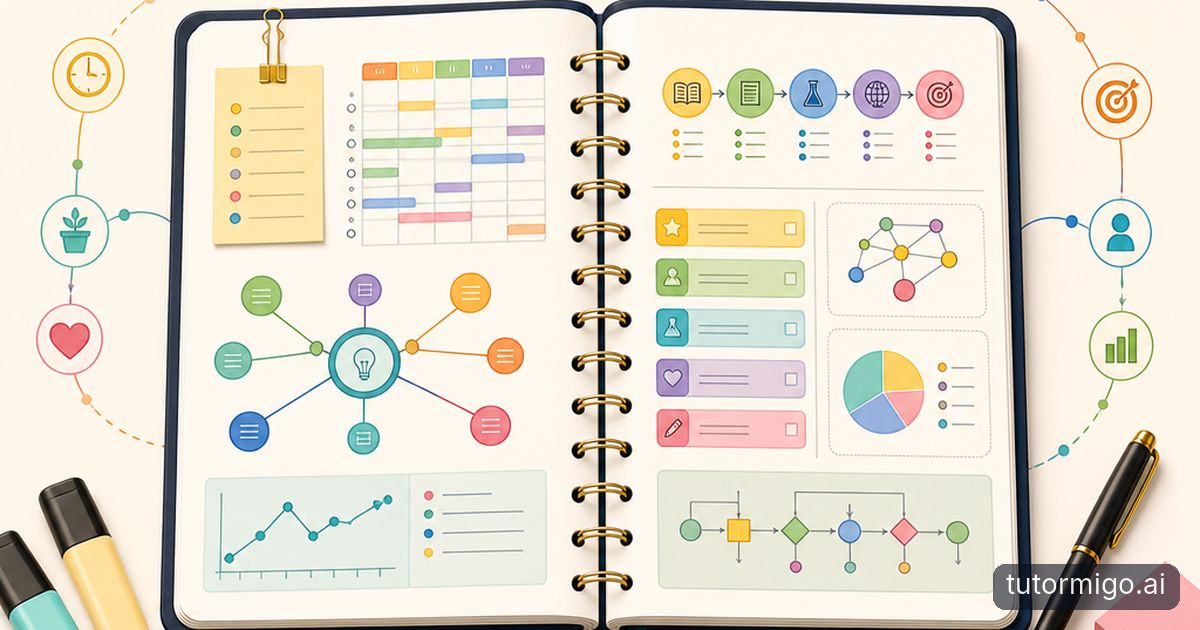
Start Before the High School Schedule Changes

Moving into high school can feel like being handed a faster schedule, unfamiliar expectations, and less time to recover from missed work all at once. Advanced coursework adds another layer: you are expected to explain your thinking, manage longer assignments, and study without constant reminders. The best preparation starts before the first demanding week.
Begin by practicing a simple weekly planning routine. On Sunday, list every known deadline, divide large assignments into smaller tasks, and reserve specific study blocks. For example, a biology project due Friday might become research on Monday, an outline on Tuesday, and a draft on Wednesday. Keep one short buffer period for unexpected work. This routine matters more than having a perfect planner because it teaches you to see pressure early, rather than discovering it the night before an assignment is due.
Build the Skills Advanced Classes Expect
Strong performance in advanced classes is not only about knowing more facts. You need to read closely, take useful notes, ask precise questions, and explain an answer with evidence. You can practice these skills with current schoolwork instead of waiting for a harder course to begin.
After reading a chapter, close the book and write three sentences: the central idea, one supporting detail, and one question you still have. In math or science, do not stop when you reach an answer; write why the method works and identify the step where you felt least certain. If you are preparing for a literature discussion, mark a passage and explain how it supports your interpretation. These small exercises make your thinking visible, which helps teachers give better feedback and helps you catch gaps yourself.
Try this: Once a week, explain a difficult idea aloud in two minutes without reading from your notes. If your explanation becomes vague, that is a useful signal to review the concept.
Practice Managing Difficulty Without Panic
Advanced coursework will include moments when effort does not immediately produce a correct answer. Treating that discomfort as information can keep one difficult quiz from becoming a crisis. When you get stuck, name the problem specifically: “I do not understand the vocabulary,” “I cannot choose the right equation,” or “I understand the reading but cannot find evidence.” A precise diagnosis gives you a next action.
Use a three-step recovery routine: review one worked example, attempt a similar problem without looking, and record the mistake in a short error log. For instance, if you repeatedly lose points by skipping units in chemistry, write that pattern down and check units before submitting the next assignment. Ask for help with the exact step you cannot complete, rather than saying only that the whole subject is confusing. This builds independence while still making support part of your process.
Create a Support Plan for the First Term
Before the term begins, decide how you will monitor both workload and understanding. A ten-minute check-in at the end of each week can answer three questions: Which assignments are unfinished? Which concepts still feel unclear? Who can help me, and when will I ask? Share this plan with a parent, teacher, counselor, or study partner so someone else can notice patterns you may miss.
Choose support based on the problem. A teacher may clarify a rubric, a classmate may compare notes, and a scheduled study session may help you restart after falling behind. If you are entering a structured exam course, use practice results to target specific skills instead of simply repeating full tests. TutorMigo.ai can also provide an on-demand tutoring workspace and spaced-review tools when you want additional guided practice. The goal is not to avoid every challenge; it is to build a reliable way to respond when the challenge arrives.
Frequently asked questions
Start several weeks before the transition if possible. Practice weekly planning, organized note-taking, and asking specific questions while current coursework is still manageable.
Review your deadlines at least once a week and break large assignments into dated, smaller tasks. This makes problems visible early and reduces last-minute pressure.
Identify the exact point of confusion, review a related example, try again, and ask for help with that specific step. Keep an error log so repeated patterns become easier to address.
Use brief, regular check-ins focused on workload, understanding, and next actions. Encourage students to describe what they have tried and what kind of help they need.
Related reading
Explore Activities With Purpose
High school offers more than classes, so sample clubs, sports, arts programs, service projects, or part-time work that genuinely interest you. You do not need to join everything. Choose one or two activities that help you meet people, develop a skill, or learn about a possible career. Reassess each semester and leave activities that create stress without adding value. Meaningful involvement is more useful than an overcrowded schedule.
Build Healthy Digital Habits
Notifications, group chats, and entertainment can quietly consume the time needed for sleep and schoolwork. Set specific periods for checking messages, silence nonessential alerts while studying, and keep your phone away from your bed when possible. Also practice respectful online communication; screenshots and posts can affect relationships, opportunities, and your reputation. Thoughtful digital habits make it easier to stay focused and protect your well-being.
Related reading
Related reading
Related reading
Turn Scattered Questions Into Continuous Tutoring
When advanced coursework becomes difficult, the problem is often not a lack of effort. You may understand yesterday’s lesson but forget where you got stuck, lose track of a question, or spend twenty minutes explaining the background before you can get useful help. A consistent tutoring workspace can make that process more manageable.
TutorMigo.ai’s AI Tutor workspace is designed for personalized tutoring conversations with session history. That continuity can help you return to a topic without starting from the beginning every time. For example, after working through a difficult algebra method, you might return the next day and ask for a similar problem without immediately seeing the solution. You can then explain which step feels uncertain and continue from there.
This is one of the practical TutorMigo benefits for students moving into more demanding classes: support can fit into the moment when confusion appears. Instead of waiting for a weekly tutoring appointment or sending a vague question, you can use a focused session to review an idea, test your understanding, and decide what to practice next. An AI Tutor is most useful when you treat it as a guided study partner, not as a shortcut around thinking.
Try this: At the end of a tutoring session, write down the concept you practiced, the mistake you corrected, and one question to revisit tomorrow.Pair Explanations With Spaced Review
Understanding a concept once is not the same as being ready to recall it under pressure. Advanced classes often build from earlier vocabulary, formulas, definitions, and procedures, so forgotten basics can make new lessons feel harder than they need to be. Spaced repetition gives you a simple way to revisit material before it disappears from memory.
With TutorMigo.ai flashcards, you can use spaced-repetition decks and review scheduling rather than rereading the same notes in one long session. AI-assisted card creation can help you turn a chapter or lesson into review prompts, but you should still check each card for accuracy and clarity. A strong card asks one focused question, such as “What evidence supports this interpretation?” instead of copying an entire paragraph.
Combine flashcards with tutoring for better diagnosis. If you miss a vocabulary card twice, ask the AI Tutor to explain the term in a new example and then create a card that tests application, not only definition. If you remember the definition but cannot use it in a problem, move to an interactive practice task. The goal is a loop: retrieve, notice the gap, get an explanation, and retrieve again later.
For a broader routine you can use across subjects, review these study skills to practice at home and choose only one or two to add this week.
Use Interactive Tools Instead of Vague Prompts
General-purpose generative chatbots can be useful for brainstorming questions or requesting an explanation, but the quality of the study session depends heavily on how you frame the prompt and organize the follow-up. A tutoring platform built around learning can make that process more deliberate by connecting conversation with tools for active practice.
TutorMigo.ai’s Study Tools Hub includes an interactive whiteboard, a code sandbox, and a math step editor. These tools suit different kinds of uncertainty. Use the whiteboard to map the causes and effects in a history topic, the code sandbox to test a small programming change, or the math step editor to inspect where an equation-solving process went off track. Seeing the work develop is often more useful than reading a polished final answer.
Suppose you are studying a system of equations and keep making an error when eliminating a variable. Rather than asking for the answer, enter your steps and identify the exact line that feels questionable. Then ask for a similar problem and solve it independently. In programming, run a short piece of code, observe the result, and explain what you expected to happen. These actions turn help into evidence about your understanding.
The same approach works for parents and teachers: ask the learner to show the attempt first, then use the explanation or tool to target the next step. That preserves productive struggle while making support more precise.
Prepare for Exams With Visible Progress
Exam preparation becomes less stressful when you know what you are practicing and why. Repeating full tests without reviewing the results can create a lot of activity without showing whether your reading, timing, mathematics, or writing skills are improving. A structured plan should connect practice results to a next action.
TutorMigo.ai offers structured preparation for SAT, ACT, AP, and IELTS, with practice sets and progress tracking. If you are preparing for one of these exams, use the results to identify a narrow target. For example, a student might notice that reading answers are usually correct when the passage is straightforward but less reliable when two choices seem plausible. The next session can focus on evidence-based elimination rather than another complete test.
Schedule short review blocks between longer practice sessions. After completing a set, record the skill, the reason for each mistake, and the correction. Then use flashcards for terms or strategies that need repeated recall, and the AI Tutor workspace for explanations of questions you still cannot resolve. This creates a connected routine instead of treating every practice set as a separate event.
Progress tracking is also useful for conversations with adults supporting you. A teacher or parent can see whether the issue is missed content, inconsistent practice, or a specific question type that needs attention. That makes the next check-in more concrete.
Give Families and Teachers Useful Visibility
Support works best when it is specific and timely. A parent may know that a student is spending hours studying but not know whether the time is going toward unfinished work, confusing concepts, or repeated review of material already mastered. A teacher may see a pattern of missed assignments without seeing the independent practice happening outside class.
TutorMigo.ai’s Parent Dashboard provides visibility into child progress, learning controls, and co-learning features. This can help families replace broad questions such as “Did you study?” with more useful ones: “Which topic did you review?” or “What will you practice next?” The purpose is not to supervise every minute. It is to notice patterns early and support a realistic plan.
The Teacher Dashboard supports class management, student monitoring, knowledge base assignment, and reporting for educators. A teacher might use that visibility to notice that several students are struggling with the same prerequisite before introducing a harder unit. A student can also arrive at a conference with clearer information about what they attempted and where they need guidance.
Keep the conversation focused on next actions. If a dashboard shows limited progress, ask whether the task was too broad, the schedule was unrealistic, or the learner needed a different explanation. Visibility should lead to support, not simply more pressure.
For a useful comparison of support styles, read AI tutoring versus human tutoring and consider where each fits your routine.
Choose the Right Tool for the Next Study Block
Comparing AI learning tools is easier when you begin with the problem you need to solve. If you need a quick explanation, a general-purpose chatbot may be enough for a starting point. If you need continuity, scheduled review, interactive practice, exam tracking, or adult visibility, look for features that support the full study process rather than one isolated answer.
Use the comparison as a decision guide, not a promise that one tool solves every learning problem. For your next block, choose one goal: explain a difficult concept, complete five targeted practice questions, review a flashcard deck, or inspect one problem-solving process. Then spend ten minutes recording what changed. A focused next step is more valuable than opening several tools without a plan.
If you want to build confidence through deliberate practice, this guide on working through one problem at a time offers a useful companion routine.
Pros and cons
Pros
- Personalized tutoring with session history
- Spaced-repetition flashcards and review scheduling
- Interactive tools for whiteboard, code, and math work
- Structured exam preparation with practice sets and progress tracking
- Parent and teacher dashboards for learning visibility
Cons and limitations
- Students still need to check explanations and practice independently
- The best results depend on specific goals and consistent study habits
- Dashboard visibility is most useful when families and teachers discuss next actions
Enjoyed this read?
Like, share, or comment below.



Comments
0Sign in required · respectful discussion · replies supported
Loading comments…