


Behind on Assigned Reading? Prepare Honestly Before Class
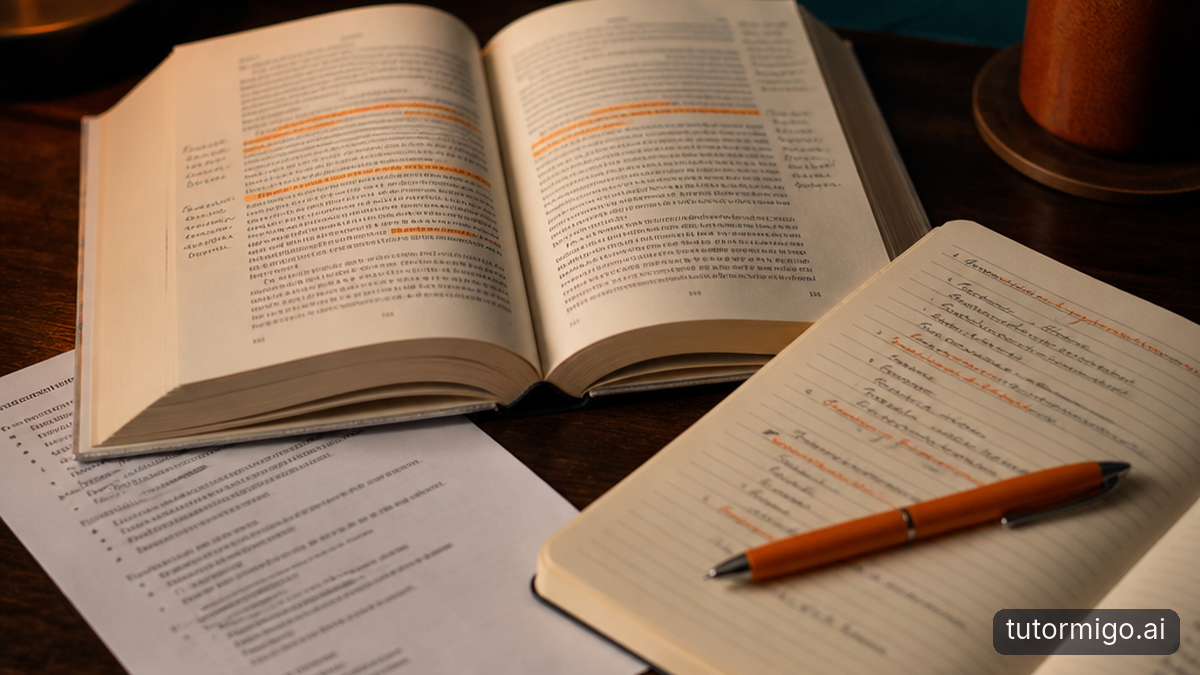
Class starts soon, the assigned reading is still mostly unread, and you’re worried about having nothing to say. Don’t try to fake finishing. Use your remaining time to check the discussion prompt, scan the argument, read a few key passages, clarify essential terms, and prepare two or three honest questions.
Your goal is a small, reliable foothold in the reading, not the appearance of complete understanding. A carefully read passage gives you something you can explain and revisit. A blur of half-read pages may leave you unable to tell whether a claim belongs to the author, an opposing viewpoint, or an example the author later rejects.
Imagine you have twenty minutes before discussing a chapter about public parks. You cannot responsibly summarize the entire chapter yet. You can identify its likely central claim, examine one example, and ask how that example supports the claim. That is a useful contribution, provided you keep its limits clear.
Keep the assignment open and start one short note titled “What I can support.” Record page numbers or section names alongside your observations. If you discover that your first interpretation was wrong, change the note. Accurate preparation matters more than producing an impressive-sounding comment, especially when classmates may have read passages you have not reached.
Start Your Time-Boxed Catch-Up: Check the Discussion Prompt and Set Priorities
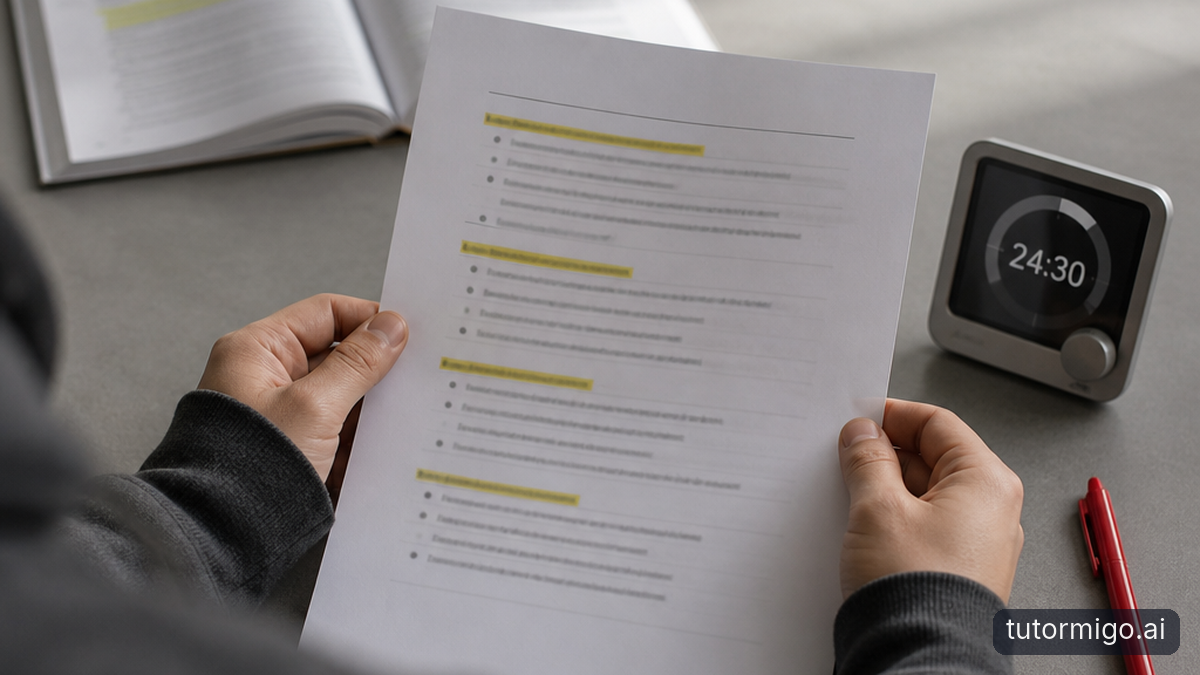
Before reading from the beginning, spend three minutes checking what the discussion actually asks. Look at the assignment instructions, any posted questions, and the assigned page range. A prompt asking you to evaluate evidence requires different preparation from one asking you to compare two viewpoints. Let that task decide where your attention goes.
Suppose the prompt says, “How does the author explain unequal access to public parks, and which evidence is most convincing?” Your priorities are the explanation, the evidence supporting it, and a possible weakness. The history of park design might be interesting, but it is secondary unless the author uses it to establish that explanation.
Divide a twenty-minute window into three minutes for the prompt, four for scanning, seven for close reading, three for essential terms, and three for notes and questions. Set a timer so that scanning does not quietly consume the whole session. If you have less time, shorten each stage rather than eliminating close reading.
Your first note could say: “Task: explain unequal access and assess evidence. Find: main claim, one supporting example, one limitation.” This gives you a stopping rule. Once you locate those elements, examine them instead of chasing every interesting detail. If the prompt requires comparison, protect enough time to inspect a relevant passage from each assigned text.
Scan Headings and Introductions to Find the Main Argument
Use your next four minutes to map the reading. Scan the title, headings, introduction, and conclusion or final paragraphs. Notice repeated ideas and transitions such as “however,” “therefore,” and “this suggests.” These can reveal where the author moves from describing a problem to explaining it or defending a position.
Separate the topic from the argument. “Public parks” is a topic. “Park access depends on practical barriers, not just distance” is a claim someone could support or challenge. In a hypothetical chapter, headings about transport, opening hours, and maintenance might suggest that broader claim. They are clues, though, not proof that you have understood the argument.
Write a provisional sentence: “The author argues that nearby parks are not necessarily accessible because transport, schedules, and upkeep affect whether people can use them.” Then locate a passage where the author actually makes that connection. If you cannot find one, label your sentence “possible argument” rather than treating your inference as settled.
Watch for a common trap: an introduction may present a familiar view only to challenge it later. Check who owns each claim. A note such as “Earlier view: distance explains access; author’s response: distance alone is insufficient” is more useful than copying a sentence without context. For narrative or less explicitly argumentative readings, identify the central tension or interpretive question instead of forcing a thesis the text does not offer.
Read Key Passages Closely and Check Only the Terms You Need Now
Now spend seven minutes reading a small number of relevant passages carefully. Start with the clearest statement of the main claim, then read the evidence most directly connected to the prompt. Include surrounding sentences so you can see qualifications, objections, and limits. A striking quotation on its own can misrepresent what the author means.
For each passage, note the claim, the support, and the connection between them. For the hypothetical parks chapter, you might write: “Claim: proximity does not guarantee use. Support: interviews describe work schedules conflicting with opening hours. Connection: a nearby park may still be unavailable when residents have free time.” Add the page number from your copy.
Use your three-minute vocabulary allowance only for terms that block this reasoning. Check a word now if it appears in the prompt, carries the main claim, recurs throughout the passage, or changes how you interpret the evidence. If “accessibility” has a specific definition in the chapter, that definition matters more immediately than an unfamiliar architectural term in a passing example.
Look first for the author’s definition, a glossary, or a course explanation. Use an outside definition only if needed, and check that it fits the context. Record plain language: “Accessibility here means practical ability to use a park, not simply living nearby.” Mark nonessential words for later rather than letting vocabulary searches replace reading.
Turn Brief Notes Into Two or Three Useful Discussion Questions
Use the final three minutes to turn what you read into two or three questions. A worthwhile question points to something specific, matters to the discussion prompt, and invites an answer supported by the text. It does not need to sound sophisticated. It needs to help you and your classmates examine an idea more carefully.
Start with a genuine uncertainty. Your note might read: “Interviews explain why some residents cannot visit, but I have not checked how participants were selected.” A useful question follows: “How does the author’s choice of interview participants affect how broadly we can apply this explanation?” That question identifies both the evidence and the issue you want to investigate.
A second question can test the reasoning: “Does the example about opening hours show that distance is unimportant, or only that distance is not enough?” A third can clarify a boundary: “Would the author’s explanation change for a park that stays open late but has poor transport connections?” Keep that last question tied to the reading rather than letting it become an unrelated hypothetical.
Avoid questions designed mainly to conceal that you are behind. “What did everyone think?” gives the group little direction. Before keeping a question, ask yourself whether you can identify the passage that prompted it and explain why the answer matters. If a question only asks for a definition you can quickly verify, resolve it now and save discussion time for interpretation.
Your Next-Step Checklist: Contribute Honestly and Plan to Finish the Reading
Before you enter class, check that you can explain one claim in your own words, point to one relevant passage, and ask a question you genuinely want answered. Keep your notes short enough to consult quickly. You are preparing to listen and contribute, not to deliver a complete account of a reading you have not finished.
If you speak, describe the scope of your preparation accurately. You might say, “I focused on the passage about opening hours. It seems to show that distance alone cannot explain access. Does the later section qualify that?” You can also say directly, “I haven’t finished the chapter yet.” Neither statement requires an elaborate apology, and both leave room for classmates to supply context.
During discussion, distinguish what the text says from what someone suggests about it. Add a page reference when classmates mention a section you need to revisit. Afterward, schedule a specific completion session rather than a vague promise to catch up. For example: “After lunch, finish the remaining pages, check the conclusion, and revise my summary.”
Bring your claim, passage reference, and two or three questions.
State uncertainty instead of guessing.
Note missing context during discussion.
Set a time to finish and update your notes.
If you want help testing your understanding afterward, TutorMigo.ai offers a personal tutoring workspace where you can discuss the passages and questions you are working through.
Frequently asked questions
Check the discussion prompt, locate the likely main claim, and read one relevant passage closely. Clarify any term that blocks understanding, then write two focused questions. Do not spend the entire window scanning.
State what the author wants you to accept, not just what the reading is about. Look for an explicit claim and check whether the evidence and conclusion support your summary. Treat it as provisional until you verify it.
Be honest about what you read and avoid implying broader knowledge. You can name the passage you focused on, explain your interpretation, and acknowledge that you have not yet checked the remaining sections.
Enjoyed this read?
Like, share, or comment below.



Comments
0Sign in required · respectful discussion · replies supported
Loading comments…