


Turn planet observations into science inquiry
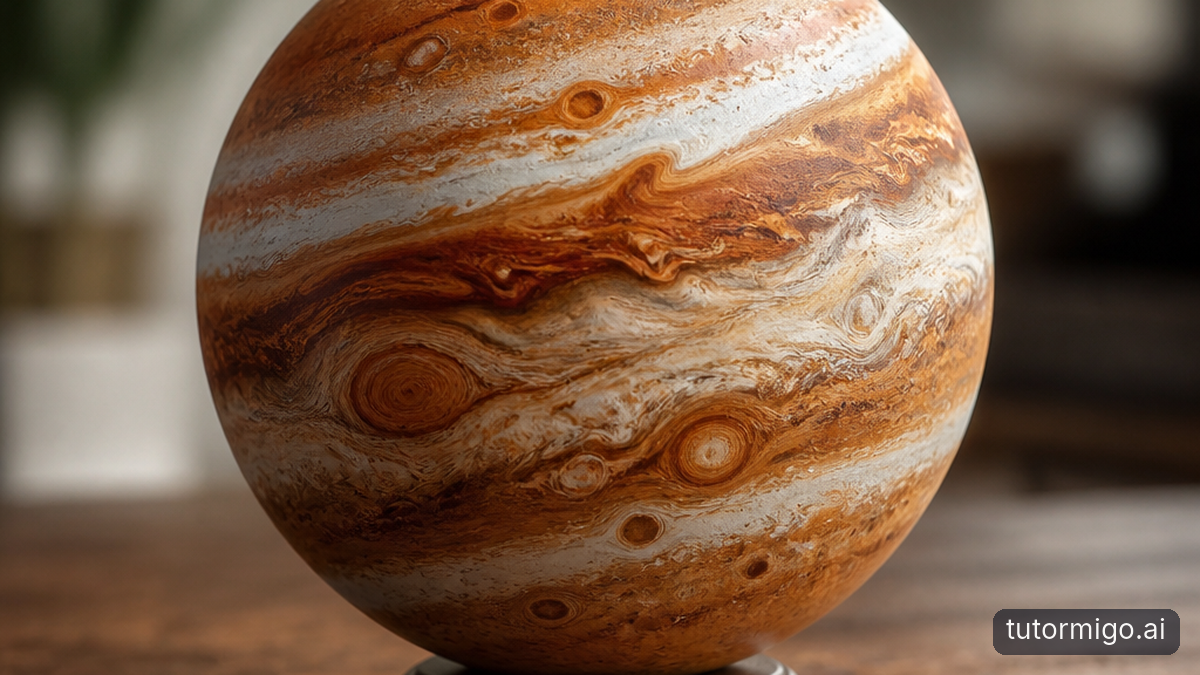
Seeing planets doesn’t automatically give you a science question. You might recognize Saturn’s rings and still wonder what to investigate. TutorMigo.ai’s solar-system demo can provide a starting point: make a prediction, explore what the model shows, record an observation, and ask a new question that the picture alone cannot answer.
Start before you study the details. Write one prediction, such as “I think Jupiter will look largest” or “I expect the planets to appear evenly spaced.” You are not trying to earn a correct answer immediately. You are making your expectation visible so you can compare it with evidence afterward.
Next, examine the representation without assuming it reproduces every property of the real solar system. Describe something specific: a planet looks larger than its neighbor, or several planets appear close together. Keep that description separate from an explanation of why it looks that way.
Finally, turn the mismatch or uncertainty into a question. “Those gaps look similar” can become “Are the distances represented using a consistent scale?” This prediction–exploration–observation–question routine gives students, parents, teachers, and independent learners a shared task. You do not need unfamiliar vocabulary to begin; you need a claim you can inspect and a willingness to revise it.
Investigate planet size and order
Investigation one: Which planet is largest? Predict your answer, then compare the planets as they appear in the demo. Record the visible evidence cautiously: “Jupiter appears widest in this representation” is stronger than “The model proves Jupiter has the greatest mass.” Apparent width and mass are different properties, and a picture does not establish both.
Jupiter is the largest planet by diameter, but confirming that real-world fact requires a reliable reference rather than appearance alone. If the model makes a comparison difficult, record that limitation instead of guessing. A useful follow-up question is, “How much larger is Jupiter’s diameter than Earth’s?” That calls for measurements from another source.
Investigation two: How does planet order compare with your prediction? Write your expected sequence outward from the Sun before checking the representation. Then compare it with the order you can identify. If perspective makes a planet’s position ambiguous, say so; apparent left-to-right placement is not necessarily distance from the Sun.
Separate remembering a sequence from explaining it. You might correctly place Earth between Venus and Mars yet still ask, “Does this arrangement show the planets’ actual positions at one moment?” That is a question about the model’s design, not something recognition alone can settle. A parent or teacher can help by asking which visible detail supports your conclusion rather than supplying the answer immediately.
Ask whether the distances are to scale
Investigation three: Are distances to scale? First predict what realistic spacing would look like. Would every neighboring pair have a similar gap? Then describe the spacing you can actually observe. Avoid turning “the gaps look similar” into “the real gaps are similar.” Your observation concerns the representation; your conclusion concerns the solar system.
A scale model uses a consistent relationship between represented distance and real distance. Visual inspection can raise doubts, but it usually cannot confirm that relationship by itself. Look for an explanation accompanying the demo, if one is provided. If no scale information is available, mark the question as unresolved and consult a reliable astronomy reference for actual distances.
There is a practical reason to simplify spacing. Showing the enormous distances between planets while keeping the planets easy to see is difficult within a limited viewing area. A model may compress distances to make the arrangement readable. That possibility explains a design trade-off; it does not establish how this particular demo was built.
Your next question could be, “What would become harder to see if the spacing were realistic?” This shifts the investigation from spotting a possible inaccuracy to understanding why scientific representations make choices. You can value a model’s usefulness while still questioning its scale.
Check proportions and notice what is missing
Investigation four: Are sizes proportional? This is separate from asking which planet looks largest. A representation can show the correct size ranking without preserving the differences between diameters. Predict whether Earth should look nearly as wide as Jupiter or noticeably smaller, then describe what the demo presents without treating your impression as a measurement.
To test proportionality, you need reliable diameter data and information about the represented sizes. If that information is unavailable, your conclusion should remain limited: “I can compare apparent sizes, but I cannot confirm their proportions.” Also keep planet-size scale separate from distance scale. Preserving one does not guarantee that the other is preserved.
Investigation five: What might the model omit? Look for information the view does not establish. Possibilities include moons, orbital inclinations, changing positions over time, surface conditions, or the distinction between a planet’s appearance and its internal structure. Check before saying an element is absent; it may simply be unclear in the view you are examining.
Omission is not automatically a flaw. A simplified model can make planet order easier to understand by leaving other details aside. The important question is whether it supports your particular investigation. If you want to understand why a planet has seasons, recognizing its place in the sequence will not be enough. Write down what additional information you would need, then seek a source suited to that question.
Compare TutorMigo benefits by the learning task
The most useful TutorMigo benefits here concern what you do with an observation after making it. In the AI Tutor Workspace, personalized tutoring chat can help you work through the difference between “I see this” and “I think this means.” Session history gives you a way to revisit earlier discussion rather than relying only on memory.
Give the AI Tutor a precise account of your evidence: “The planet gaps look similar to me, but I have not found scale information. What should I check next?” This is more productive than asking whether the whole model is accurate. Treat the response as guidance for investigation, not as proof that a visual impression is correct.
Once you have verified a fact, spaced-repetition flashcards offer a separate review task. You could review planet order or the distinction between diameter and distance. Flashcards support recall; they do not replace checking whether a model preserves scale. For a broader look at that learning process, see how TutorMigo supports science learning.
When comparing tools, match each feature to a need. General-purpose chatbots can also help generate questions and discuss evidence; their history and study features vary. TutorMigo.ai’s personal workspace and scheduled flashcard review are concrete comparison points, not reasons to assume every answer is reliable.
| Learning task | TutorMigo.ai | General-purpose generative chatbot |
|---|---|---|
| Develop a follow-up question | Personalized tutoring chat in the AI Tutor Workspace. | Can help generate and refine questions; guidance varies by tool and prompt. |
| Revisit earlier reasoning | Session history lets you return to previous tutoring discussions. | Conversation history and continuity features vary by product. |
| Review verified planet facts | Flashcard decks provide spaced repetition and review scheduling. | Can generate practice questions; dedicated scheduling depends on the product. |
| Confirm the demo’s scale | Tutoring discussion does not itself establish the model’s scale. | A generated explanation does not itself establish the model’s scale. |
Next: record one observation and research one question
Finish with a small, checkable result rather than trying to master the whole solar system. Record one observation in plain language: “In the view I examined, the gaps between several planets appeared similar.” Include the uncertainty. You have described your experience without claiming that the real planets are evenly spaced.
Then choose one unanswered question: “Are these distances represented to scale?” First look for information supplied with the model. If it does not resolve the question, consult a reputable astronomy source, such as a space agency’s planetary information pages. Check that the source addresses distance rather than diameter; both may involve scale, but they answer different questions.
Write a short note explaining what the source establishes and what remains unknown about the demo. Real planetary distances can show why your initial assumption was questionable without revealing the designer’s exact choices. Returning to the original prediction makes that distinction easier to see.
If you are learning together, compare observations before comparing answers. Different descriptions can reveal an ambiguity worth investigating. Your next step is simple: record one observation, research one unanswered question, and revise your prediction when the evidence calls for it.
Frequently asked questions
Not by appearance alone. You need scale information and reliable reference data to check proportions. If those are unavailable, describe what you see and leave the scale question unresolved.
Ask whether the representation preserves distances or sizes, what information it leaves out, or which question it helps you answer. Familiar facts can become starting points for deeper investigation.
Use it to clarify your prediction, separate observations from interpretations, and identify what evidence you need. Check factual conclusions against reliable sources rather than treating a chat response as verification.
Enjoyed this read?
Like, share, or comment below.



Comments
0Sign in required · respectful discussion · replies supported
Loading comments…