

Can an AI Tutor Know When You Start Forgetting?

You can recognize a topic, follow an explanation, and still be unable to recall it tomorrow. That gap is frustrating because it often feels like learning happened—until a blank page, unfamiliar question, or simple follow-up exposes what faded. An AI tutor can notice some warning signs, but it cannot read memory directly.
What it can observe is your performance over time. It may compare an answer you give today with one you gave last week, notice that you need more hints, or see that you repeatedly confuse two related ideas. If you answer a question about photosynthesis correctly only after being shown the key terms, that is different from explaining the process independently. The distinction matters because familiarity can masquerade as knowledge.
Timing also provides clues. A correct response after three seconds suggests a different level of retrieval than a correct response after several revisions and prompts. Still, these signals are indirect. A poor answer may reflect tiredness, unclear wording, anxiety, or a gap in background knowledge rather than fading memory.
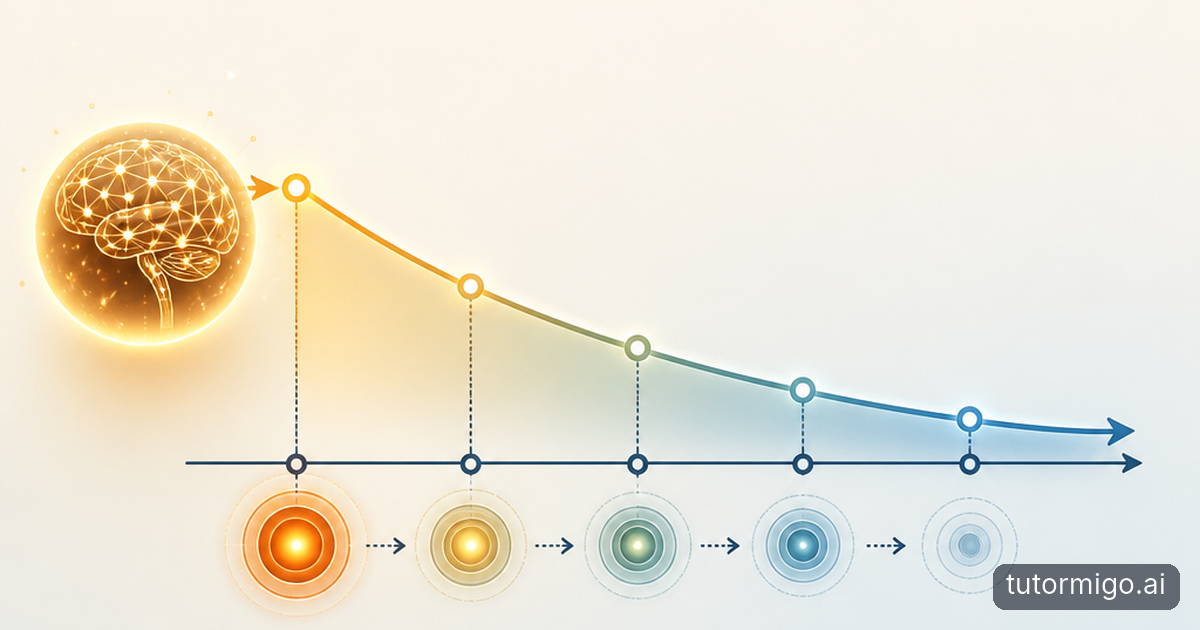
The most accurate answer to “can an AI tutor know” is therefore qualified: it can estimate when learning may be fading by tracking patterns in your responses, but you and the tutor must test that estimate with deliberate recall.
What Fading Learning Looks Like in Your Answers and Mistakes
Fading learning rarely appears as one dramatic wrong answer. More often, your responses become less precise. You remember that a historical event involved a treaty but cannot explain its consequence. You can set up a chemistry problem but choose the wrong unit at the end. In language study, you recognize a word in a sentence but cannot produce it when asked for the translation.
Look for changes in the kind of help you need. If you once solved a problem after reading the question but now need a worked example, your usable knowledge may have weakened. Repeatedly making the same mistake is another strong clue: reversing cause and effect, dropping a negative sign, or applying a rule to the wrong type of problem suggests that the underlying pattern is not stable.
Errors can also become less specific. Instead of saying, “I used the wrong formula,” you may write, “I don’t know.” That broad uncertainty can hide several smaller gaps. A useful review of why correct answers do not always prove learning makes this distinction especially clear.
Keep a short error log with the question, your first response, the correction, and the reason for the mistake. Over several sessions, the pattern is more informative than any single score.
How an AI Tutor Can Detect Gaps Through Recall and Repeated Errors
A reliable check begins with retrieval, not rereading. Instead of showing you an explanation and asking whether it makes sense, the tutor can ask you to produce the idea from memory. For example, after a lesson on supply and demand, it might ask you to predict what happens when supply falls while demand stays steady, then explain why in your own words.
Repeated practice makes the evidence stronger. Suppose you answer a question about solving linear equations correctly on Monday, miss the same step on Thursday, and succeed only after a hint on Saturday. That sequence suggests the procedure is available but not durable. A tutor can flag the recurring step, ask a slightly different version, and check whether you can transfer the method rather than repeat a memorized example.
Useful detection also includes spacing. A correct answer immediately after instruction tells you less than a correct answer after a delay. Questions should vary in wording, order, and difficulty so recognition does not do all the work. Asking you to explain a concept, solve a new example, and identify a common mistake gives a fuller picture than a multiple-choice item alone.
This is part of a broader principle in personalized learning research: progress is not just how much you have seen, but what you can retrieve and use when support is removed.
Where AI Tutors Can Misread Confusion, Guessing, or Lost Confidence
An incorrect answer does not always mean forgotten learning. You may understand the concept but misread a dense question, rush because you are tired, or make a small arithmetic slip. Conversely, a correct answer may be a guess. If you choose the right option by eliminating three obviously wrong choices, the result can look stronger than your understanding.
Confidence creates another complication. Some learners give a correct answer tentatively and ask for reassurance; others answer quickly even when they are unsure. If a system treats speed as certainty, it may underestimate a cautious learner. If it treats every request for a hint as a knowledge gap, it may mistake healthy checking for dependence.
Context matters too. A student who misses a question about fractions may not need a full review of fractions. They may be struggling with vocabulary in the prompt, attention after a long session, or the difference between a diagram and a written description. Ask yourself, “Could I explain the idea aloud without looking?” and “Would I recognize the same problem in a new setting?” Those questions help separate memory from performance conditions.
Use the tutor’s interpretation as a hypothesis, not a verdict. Tell it whether you guessed, felt confused by the wording, knew the method but made a calculation error, or lost confidence despite having the idea. That extra information improves the next check.
How to Check Whether You Really Still Know the Material
Start with a blank-page test. Close your notes and write everything you can remember about one narrow topic for two or three minutes. Do not worry about polished wording. Then compare your response with a trusted explanation and mark three categories: remembered accurately, partly remembered, and missing or incorrect.
Next, use three forms of retrieval. First, define the idea in plain language, as if explaining it to a younger learner. Second, complete a familiar example without assistance. Third, try a new example with different numbers, wording, or context. Someone who can only complete the familiar example may recognize a pattern without understanding how to use it.
Add a confidence prediction before each answer. Write “high,” “medium,” or “low,” then check whether your prediction matched your result. If you are often highly confident and wrong, slow down and explain your reasoning. If you are often doubtful but correct, practice trusting evidence from your steps rather than relying only on a feeling.
Repeat the check after a delay—later that day, two days later, and again the following week. A short, spaced test is more revealing than a long review session. Keep the questions that exposed weakness, because they become useful prompts for your next practice round.
What to Do When an AI Tutor Spots Learning Fade
Do not respond to a fading-learning signal by rereading the entire chapter. First identify the smallest missing piece. If you cannot solve a percentage problem, determine whether the issue is converting the percentage, choosing the operation, or checking the answer. A narrow diagnosis prevents an unfocused review.
Then ask for graduated support. Try the problem alone, request a small hint, and attempt it again before viewing a complete solution. Afterward, explain the key step without copying the wording you were shown. If you made the same error twice, create a contrast question that asks when the rule applies and when it does not.
Schedule a short follow-up rather than assuming the gap is fixed. Revisit the idea tomorrow with one direct question, then test it in a different context a few days later. Keep the session brief enough that you can concentrate, and stop to name whether the difficulty came from forgetting, confusion, guessing, or confidence.
If you want structured help with this cycle, TutorMigo.ai’s AI Tutor Workspace can support tutoring conversations and keep session history available for follow-up practice. Pair that support with your own recall checks, because the goal is not to produce a correct answer in the moment—it is to make the knowledge available when you need it.
Frequently asked questions
Not reliably from correctness alone. It can look for hesitation, revisions, hints, and repeated performance patterns, but you should say when you guessed or felt unsure.
Try a short recall check later the same day, then repeat it after two or three days and again about a week later. The best spacing depends on the difficulty and importance of the material.
No. A hint may reveal a small retrieval block, confusing wording, low confidence, or a genuine knowledge gap. Test the idea again without help to see whether the support was temporary.
Use blank-page recall, explain the idea in your own words, solve a new example, and revisit the same material after a delay. These checks show whether you can retrieve and apply the knowledge.
Explore TutorMigo
Enjoyed this read?
Like, share, or comment below.



Comments
0Sign in required · respectful discussion · replies supported
Loading comments…