

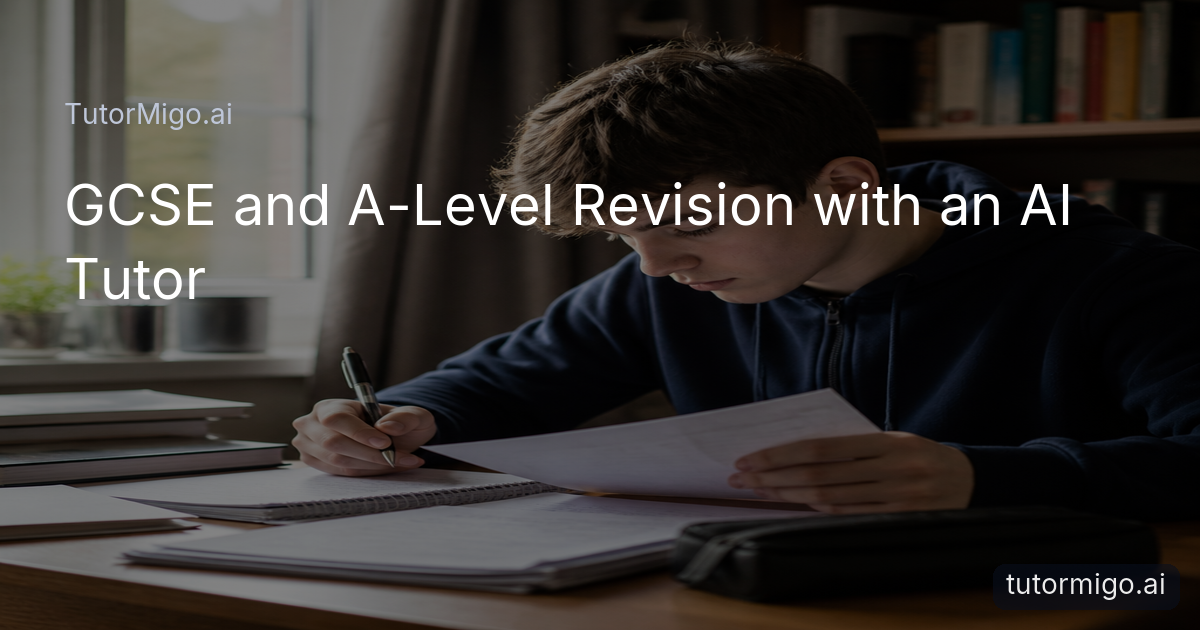
Why Last-Minute Rereading Fails UK Students

Exam season arrives with a familiar wave of panic for GCSE and A-Level students across the UK. Faced with towering revision guides, colour-coded highlighters, and past papers stacked high, many students default to the most comfortable habit available: rereading textbooks. It feels productive to spend hours tracing over highlighted paragraphs of biology notes or scanning organic chemistry mechanisms. Unfortunately, cognitive science reveals a harsh truth: passive rereading creates a dangerous illusion of competence. When you read familiar text over and over, your brain recognizes the words, tricking you into believing you have mastered the concept. When you sit in the exam hall under time pressure, however, that illusion shatters because you never actually practiced retrieving the information from scratch.
This is where an AI tutor fundamentally changes your preparation strategy. Instead of passively absorbing information, you engage in active dialogues that test your true comprehension. If you are revising GCSE Combined Science, for instance, simply reading about homeostasis is not enough. An intelligent assistant can instantly challenge you to explain how the body responds to a drop in core temperature, pointing out gaps in your explanation before the examiner does. By shifting from passive consumption to active dialogue, you train your brain to retrieve knowledge swiftly and accurately when it matters most.
Revision Tip: Stop highlighting entire pages. If you cannot explain a concept out loud with your textbook closed, you do not know it yet—use your AI tutor to check your verbal explanations. Visit: tutormigo.ai
Furthermore, traditional study methods often leave students isolated with their weaknesses. A student struggling with A-Level Maths calculus or English Language stylistic analysis might reread the same confusing chapter three times without gaining any new clarity. By incorporating structured study tools and session continuity, you can maintain a coherent thread across multiple revision sessions. Your learning history stays intact, allowing you to pick up exactly where you left off, target persistent weak spots, and build genuine subject mastery well before exam morning.
Mastering Active Recall and Mark-Scheme Logic

Scoring top marks in GCSE and A-Level exams is rarely just about knowing the facts; it is about understanding how examiners award marks. Many students write factually correct answers that still miss out on top grades because they fail to address the specific command words in the prompt. Whether an exam question asks you to 'evaluate', 'analyse', or 'describe', the examiner expects a very specific structure. Working with an AI tutor allows you to dissect mark-scheme logic line by line, learning how to structure your arguments, apply relevant terminology, and avoid common pitfalls that cost students precious marks.
Let us take an English Language paper as an example. When analysing a 19th-century prose extract, students often write vague impressions such as 'the writer uses good adjectives to make it spooky.' A sophisticated study session with your AI tutor helps you unpack that sentence into grade 9 components: identifying the specific lexical field, commenting on structural shifts, and evaluating the psychological impact on the reader. You can practise writing mini-responses and ask your tutor to evaluate them against specific assessment objectives. To explore broader study methods for language acquisition and exam technique, take a look at our guide on active recall study methods for additional inspiration at tutormigo.ai.
Of course, maintaining factual memory alongside essay technique requires rigorous repetition. Utilizing dedicated flashcards with spaced repetition ensures that key definitions, historical dates, or chemical equations move securely from your short-term working memory into long-term retention. When your revision is backed by structured exam preparation and progress tracking, you stop guessing what to study next and start following a data-driven path to success.
A Practical 4-Week GCSE and A-Level Revision Timetable
A successful revision timetable must be realistic, balanced, and structured around active output rather than passive reading blocks. Trying to revise every subject every day leads to cognitive fatigue and burnout. Below is a practical four-week framework designed to rotate core subjects, incorporate past-paper practice, and schedule essential rest days to keep your mind sharp right up to exam day.
During Weeks 1 and 2, focus on consolidating content and eliminating weak spots. Structure each week by alternating between quantitative subjects, such as GCSE Maths or A-Level Sciences, and qualitative subjects, such as English Language or History. Work in forty-minute blocks on specific topics, then immediately complete targeted questions. In Week 3, shift your focus to timed past-paper practice and mark-scheme analysis. Use this stage to test your stamina under exam conditions and identify exactly which question types waste your time or cause confusion. Dedicate Week 4 to fine-tuning: review your error logs and reinforce your memory with spaced-repetition flashcards instead of opening new textbooks
Consistency beats intensity every single time. A steady two to three hours of focused, active revision each day yields far better results than an eleventh-hour cramming session that leaves you exhausted. Make sure your timetable includes mandatory rest days—physical recovery and downtime are when your brain actually consolidates the complex information you have fed it throughout the week. If you are also balancing other international exams, our SAT prep strategy guide at tutormigo.ai provides further insights into structuring multi-week study timetables effectively.
Subject Vignettes: Maths, Science, and English Mastery
Every academic subject demands a distinct revision approach. A generic study method that works for history will rarely deliver top grades in mathematics or experimental sciences. By tailoring your approach to each subject's unique demands, you maximize every minute spent at your desk. Let us examine how targeted practice transforms performance across three common core subjects for UK secondary students.
In GCSE Maths, passive observation of worked examples is a trap. You can watch a teacher solve a quadratic simultaneous equation and feel completely confident, only to freeze when facing a slightly different variation in the exam. Using an interactive math step editor within your study workspace allows you to work through problems line by line, receiving immediate corrective feedback if you make an algebraic slip. For Combined Science, the challenge lies in linking theoretical concepts—such as energy transfers or natural selection—to practical investigation questions. Your AI tutor can quiz you on experimental variables, control methods, and data analysis, ensuring you can tackle both foundation and higher tier paper requirements with confidence.
English Language requires a different kind of precision. Because there are no factual formulas to memorize, students often struggle to structure their time effectively during a forty-five-minute creative writing or source analysis task. You can use your AI tutor to practise planning responses under strict time limits, testing different narrative hooks or argumentative structures. Whether you need to sharpen your punctuation accuracy or elevate your vocabulary, personalized guidance ensures your writing meets the highest assessment criteria.
Customising Question Difficulty: Grade 5 vs. Grade 8/9 Demand
One of the greatest challenges in independent revision is finding practice questions that match your exact current ability. Too often, revision workbooks offer questions that are either overwhelmingly difficult—causing frustration and demoralization—or too simplistic, giving a false sense of security. A powerful benefit of using an AI tutor is the ability to dynamically scale question difficulty on demand, tailoring every practice session to your target grade.
If you are currently working at a Grade 5 level in GCSE Maths or Combined Science and want to secure that solid pass before pushing higher, you can prompt your tutor accordingly. Ask it to generate foundational questions focusing on core algorithms, basic definitions, and standard multi-step calculations with gentle scaffolding. Once you master those fundamentals and feel your confidence grow, you can instantly prompt the AI to ramp up the challenge to Grade 8/9 demand. At this higher tier, questions will require multi-disciplinary synthesis, evaluation of complex experimental anomalies, and rigorous multi-stage problem solving.
This adaptive pacing prevents cognitive overload and ensures continuous progression. You never waste time wading through content that is too basic, nor do you get stuck staring hopelessly at advanced problems without guidance. By regularly adjusting the difficulty slider in your study sessions, you create a personalized ladder of achievement that bridges the gap between where you are today and the top-tier grades you are aiming for.
Parental Support Without Hovering: The Modern Approach
Parents naturally want the best for their children during GCSE and A-Level exam seasons, but well-intentioned hovering can quickly create friction at home. Constantly asking 'Have you revised yet?' or hovering over a teenager's desk often increases anxiety rather than productivity. Modern revision support relies on smart visibility rather than micromanagement, allowing parents to encourage independence while staying informed about progress and consistency.
Using a dedicated parent dashboard changes the dynamic entirely. Instead of nagging, parents can view milestone achievements, study streak consistency, and identified weak areas through clear, high-level metrics. This transparency empowers parents to provide meaningful encouragement—such as celebrating a completed revision block or helping schedule a relaxing weekend break—without needing to police every minute of study time. Co-learning features also enable parents to engage constructively when asked, turning study support into a collaborative, stress-free partnership.
Ultimately, secondary students preparing for major public exams need space to develop self-regulation and independent time-management skills. When you combine an intuitive AI tutor for GCSE revision with transparent parental oversight, you build a supportive ecosystem where students feel accountable, empowered, and fully equipped to achieve their academic potential.
| Revision Strategy | Traditional Rereading | TutorMigo AI Tutor Approach |
|---|---|---|
| Primary Method | Passive highlighting and text rereading | Active recall, targeted testing, and mark-scheme logic |
| Difficulty Scaling | Static textbook questions (fixed level) | Dynamic grading (adjusts from Grade 5 to Grade 8/9 on demand) |
| Memory Retention | High illusion of competence, rapid forgetting | Spaced repetition flashcards and session continuity |
| Parental Oversight | Guesswork or nagging without clear metrics | Parent dashboard visibility into progress and weak spots |
Pros and cons
Pros
- Provides customizable difficulty scaling from Grade 5 to Grade 8/9 demand
- Helps decode examiner reports and mark-scheme logic without leaking live papers
- Integrates spaced repetition and parent visibility into one platform
Cons and limitations
- Requires disciplined adherence to the 4-week schedule rather than last-minute cramming
- Active recall demands more initial mental effort than passive reading
Frequently asked questions
An AI tutor acts as a personalized study partner available 24/7. For GCSE and A-Level revision, it helps you break down complex topics, test your understanding through active recall, explain mark-scheme logic, and adjust question difficulty from a Grade 5 foundation up to Grade 8/9 mastery.
Traditional rereading gives an illusion of competence where text feels familiar, but you cannot recall it under exam conditions. Active recall forces your brain to retrieve information, which strengthens neural pathways and dramatically improves long-term memory retention.
Parents can support secondary students by tracking progress through dedicated parent views rather than hovering or nagging. This allows you to encourage good study habits, celebrate milestone completion, and ensure healthy rest breaks without micromanaging daily study blocks.
Yes, TutorMigo.ai includes structured exam preparation tools, spaced-repetition flashcards, and an interactive AI tutor workspace that helps students across international curricula as well as UK public exams—see our guide on international exams for related study strategies.
Explore TutorMigo
Enjoyed this read?
Like, share, or comment below.



Comments
0Sign in required · respectful discussion · replies supported
Loading comments…