


Study Planning After a Bad Grade: Review Your Marked Work
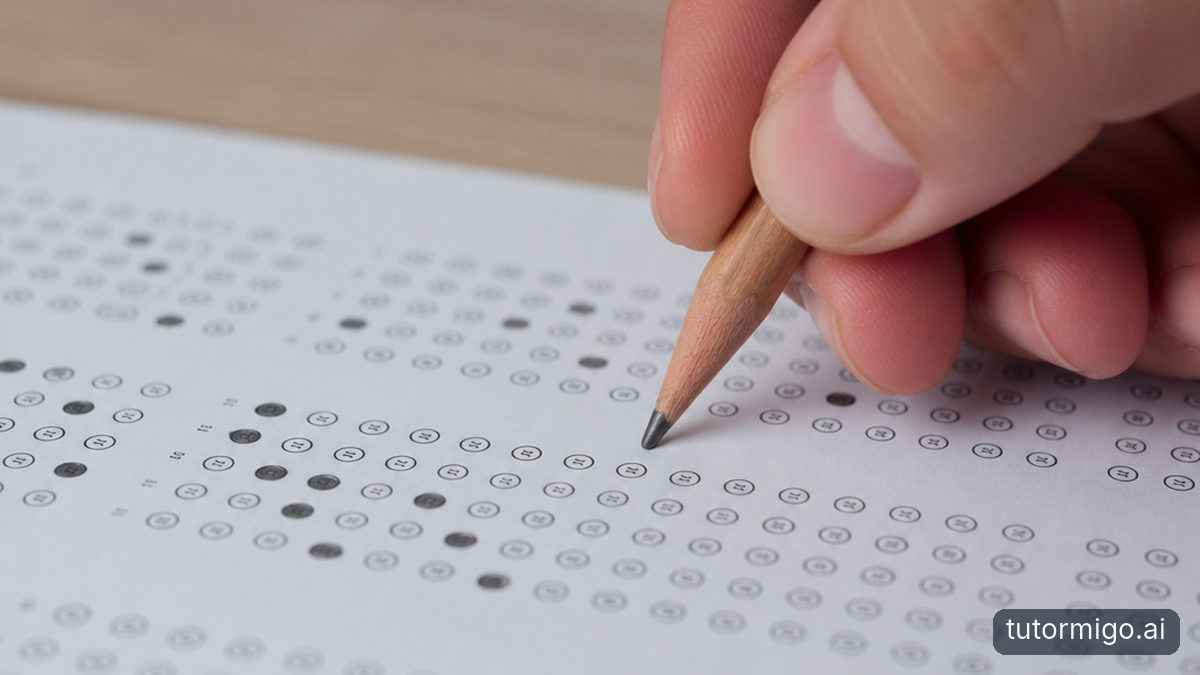
You studied hard, walked into the assessment hoping it would pay off, and still got a disappointing grade. Before you decide you need more hours, look at your marked work. It can help you identify one recurring mistake, choose practice that tackles its cause, and set a goal you can check.
Give yourself a little breathing room first. Feeling frustrated is understandable, especially when the result seems out of step with your effort. But neither “I’m bad at this” nor “I just need to try harder” tells you what to do tomorrow. Your marked answers offer more useful evidence than the grade alone.
Put the paper, the marking guidance if available, and a blank sheet beside you. Read the questions and feedback before reading your notes. For each lost mark, record what the task required, what you actually did, and where the two diverged. Keep this factual: “Explained the process but omitted the example” is more useful than “Terrible answer.”
Start with a few questions rather than examining everything at once. Look for repeated patterns across them. Perhaps your explanations were accurate but incomplete, or your calculations repeatedly went wrong after a negative sign. If a comment is unclear, ask your teacher to explain one specific example. You need to understand why marks were lost before deciding how to recover them.
What Went Wrong? Spot Knowledge Gaps, Misread Instructions, Careless Errors and Time-Pressure Mistakes

Sort mistakes by their likely cause, not just by the topic printed above the question. Two wrong answers about the same topic can need completely different practice. Use these four categories as working explanations, and check them against what you can do now without looking at the solution.
Knowledge gaps: you cannot explain the idea, recall the needed information, or choose a method independently. For example, you recognize a definition when you reread it, but cannot produce it with your notes closed. Try answering a similar question without help. If you still cannot begin, more careful checking alone will not solve the problem; you need to rebuild the missing knowledge.
Misunderstood instructions: you knew relevant material but answered a different task. Perhaps the question asked you to compare two explanations, but you described only one. Point to the exact instruction your response missed. If you do not understand what “compare” requires, clarify that first rather than simply reminding yourself to read carefully.
Careless errors: you can explain the method and complete a fresh example, but made a local slip, such as copying a number incorrectly. Treat this label cautiously. Repeated sign errors may reveal an uncertain rule rather than inattention. Ask yourself to explain the step where the error happened; uncertainty suggests a knowledge gap.
Time-pressure mistakes: you left answers unfinished, rushed later questions, or skipped checks as time ran out. Compare an untimed attempt with a short timed one on similar material. Success only without the clock suggests a pacing issue; difficulty in both conditions points elsewhere. A mistake can have two causes, so record your best explanation rather than forcing certainty.
Match Your Practice to the Mistake: Five Sign-Error Problems or Recall Instead of Rereading
Once you have a likely cause, choose a task that makes you practice the missing action. “Revise the chapter” is too broad. “Recall the five definitions I could not produce” or “Check negative signs while expanding brackets” gives your next session a clear job.
For a knowledge gap, review one short explanation or worked example, then close it. Explain the idea aloud, answer a question from memory, or reconstruct the method on blank paper. Check your attempt and correct what was missing. If rereading made information feel familiar but did not help you retrieve it, practice recall instead. Return to the same prompts in a later session to see what stayed with you.
For sign errors, work through five short problems with full working. For example, expand and explain why the constant becomes positive: . Then try a similar expression independently. Before checking the answer, inspect each multiplication involving a negative number. If you cannot explain a sign, revisit the rule; if you can, practice making that check reliably.
For misread instructions, take three questions and write a one-sentence description of what each answer must contain before answering. A comparison needs both subjects and an explicit connection between them. Check your response against that requirement, not merely against whether its facts are correct.
For time pressure, first make sure you can complete the task accurately without a timer. Then practice a small timed set, with a planned point for moving past a question that has stalled you. Record both accuracy and completion. Finishing faster while making more errors is not necessarily progress. This is why practice and worked examples build understanding more effectively when you actively attempt, check and adjust.
Choose One Recurring Mistake and Set a Small, Measurable Improvement Goal
You may find several weaknesses, but you do not need to fix them all in your next session. Choose one mistake that appeared repeatedly and that you can practice directly. A recurring sign error is usually a more manageable starting point than a broad ambition such as “Get better at maths.”
Write your goal using three details: the task, the success measure and the checking condition. For example: “In my next session, I will complete five bracket-expansion problems without notes, get at least four correct on the first attempt, and check every negative multiplication before marking.” That tells you exactly what to do and what evidence to collect.
For recall, your goal might be: “Tomorrow, I will answer six definition prompts without looking and give a complete answer to at least five.” For instructions, try: “Across three comparison questions, I will include both subjects and one explicit similarity or difference in every response.” Choose a target that stretches your current performance without demanding instant perfection.
Keep first-attempt results separate from corrected answers. Understanding a correction matters, but copying it does not show that you can now perform independently. After reviewing mistakes, try a fresh question or return to the skill later without the solution visible. If you miss your target, use the evidence to adjust the practice, not to judge yourself. One short set shows how that session went; repeated checks show whether the change is sticking.
Your Next-Study-Session Checklist: Review, Practice and Check Your Progress
Make the next session small enough to start without a major planning exercise. Set aside about twenty minutes, gather the marked question and any explanation you need, and write your chosen mistake at the top of a page. You are not trying to redo the entire assessment. You are testing whether one specific change helps.
Spend the opening few minutes reviewing the original error and explaining its cause. Then do your targeted practice with answers hidden. Leave time at the end to mark your first attempts, correct mistakes and try one fresh question. If the same error appears again, note the exact step where it happened rather than writing only “Still wrong.” That detail determines your next move.
Finish by recording a brief result: what you attempted, how many first attempts were correct, and what you will check next time. If you met the goal, repeat a short check in a later session before moving on. If you did not, narrow the task or seek clarification about the troublesome step. You leave with evidence and a next action, rather than another vague promise to study harder.
Review: identify one repeated mistake in your marked work.
Explain: decide whether it reflects knowledge, instructions, accuracy or timing.
Practice: choose a short task that targets that cause.
Measure: set a first-attempt accuracy or completion target.
Check: mark, correct and attempt something fresh.
Return: schedule a brief later check without notes.
If recall was your main difficulty and you want help organizing repeat practice, TutorMigo.ai offers spaced-repetition flashcards with review scheduling.
Frequently asked questions
Explain the troublesome step and try a fresh example without help. If you cannot explain the rule or repeat the method reliably, treat it as a possible knowledge gap rather than assuming you were careless.
Not immediately. Start with one recurring mistake, practise its underlying skill, and then attempt fresh questions. Return to the remaining errors in later sessions.
Check the skill again without notes after a delay. You may need more spaced practice, or the new question may add a difficulty your original practice did not cover.
Related reading
Enjoyed this read?
Like, share, or comment below.



Comments
0Sign in required · respectful discussion · replies supported
Loading comments…