


Give each tutoring session an IELTS preparation goal
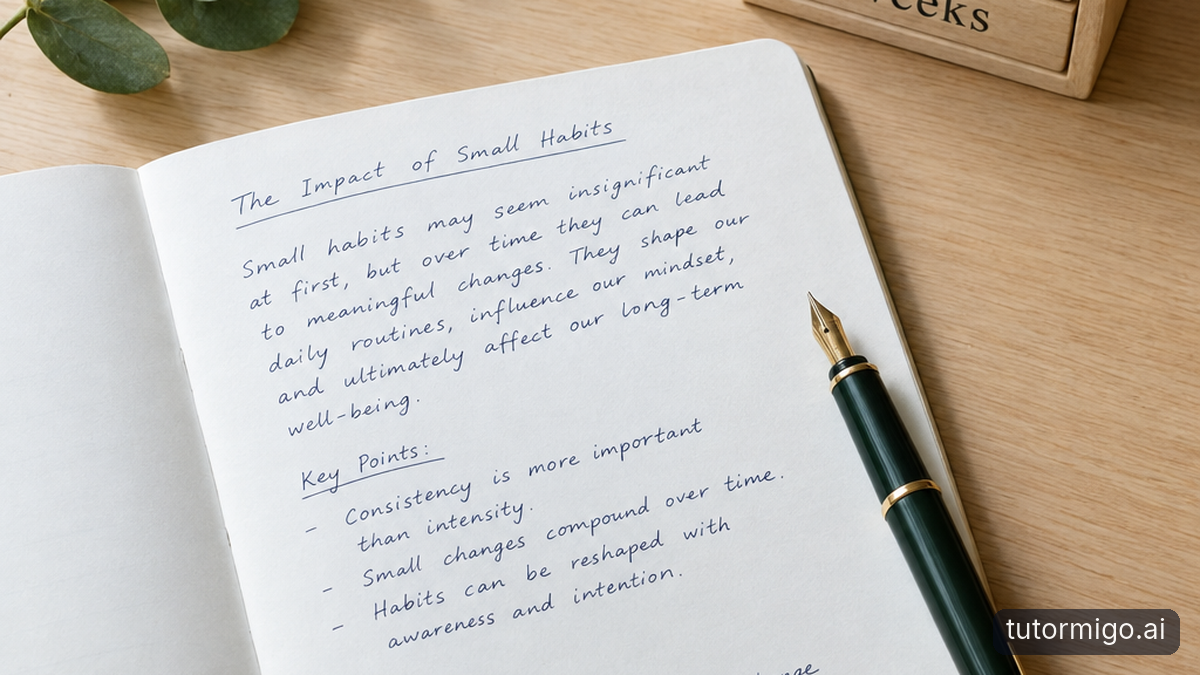
Start your IELTS preparation with a concrete gap, not “help me improve my English.” Tell the AI Tutor which IELTS version you are taking, your target band, your test date and the task you find difficult. A working adult returning to study might say: “I’m taking IELTS Academic in eight weeks. My target is band seven, but my essays become lists of ideas. Help me develop one clear argument.”
In the personalized tutoring workspace, share a paragraph and ask for a focused response: identify the main claim, flag an unsupported point, and suggest a question that would help you develop it. Then rewrite the paragraph yourself. This makes the explanation part of active practice rather than something you simply read and accept.
Use session history to revisit the original paragraph, the explanation and your revision. At your next session, return to that discussion and ask whether a new paragraph shows the same weakness. Keep a short closing note in the conversation: “Next time: explain examples more fully.”
Anchor feedback to the relevant IELTS assessment criteria. For Writing, distinguish task response or task achievement from coherence, vocabulary and grammar. Treat an AI Tutor’s comments as practice guidance, not an official examiner’s band score.
Turn explanations into practice across all four skills

Use structured IELTS practice sets to give each session a task and a finish point. Choose work that tests the weakness you just discussed, then review the result before moving on. A useful weekly plan combines focused exercises with timed sections; it does not need to cover every skill in every sitting.
For Listening, investigate why you missed an answer. Was it a spelling error, a word-limit mistake or a distractor where the speaker changed their mind? For Reading, distinguish misunderstanding the passage from overlooking the question. If you confuse “False” with “Not Given,” bring the question and relevant passage into tutoring and explain your reasoning before asking for help.
For Writing, match practice to your IELTS version: Academic Task One may involve describing a chart, while General Training Task One involves a letter. For Speaking, rehearse a Part Two response aloud with a timer, then use tutoring to examine your outline or a transcript you provide. Text feedback cannot establish how clearly you pronounced your answer.
Once a week, use appropriate practice materials for a timed section or a fuller mock. Keep assistance off while answering. Afterwards, review repeated errors rather than treating every wrong answer as a separate problem.
Schedule vocabulary review around useful language
Move useful language from your tutoring and practice into spaced-repetition flashcard decks. Use AI-assisted card creation to draft cards, then check each one for accuracy and relevance. Organize decks around recurring needs, such as describing change in Academic Writing or explaining opinions in Speaking, rather than collecting every unfamiliar word.
A useful card tests a decision. The front might say, “Complete the phrase: a sharp ___ in housing costs.” The answer is “increase,” followed by a short example sentence. Another card could contrast “rise” and “raise” in context. These cards address errors you can actually make under time pressure.
Use review scheduling to make vocabulary a returning appointment, not a one-time list. Complete scheduled reviews before adding more cards. If you remember a definition but cannot use the phrase, revise the card to require a sentence or a suitable collocation.
The reason for spacing is practical: recalling language after a gap is different from recognizing it immediately after reading. This explanation of why learning fades and how spacing helps adds useful background. Keep the workload manageable—for example, a brief review before your main IELTS session—so vocabulary supports practice instead of replacing it.
Track progress that leads to a better next session
Use IELTS practice-set progress tracking to keep your preparation organized, then interpret it alongside your actual work. Completing more sets shows activity; improvement needs closer inspection. Are Reading mistakes clustering around matching headings? Does your revised essay answer the whole question? Choose the next practice task from that evidence.
Keep comparisons reasonably consistent. A short, untimed exercise and a full timed section place different demands on you. Record those conditions in your study notes before deciding that a better result means you are ready for your target band. Listening and Reading practice results are useful signals, but Writing and Speaking also need criterion-based judgment.
For parents and teachers, what can dashboards reveal? Only what their displayed information supports. Practice progress can start a useful conversation about consistency and difficult tasks; it cannot by itself explain a mistake or prove exam readiness. The practice-tracking capability described here does not establish which records a parent or teacher dashboard displays, so check access and visibility rather than assuming.
Review a sample together: “Show me one Reading answer you changed and explain why.” For adult candidates, agree on what to share. Support should help you choose the next IELTS task, not turn every study session into surveillance.
Understand the difference from a general-purpose chatbot
A general-purpose chatbot can explain IELTS questions, suggest essay structures and help you practise vocabulary. Depending on the tool and its settings, it may also retain conversations or support organized projects. The difference is not that ordinary chatbots are incapable of useful preparation; it is how much organizing you must do yourself.
With TutorMigo.ai, the relevant pieces include a personalized tutoring workspace with session history, structured IELTS practice sets with progress tracking, and flashcards with review scheduling. You can build a repeatable path: discuss a weakness, practise it, inspect your work and schedule useful vocabulary for later recall.
Do not assume “connected” means every action happens automatically. You may need to bring an error into the tutoring conversation, select language for cards and decide which practice set comes next. The benefit is having these study functions available within one platform, not a promise of automatic diagnosis or guaranteed band improvement.
When comparing tools, test the same small workflow in each. Can you find last week’s explanation, apply it to a fresh IELTS task and return to vocabulary when review is due? Judge the effort and usefulness of that routine, not just the fluency of one answer.
Start with one session, one task and one review
For your next session, choose one IELTS difficulty you can describe in a sentence. Open the tutoring workspace and provide your exam version, goal and a sample. Ask for one priority: “Help me make comparisons in this Academic Task One overview without adding unsupported explanations.” Work through the response and revise the sample yourself.
Next, complete a relevant IELTS practice set or a suitable task from your practice materials. Set a realistic time limit and finish before seeking help. Check your answers or review the response against the relevant criteria, then return to tutoring with a specific question about the mistake. Note the result and your next focus alongside your study plan.
Finally, choose a few useful phrases or recurring errors for flashcards. Check the AI-assisted cards, use review scheduling, and return when reviews are due. End by writing a short handover note in your session: “Next session: practise overview comparisons, then check whether I still confuse ‘rose’ and ‘raised.’”
Repeat this small cycle before expanding it. Your IELTS preparation becomes easier to manage when the next action comes from the last session’s evidence—not from opening another tab and starting again.
Frequently asked questions
No. Tutoring and practice can support preparation, but AI feedback and practice progress are not official IELTS scores or guarantees.
Not necessarily. Rotate focused sessions across the week, prioritize weaknesses and include timed practice without neglecting any tested skill.
Do not assume automatic transfer. Select useful language, use AI-assisted card creation, check the cards and use review scheduling.
Do not assume that session history is visible to supporters. Check the dashboard’s actual access and agree with the learner on what to share.
Explore TutorMigo
Enjoyed this read?
Like, share, or comment below.



Comments
0Sign in required · respectful discussion · replies supported
Loading comments…