

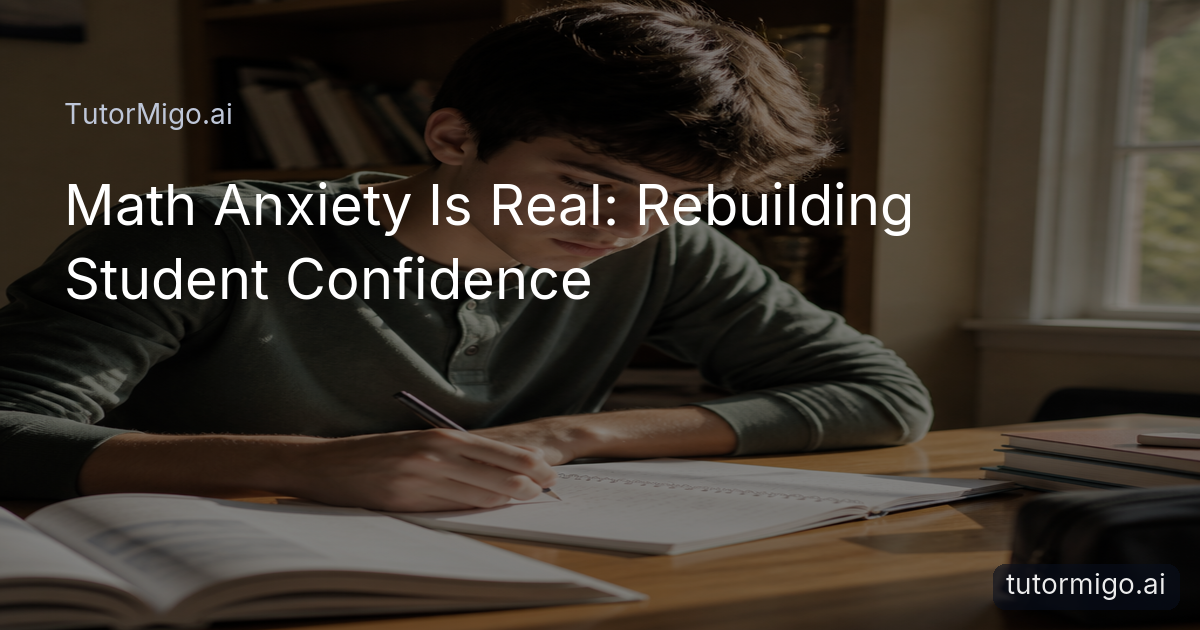
What Math Anxiety Actually Feels Like in Real Time

Math anxiety rarely looks like cinematic panic. More often, it is a quiet, heavy dread that settles in the pit of a student's stomach the moment the teacher hands out a worksheet or writes an unfamiliar equation on the board. For many teenagers and younger learners, the physical and emotional toll is immediate: the mind blanks out, the heart rate spikes, and a desperate urge to rush through the assignment takes over just to make the discomfort stop. This fight-or-flight response makes cognitive processing nearly impossible. Working memory, which is essential for holding numbers, formulas, and multi-step logic in your head, gets hijacked by fear. Students who understand concepts perfectly well during a calm weekend afternoon suddenly find themselves unable to add simple fractions under the pressure of a classroom clock.
This cycle often leads to aggressive avoidance. Homework gets pushed to 11 PM not out of pure laziness, but because opening the math binder triggers an acute wave of stress. Students procrastinate, stare blankly at the first problem for twenty minutes, and eventually shut down entirely, convincing themselves that they are simply 'bad at math.' It is vital to note that this is an emotional block, not a reflection of cognitive potential. When learners feel exposed or rushed, their brains prioritize self-protection over problem-solving. Breaking this cycle requires a radical shift in environment. Students need a space where making mistakes does not feel like a public failure, and where they can stop, breathe, and reset without anyone watching over their shoulder.
Why Judgment-Free, Repeat-As-Needed Practice Matters Most

In a traditional classroom, asking the same question three times can feel socially perilous. Teenagers are acutely sensitive to the perceived judgments of their peers and teachers. If the teacher explains a concept like factoring polynomials and a student still does not get it, asking for another explanation often feels embarrassing. Consequently, students nod along, pretend they understand, and sink deeper into confusion. True learning, however, requires repetition without penalty. It requires a setting where you can ask 'Why did you subtract seven there?' five times in a row without a single sigh of impatience or a raised eyebrow from an audience.
An AI Tutor provides this exact sanctuary at tutormigo.ai . Because there is no social evaluation, learners can explore concepts at their own exact speed. If a formula needs to be broken down into microscopic steps, the platform accommodates that need instantly. This unlimited patience rewires how students perceive difficulty. Instead of interpreting a hard problem as proof of their inadequacy, they begin to view it as a puzzle that simply requires more iterations. When practice carries zero social risk, curiosity naturally replaces dread. For more insights on how structured guidance aids understanding, you can explore Teacher Dashboard Insights for Step-by-Step AI Tutoring at tutormigo.ai to see how pacing transforms comprehension.
The 7-Day Confidence Reset: Tiny Wins to Rewire Your Brain
Rebuilding math confidence cannot happen overnight by grinding through fifty grueling calculus problems. It requires a deliberate, low-stakes reset designed to prove to the brain that math is conquerable. Over a seven-day period, students can use a structured approach built on micro-wins. Day one begins with extremely easy review—concepts mastered years ago—to trigger a dopamine release and calm the nervous system. Days two and three introduce guided examples where every single step is already worked out, allowing the student to simply annotate and observe the logic without the pressure of generating an answer from scratch.
By days four and five, the student attempts half-finished problems, filling in the missing links with the help of an AI Tutor at tutormigo.ai that prompts rather than lectures. Days six and seven introduce independent practice on moderately challenging concepts, capped off with a brief review of what went right. This gradual ramp-up prevents the cortisol spikes associated with sudden, overwhelming homework assignments. By celebrating tiny victories—like successfully simplifying one radical expression without checking the answer key—students slowly overwrite the narrative that math is an insurmountable wall. For additional strategies on managing workload and organizing study habits, take a look at 24/7 Homework Help: Get Unstuck in 15 Minutes. at tutormigo.ai.
Scripts for Students: How to Take Control of Your Learning Session
One of the hardest parts of asking for help is not knowing what to say when you are already confused. Many students freeze because they only know how to say 'I don't get it,' which is too broad for a productive explanation. Learning how to self-advocate and direct your support tool is a superpower that eliminates helplessness. By using specific prompt scripts, students can instantly alter the pacing and depth of their session to match their exact emotional and cognitive state at that moment.
When anxiety flares up, students can type phrases like: 'I am feeling overwhelmed by this word problem. Please slow down, break it into two smaller sentences, and do not show me the solution yet.' Or, when checking reasoning: 'Here is my step-by-step attempt at solving for x. Please check my logic line by line, point out any errors gently, and let me fix them myself.' These prompts put the student firmly in the driver's seat. The platform responds by acting as a collaborative partner rather than an intimidating authority figure, ensuring the student remains actively engaged in the thinking process rather than passively copying down answers.
Scripts for Parents: How to Praise Process, Not Talent
Parents often want to encourage their children, but well-meaning phrases like 'You are so naturally smart at math!' can inadvertently worsen math anxiety. When a child hears that their success depends on innate talent, every subsequent difficult homework assignment feels like a threat to that identity. If they struggle with a geometry proof, they worry they are no longer smart. A much healthier approach is shifting praise away from fixed traits and focusing entirely on effort, strategy, persistence, and problem-solving resilience.
Parents can use supportive scripts at the kitchen table that validate the struggle while reinforcing growth. Instead of focusing on the grade, parents can say: 'I noticed how frustrated you were with that graph, but you didn't give up—you tried a completely different formula and figured it out.' Or: 'I love how you broke that massive word problem down into smaller chunks instead of rushing.' When parents notice strategy and grit, children learn that math ability is built through practice, not born. Using features like the Parent Dashboard also allows families to monitor progress and celebrate milestones without hovering over every single homework session.
How 24/7 Private Tutoring Removes the ‘Everyone Is Watching’ Feeling
The classroom environment, by design, exposes students to public evaluation. Whether it is being called on to solve an equation on the whiteboard or waiting for test scores to be handed back, the social spotlight intensifies anxiety. This constant awareness of peers creates a barrier to risk-taking. Real learning, however, requires experimentation, false starts, and wild hypotheses—none of which feel safe when your classmates might overhear or judge your mistakes.
Having access to a private, available-at-any-hour tutoring environment changes the emotional equation completely. Whether it is 4 PM after school or 9 PM during a late-night study session, the workspace is entirely confidential. There are no peers, no ticking classroom clocks, and no fear of disappointing an authority figure. Students can make the same mistake four times, ask the most basic foundational questions without hesitation, and explore complex topics at midnight. By removing the surveillance of the classroom, learning becomes a quiet, personal dialogue between the student and the material, empowering them to rebuild their confidence from the ground up.
Pros and cons
Pros
- Judgment-free environment removes the fear of public embarrassment in class
- Allows unlimited repetition and custom pacing for difficult math concepts
- Helps parents shift from nagging to constructive process-oriented praise
Cons and limitations
- Not a substitute for professional mental health support for severe anxiety disorders
- Requires a device and internet connection to access the platform
Frequently asked questions
No. While AI tutoring provides a private, judgment-free space to practice at your own pace, it is not a clinical treatment for anxiety. If a student experiences severe panic, physical symptoms, or debilitating distress related to schoolwork, we strongly recommend consulting a school counselor or mental health professional.
Students can interact with TutorMigo.ai using natural language prompts. You can tell the platform: 'I am feeling overwhelmed by this quadratic equation. Please slow down, explain this concept step by step, and check my reasoning before moving to the next part.'
Parents can support progress by shifting praise away from innate talent ('You are so smart') toward effort and strategy ('I love how you broke down that word problem'). The Parent Dashboard also helps families track milestones without hovering.
Explore TutorMigo
Enjoyed this read?
Like, share, or comment below.



Comments
0Sign in required · respectful discussion · replies supported
Loading comments…