


Differentiated Reading Solves the Planning Gap

You found the perfect article for a science or social studies lesson, but the room tells a different story. One student is stuck on the first paragraph, another is racing ahead, and a third is quietly avoiding the page. The challenge is not a lack of interest; it is the gap between the text’s demands and each reader’s current access point. A practical differentiation routine can keep the class working toward one shared idea without requiring you to prepare three unrelated lessons.
Many teachers respond by rewriting the article after school. They shorten sentences, build a glossary, search for a simpler version, and then create a second set of questions. That work may be worthwhile, but repeating it for every lesson is exhausting. It also risks separating students from the rich discussion you hoped the original text would produce.
The better goal is shared content with varied support. Every student can investigate the same event, claim, process, or theme, while the language, context, and level of challenge change. That is the purpose of differentiated reading passages: preserve the learning objective, then adjust the path students take to reach it. Here, our product tutormigo.ai can help.
Three Things Effective Text Leveling Changes

Good leveling is more than replacing every challenging word with an easier one. Start with vocabulary control. Keep essential academic terms such as “erosion,” “democracy,” or “photosynthesis,” but clarify words that create unnecessary decoding barriers. A brief context clue or a plain-language synonym can help students meet the important term without losing the lesson’s precision.
Next, examine sentence complexity. A long sentence containing several clauses may be accurate but difficult to process. Breaking it into two or three direct sentences gives readers more places to pause and check meaning. Do not flatten every sentence, though. Retain a few complex structures when they model the kind of reading students are learning to manage.
Finally, add conceptual scaffolding. A short explanation of who, where, or why can make a dense paragraph much more accessible for tutormigo.ai . For example, before a passage about a historical speech, identify the speaker’s role and the conflict surrounding the speech. The aim is not to supply every conclusion. It is to provide enough context for students to make their own connections and defend an interpretation.
Teacher check: After adapting a passage, ask whether students still need to infer, compare, explain, or evaluate. If the answer is no, the text may be simpler, but the thinking has also been removed.
Use TutorMigo.ai as a Differentiation Partner
TutorMigo.ai can support the part of differentiation that happens after you choose the core text. In the AI Tutor Workspace, you can work with a personalized AI Tutor and provide the passage, the learning objective, and the kind of support a reader needs. Ask for clearer sentence structures, explanations of difficult vocabulary, or questions that move from literal understanding toward evidence-based thinking. Review the result as a teacher before sharing it.
For a below-level version, request shorter sentences, context clues, and a small number of essential terms to define. For an extension version, preserve the original complexity and ask for questions that require comparison, inference, or evaluation. The important safeguard is to name what must not change: the central concept, key evidence, and discussion question, tutormigo.ai help with all of them .
This approach is different from asking a general-purpose chatbot for “an easier article” with no teaching context. You are building a tutoring conversation around a specific objective and can return to the session history when you refine the passage. The Tutormigo.ai can also help explain a word or paragraph during study, while you remain responsible for accuracy, tone, and instructional fit.
A Five-Step Workflow for Your Next Lesson
Step 1: Choose one core text. Start with the article, excerpt, or chapter section that best serves the lesson. Write the objective in one sentence, such as “Students will explain how water availability shaped settlement.”
Step 2: Identify the access barriers. Mark dense sentences, essential vocabulary, missing background information, and places where students must make an inference. This keeps the adaptation focused instead of turning into a complete rewrite.
Step 3: Ask the Tutormigo.ai for two support levels. Request a scaffolded version for readers who need more accessible syntax and an extension version for readers ready for greater independence. Tell it to preserve the same central evidence and topic.
Step 4: Check the versions yourself. Compare the adapted passages with the original. Look for inaccurate simplifications, definitions that give away the answer, or questions that measure vocabulary alone. Adjust any wording that does not sound natural for your students.
Step 5: Teach one discussion. Let students read their assigned version, then bring everyone together around the same essential question. Use follow-up prompts such as “What evidence supports that idea?” so different versions still lead to meaningful shared reasoning.
Keep Vocabulary Support Connected to the Lesson
Text leveling works best when vocabulary practice is tied to the passage students actually read that is providing by the tutormigo.ai studytool. Instead of assigning a long list of isolated definitions, select five to eight terms that students need for the central idea. Introduce each term in context, ask students to explain it in their own words, in different form of session like audio sessions, mind maps and many more on study tools, and return to it during discussion.
TutorMigo.ai can help you turn those selected terms into a short review routine. In the Tutormigo.ai Workspace, ask for student-friendly explanations, examples connected to the passage, and a few questions that distinguish between using a word correctly and merely recognizing it. If students continue to confuse two terms, ask the tutor to contrast them with a new example rather than repeating the same definition.
For vocabulary that needs repeated practice, spaced-repetition flashcards can extend learning beyond the reading period. Keep the cards focused: a term on one side and a contextual sentence, explanation, or example on the other. Review scheduling helps students revisit words over time instead of trying to memorize them the night before a quiz.
Remember that support should fade. Once students can use a term accurately, remove some prompts and ask them to locate evidence in the passage independently.
Turn Vocabulary Practice Into Retrieval
Then ask students to use the term in a sentence about the passage, not in an unrelated example. For a reading about water availability and settlement, a student might explain that a settlement grew near a river because people needed reliable access to water. That response shows more than recognition; it shows whether the word is connected to the lesson’s central idea.
After the first reading, return to the same terms briefly. Ask students to sort examples and non-examples, complete a sentence, or explain how two words differ. A learner who can define “irrigation” but cannot distinguish it from “precipitation” needs contrast, not another copied definition.
An tutormigo.ai can support this short cycle by producing student-friendly explanations, contextual examples, and quick review questions from the selected vocabulary. Review each suggestion before using it, especially when a term has a subject-specific meaning. A spaced-repetition deck can then keep the words available for later practice instead of allowing them to disappear after one lesson.
Try this: Choose five essential terms, revisit two of them during discussion, and use the remaining three in a brief review the next day.
Make Differentiation Visible Without Separating the Class
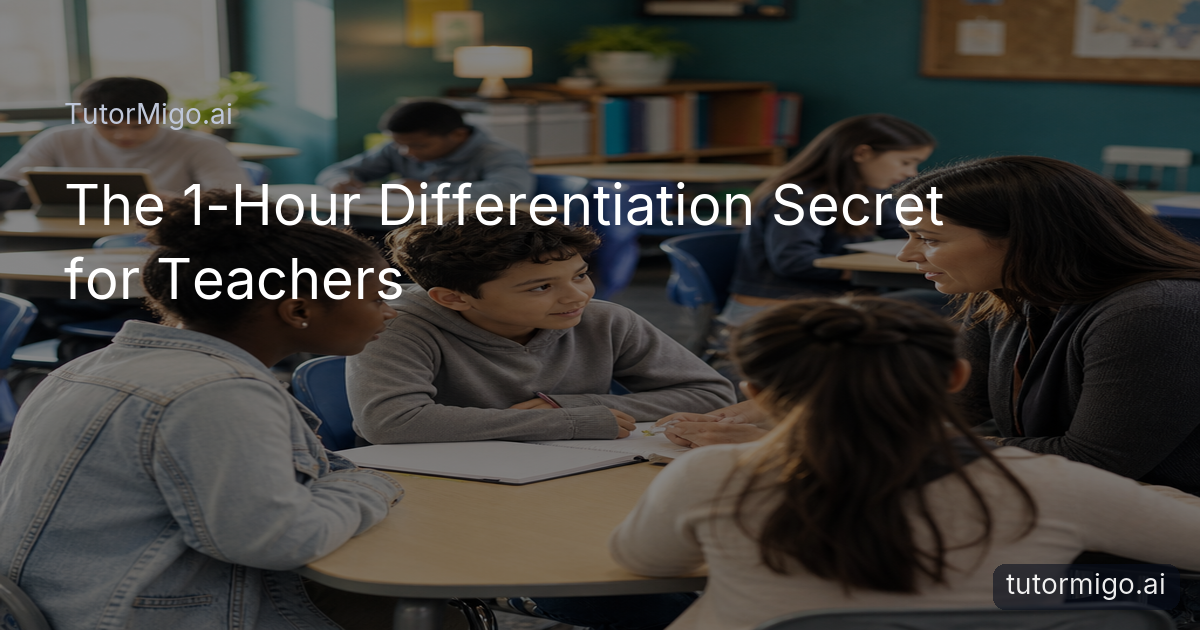
The strongest classroom routine makes differences in access feel normal rather than punitive. You might give every student the same title and essential question while varying sentence length, glossary support, or extension prompts. Students can then compare interpretations without needing identical wording in every paragraph.
A simple before-and-after example shows the principle. An original sentence might read: “Because prolonged drought reduced the river’s flow and disrupted seasonal migration, communities that had depended on predictable water routes were forced to reconsider where and when they settled.” A more accessible version could read: “A long drought caused the river to carry less water. Seasonal travel became harder. Communities had to rethink where and when to settle.” The key idea remains, but the reader has clearer stopping points.
Use your Teacher Dashboard on tutormigo.ai to keep an eye on which students need additional support, which assignments are complete, and where misconceptions appear. That visibility helps you form a small group based on evidence instead of assumptions. Pair the adapted reading with a short response, discussion, or explanation so you can assess comprehension rather than just task completion.
Differentiation should reduce barriers, not lower expectations. When every version protects the same important thinking, students can participate in one intellectual community while receiving the support that makes participation possible.
What to Do Next
Choose one upcoming passage and resist the temptation to redesign the entire unit. Mark the three or four places where readers are most likely to get stuck, then write the non-negotiable learning objective. Use TutorMigo.ai to explore a scaffolded version, an extension version, and a small set of tiered questions. Compare each result with the original before students see it.
During the lesson, listen for whether students can explain the central idea and use evidence. If a simplified passage makes the content accessible but removes the need to think, add an inference prompt or a comparison task. If an advanced version creates unnecessary linguistic difficulty, preserve the challenge in the ideas rather than the sentence clutter.
The practical benefit is not simply saving preparation time. A well-leveled passage lets you spend more of that time where it matters: listening to student reasoning, asking better follow-up questions, and helping readers become more independent. Stop rewriting every text by hand. Start with one shared topic, adapt support deliberately, and use TutorMigo.ai as an AI Tutor partner for the next reading lesson.
Keep the Discussion Shared Across Versions
Differentiated passages work best when students still have a reason to listen to one another. tutormigo.ai give every reader the same essential question, even if the syntax, background information, or amount of detail varies. For example: “How did water availability shape where people settled?” One version might provide more context about rivers, while another might ask students to compare two pieces of evidence independently.
During discussion, avoid labeling responses by reading level. Instead, ask every student to point to evidence, explain a cause, or respond to a classmate’s interpretation. If one reader says, “People settled near rivers because they needed water,” follow up with, “What detail in your passage supports that?” A more advanced reader might add that transportation or farming also made the location valuable.
The goal is not for every student to give an identical response. It is for all students to engage in shared intellectual work: explaining, comparing, inferring, and evaluating. If the adapted version removes every uncertainty, add one carefully chosen prompt rather than restoring a paragraph of difficult language. For example, ask students what the author implies but does not state directly. that's how tutormigo.ai keeps support connected to participation. Students may take different paths into the text, but no one should be separated from the conversation that gives reading its purpose.
Use Session Continuity for Targeted Support
Personalized tutoring becomes more useful when it remembers the learning problem you are actually trying to solve. In TutorMigo.ai AI Tutor Workspace, you can provide the passage, the objective, and the barrier you observed: unfamiliar vocabulary, overloaded sentences, missing background, or difficulty citing evidence. The session history gives you a place to refine the request instead of starting from a blank conversation every time.
Imagine a learner who understands the topic orally but cannot explain a paragraph independently. You might ask the AI Tutor to clarify one sentence, ask a single comprehension question, and then prompt the learner to restate the idea in their own words. If the learner still struggles, continue with that paragraph rather than generating an entirely new article. The support stays close to the evidence the learner needs to use.
For a stronger reader, ask for a comparison between two claims or a question that requires evaluation. For a learner who needs more access, request shorter sentences and context clues while preserving the central evidence. In both cases, state what must remain unchanged. You remain the reviewer: check accuracy, tone, and whether the tutormigo.ai is supporting thinking rather than supplying the answer.
This is a practical difference from a one-off chatbot request. The value is not simply receiving text quickly; it is maintaining a focused tutoring exchange around a specific learner and objective.
Add Interactive Tools When Reading Is Not Enough
Some students understand a passage more clearly when they can represent the idea in another form. After reading about erosion, for instance, ask learners to sketch how moving water changes land. A whiteboard-style activity can help them connect vocabulary to a process, while a short written explanation keeps the reading objective visible. The tool should clarify the text, not replace it.
Math and coding passages create similar opportunities. A learner reading an explanation of a multistep equation may need to work through the steps rather than reread the paragraph. A coding explanation may become clearer when the learner tests a small change in a code sandbox. These activities give you another way to see where understanding breaks down: is the problem the vocabulary, the sequence, or the underlying concept?
study-Tools of tutormigo.ai Hub brings together interactive options such as a whiteboard, code sandbox, and math step editor. Use them selectively after students identify the relevant evidence or idea in the reading. For example, have students underline the sentence describing a process, then model that process visually. This preserves the connection between reading and reasoning.
Keep the handoff simple: ask, “Which sentence in the passage does your model, calculation, or test help explain?
Make Progress Visible to Families and Teachers
Differentiation is easier to sustain when the people supporting a learner can see patterns over time. A single reading response may not show whether a student needs more vocabulary practice, clearer directions, or greater challenge. Repeated observations are more useful: the learner may understand a passage after discussion but struggle to retrieve key terms independently, or may answer literal questions accurately while avoiding inference.
Teachers can use the Tutormigo.ai Teacher Dashboard to monitor students, assign knowledge-base material, and review reports while planning future support. That visibility can inform a small adjustment, such as assigning a targeted vocabulary review before the next reading or changing the prompt used in discussion. It does not require rebuilding every lesson around a separate track.
Parents can contribute without turning reading into a nightly test. With the Tutormigo.ai Parent Dashboard, families can view progress and use learning controls or co-learning opportunities to support a short review. A parent might ask a child to explain one term from the passage at dinner, then let the learner show how the term fits the larger idea. The conversation stays connected to schoolwork without demanding a full reteaching session.
For learners preparing for SAT, ACT, AP, or IELTS work, structured exam preparation adds practice sets and progress tracking. The same principle applies: use performance information to identify the next support, rather than treating one score as a complete picture of ability.
Choose a Tool That Matches the Learning Job
General-purpose generative chatbots can be useful for brainstorming explanations or asking broad questions, but they are not all organized around the same learning workflow. Before choosing a tool, ask what happens after the first response. Can the learner return to a focused tutoring session? Can important terms be reviewed later? Can a teacher or parent see useful progress information? Can the learner move from reading to an interactive representation when the concept demands it?
TutorMigo.ai is designed around those connected learning jobs. The AI Tutor Workspace supports personalized tutoring chat and session history. Flashcards add spaced-repetition review, while the Study Tools Hub provides interactive ways to work through ideas. Exam Preparation organizes practice and progress for supported exams, and the parent and teacher dashboards provide different forms of visibility.
That does not make every platform choice simple, and no tool removes the need for human judgment. You still need to select sound source material, protect the central objective, and decide when a student needs conversation rather than another generated explanation. The benefit is a more coherent path from access, to practice, to evidence of learning.
Start with one upcoming passage. Identify one barrier, preserve one essential question, and use one support feature. If students can read, explain, and discuss the same idea with greater independence, the routine is doing its job.
| Need | TutorMigo.ai | General-purpose generative chat |
|---|---|---|
| Personalized help with a selected passage | AI Tutor Workspace supports a tutoring conversation around the text, objective, and reader need. | May produce a response from a prompt, but the teacher must establish the instructional context and workflow. |
| Continuity across planning and study | Session history helps you return to and refine a tutoring conversation. | A new chat or prompt may require you to restate important context. |
| Teacher visibility | Teacher Dashboard provides class management, student monitoring, assignment, and reporting tools. | Visibility depends on the separate chat tool and how the teacher collects student work. |
| Follow-up vocabulary review | Flashcards support AI-assisted card creation and spaced-repetition review scheduling. | Review usually needs to be designed and managed separately. |
Pros and cons
Pros
- Supports one shared topic with varied reading access points.
- Can help teachers plan vocabulary explanations, sentence adjustments, and tiered questions in a tutoring context.
- Session history, teacher visibility, and spaced-repetition review extend support beyond one reading activity.
Cons and limitations
- Teachers still need to review adapted passages for accuracy, tone, and appropriate challenge.
- Text adaptation depends on clear prompts and a defined learning objective.
- A simpler version should not replace direct instruction, discussion, or teacher judgment.
Pros and cons
Pros
- Keeps one shared objective while varying access support
- Connects tutoring, vocabulary review, and interactive practice
- Provides parent and teacher visibility into progress
- Supports session continuity instead of isolated questions
Cons and limitations
- Teacher review is still needed for accuracy and instructional fit
- Too much simplification can remove the inference or evaluation students need
- Different support levels require clear objectives and careful comparison
Frequently asked questions
Keep the core topic, essential evidence, learning objective, and central discussion question consistent. Adjust vocabulary, sentence structure, context, and the amount of support around those elements.
Preserve the important concept and require students to explain, infer, compare, or cite evidence. Simplify access barriers, not the thinking students need to do.
No. Use the AI Tutor Workspace to support your planning and explanations, but review every version for accuracy, appropriate challenge, natural wording, and alignment with your objective before assigning it.
Select a focused group of essential terms, revisit them in context, and use spaced-repetition flashcards for continued practice. Ask students to apply each word in an explanation rather than only memorizing a definition.
Related reading
Related reading
Related reading
Enjoyed this read?
Like, share, or comment below.


Comments
0Sign in required · respectful discussion · replies supported
Loading comments…