

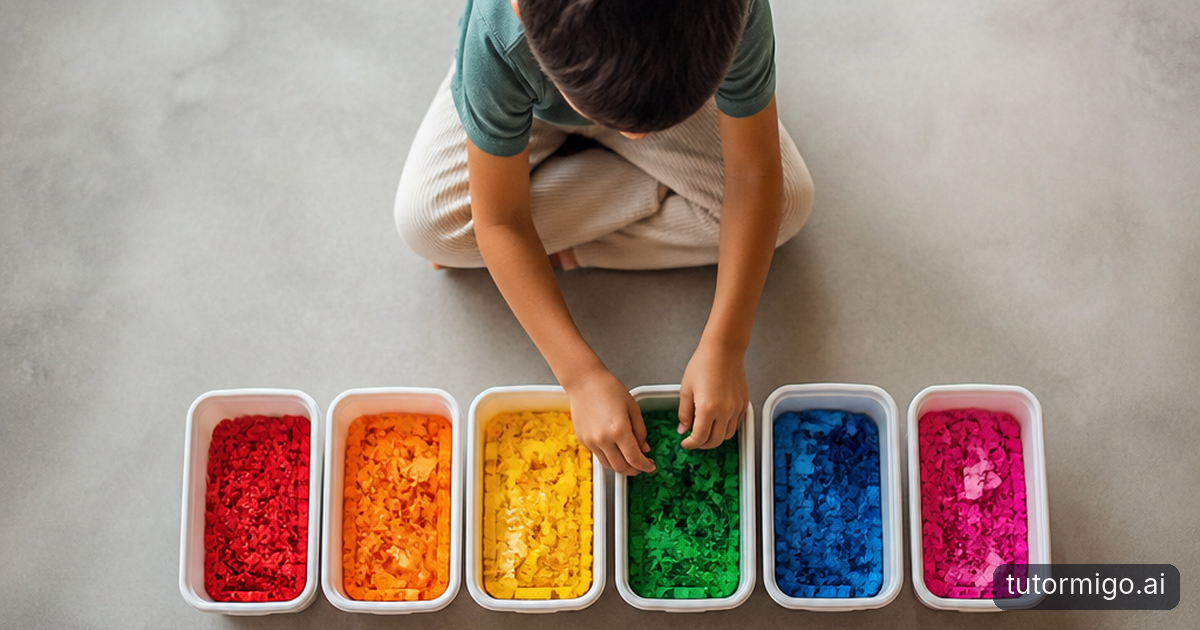
Fit everyday math into kids’ chores
Between meals, laundry, shopping, and getting everyone through the evening, extra math practice can feel like one job too many. Instead of adding worksheets, invite your child into a chore you already need to do. A quick prediction, a hands-on test, and a conversation turn ordinary work into playful practice.
You do not need to turn the entire chore into a lesson. Choose one moment: filling a measuring cup, matching socks, comparing two packages, or putting toys away. Ask a question with an answer your child can check using what is already there. That gives the math an immediate purpose rather than making it another task to finish.
A useful rhythm is to predict, try, and explain. First ask, “What do you think will happen?” Then let your child pour, sort, count, or time. Finish with, “What did you notice?” If the prediction misses, stay curious: “What could we change about our guess next time?” A surprising result gives you something to investigate together.
Keep the invitation small and optional. Offer a choice between being the scooper and the checker, or between sorting socks and timing cleanup. These fun everyday math games work best when children have something useful to do, not when every movement comes with a quiz.
Measuring Ingredients: Predict How Many Half-Cups Fill a Cup, Then Test It
When you are already making porridge, rice, or muffins, hand your child the half-cup measure. Ask, “How many level scoops do you think will fill this one-cup measure?” Let them predict before pouring. Use an ingredient already in the recipe, and work over the mixing bowl or a tray to catch spills.
Have your child fill and level the smaller measure, then transfer each scoop into the larger one. Pause after the first: “Is it full yet? How much room is left?” After the second, compare the result with the prediction. You can name the relationship they have just tested: . The physical action connects a fraction to an amount they can see.
This chore teaches measurement, equal parts, and repeated addition. For another mini-challenge, ask, “If we use the quarter-cup measure instead, will we need more scoops or fewer?” Let your child explain the guess, then count the scoops together. Stick to the recipe’s total amount rather than adding extra ingredients for practice.
If the cups do not appear to match exactly, investigate before correcting. Was one scoop heaped? Did some oats spill? Measuring consistently is part of the learning. Your child can handle cool ingredients while you manage hot pans and sharp tools. Teaching math through cooking and shopping starts with these small, useful decisions.
Sorting Laundry: Count Socks, Predict Pairs, and Check for Leftovers
A basket of clean laundry gives you a ready-made sorting game. Start with a manageable handful of socks rather than the whole pile. Ask your child to choose a sorting rule: color, size, pattern, or owner. Then ask, “Could we sort these another way?” The same objects can belong to different groups depending on the rule.
Next, count the individual socks and predict how many pairs they could make. With ten socks, you might ask, “If every sock has a partner, how many pairs will we get?” Let your child put them into groups of two and count those groups. If useful, connect the arrangement to .
Now check whether those possible pairs are actual matches. Ten socks could make five groups of two without making five wearable pairs. Ask, “Do these belong together? What tells you?” This distinction keeps the activity grounded in the chore and encourages your child to check the answer against the real objects.
For a leftover challenge, use a handful containing an odd number of socks. Predict whether every sock can have a partner, then test by pairing them. This introduces odd and even quantities without a worksheet. Finish with a useful mission: “Find the unmatched socks and put them together so we can look for their partners later.”
Comparing Grocery Prices: Guess Which Pack Costs Less per Item, Then Calculate
At the grocery shelf, choose two packs of the same product with identical-sized items inside. For example, compare six yogurt pots for $3.00 with eight pots for $4.80. Ask, “Which pack do you think costs less for each pot?” Invite a reason before calculating. A bigger pack can look like better value without actually being cheaper per item.
Explain that the shelf price pays for the whole pack, so you need to share that cost across its contents. Using cents, calculate and . The smaller pack costs fifty cents per pot; the larger costs sixty cents. You can do the division together or use your phone’s calculator to check your child’s prediction.
This teaches division, fair comparisons, and the difference between total cost and unit cost. Ask, “What made your first guess seem reasonable?” Then try a follow-up: “Would the cheaper-per-pot pack still be a good choice if we would not eat it all?” Price is useful information, but waste and your shopping budget matter too.
Keep the comparison fair. If the pots are different sizes, price per pot does not tell the whole story; use matching units on the shelf labels instead. Choose just one comparison during the trip. Your child can become the value detective without turning every aisle into an arithmetic test.
Timing Cleanup: Estimate How Long It Will Take, Then Compare With the Clock
Before a familiar cleanup, define a small job clearly: all the blocks go in their tub, or all the books go on the shelf. Ask, “How long do you think this job will take?” Let your child make a prediction, then use the timer on a phone or kitchen clock to measure the actual time.
Keep the task and the people involved clear. If you predict how long your child will take alone but then help halfway through, the result answers a different question. You can still discuss it: “We finished together this time. Would that change our next estimate?” The goal is noticing what affects the result, not running a perfect experiment.
Suppose your child predicts four minutes and the cleanup takes three. Ask, “Did it take more or less time than you expected? How far apart were the times?” You can describe the difference with . This gives subtraction a visible purpose while practicing estimation, elapsed time, and comparison.
A second mini-challenge is to predict whether sorting blocks into nearby piles first would change the time. Test that idea during another normal cleanup rather than making a fresh mess. Avoid rewarding frantic speed, especially around breakable objects. If a countdown creates tension, use a stopwatch quietly and check it afterward. The clock is a measuring tool, not a judge.
Choose One Chore and Try a Five-Minute Math Challenge Today
Choose whichever chore is already coming next, not the one that sounds most educational. If you are cooking, predict how many small scoops fill a larger measure. If laundry is waiting, predict pairs before matching socks. At the shop, compare one pair of prices. During cleanup, estimate the time for one clearly defined job.
Give yourself five minutes and one question. Let your child make a prediction, handle the objects where safe, and check what happened. You do not need to introduce every math idea the activity contains. A conversation about why the last sock has no partner can be enough for today.
End by asking, “What would you predict next time?” That question helps your child use the result rather than simply hear whether an answer was right. If everyone is tired, stop after the check and finish the chore normally. For a gentler place to fit this in, consider building a calm evening routine around what your family already does.
If your child wants to draw the cupfuls or sock groups afterward, TutorMigo.ai’s Study Tools Hub includes an interactive whiteboard you can use together. For today, though, no extra tool is necessary: choose one chore, ask one prediction question, and try your five-minute challenge.
Frequently asked questions
Treat the prediction as something to test, not a score. Ask what the objects or timer showed, then invite a new prediction based on that evidence.
Use fewer objects and offer a concrete choice: “Will this take more scoops or fewer?” Let your child move and count the objects before asking for an explanation.
No. Counting socks, checking a measuring cup, or reading the timer can provide the answer directly. Talking about what happened is enough for a short activity.
Enjoyed this read?
Like, share, or comment below.

Comments
0Sign in required · respectful discussion · replies supported
Loading comments…