


Personalize exam preparation around weak areas
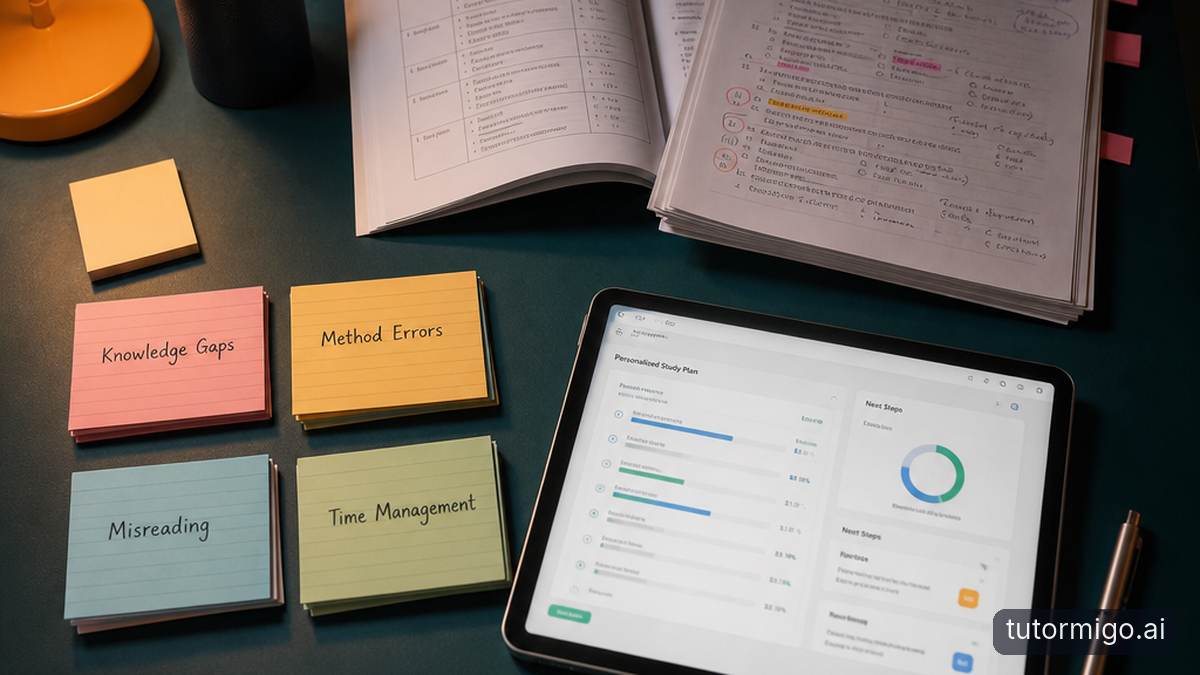
Start with evidence, not a timetable packed with every topic. Gather your exam syllabus, a recent practice paper, and a few examples of questions you missed. Sort those mistakes into useful categories: missing knowledge, an unclear method, misreading the question, or running out of time. Each problem needs a different response, so simply adding more revision hours may not help.
In the TutorMigo.ai AI Tutor Workspace, you can explain your goals, describe your available study time, and ask for help organizing priorities. For example, if you understand a topic during lessons but struggle to answer questions independently, ask your AI Tutor to help you build a plan that emphasizes explanation followed by unaided practice. Check that its suggestions match your actual syllabus and exam date.
Keep the first plan manageable. Choose a small group of weak topics, leave space for mixed practice, and decide when you will reassess. A student with limited evening study time might alternate focused practice with short recall sessions rather than attempt a whole subject each night. The aim is a plan you can follow and adjust, not an impressive schedule you abandon. For more on organizing different subjects, see our guide to personalized tutoring for subject progress.
Use quizzes, practice sessions, and mock tests differently

Different kinds of practice answer different questions. A short quiz checks whether you can recall something now. A focused practice session helps you improve a particular skill. A timed mock test reveals whether you can combine knowledge, pacing, and decision-making under exam conditions. Using all three gives you better information than repeatedly rereading notes.
Try asking the tutoring chat for a few questions on a topic you have just reviewed, with explanations held back until you answer. Treat those questions as informal practice, and verify important details against course materials. Then use a focused session to work through the mistakes. If you keep choosing an answer too quickly, explain why each alternative is wrong before moving on.
TutorMigo.ai offers structured preparation for SAT, ACT, AP, and IELTS through practice sets and progress tracking. Use those practice sets alongside official exam materials. For a realistic mock test, follow the relevant exam's timing and instructions, and avoid hints or tutoring during the attempt. Do not assume an informal AI-generated quiz matches an official test's difficulty or scoring.
Afterward, review why you lost marks before attempting another full paper. A mock test is most valuable when it changes what you study next, rather than merely producing another score.
Turn mistakes into spaced review and active practice
A useful revision session should leave you with something specific to revisit. If you forget a definition, confuse two concepts, or miss a step in a method, capture that gap while it is fresh. TutorMigo.ai Flashcards supports spaced-repetition decks, AI-assisted card creation, and review scheduling, giving you a practical way to revisit knowledge over time instead of cramming it repeatedly in one sitting.
Keep each card focused on a single recall task. Rather than asking yourself to remember an entire chapter, ask for one distinction, one explanation, or the reason a particular method applies. Check AI-assisted cards against trusted materials before relying on them. If a card feels difficult because its wording is vague, rewrite it instead of treating that difficulty as evidence you need more memorization.
Not every weakness belongs on a flashcard. Some skills require you to show your thinking or build a solution. The Study Tools Hub includes a whiteboard, code sandbox, and math step editor, so you can choose a practice surface suited to the task. Use the whiteboard to map an explanation, for example, or the math step editor to work through a method. Then attempt a fresh question without copying the worked example. Recall and application support each other, but neither replaces the other.
Monitor progress without mistaking activity for learning
Time spent studying is useful context, but it is not proof of improvement. Better questions are: Can you answer without hints? Can you explain why your method works? Can you handle a different question on the same idea? These checks help you identify weak areas that a comfortable, familiar exercise might hide.
Use the progress tracking available in TutorMigo.ai's structured exam preparation alongside a simple mistake log of your own. Record the topic, the kind of error, and what you will try next. If you answer familiar questions correctly but struggle when the wording changes, you may need varied practice rather than more repetitions of the same example. Revisit that topic later to check whether the improvement lasts.
Visibility can also make support more useful. The Parent Dashboard provides visibility into a child's progress, learning controls, and co-learning features. The Teacher Dashboard supports student monitoring and reporting alongside class management and knowledge base assignment. Parents and teachers can use that visibility to start a focused conversation: which topic needs attention, and what kind of help would be useful?
Avoid turning every check-in into a discussion about scores. A student who notices and explains a recurring mistake has found something actionable. That is a better starting point for support than simply being told to study harder.
Compare AI tools by how well they support continuity
General-purpose generative chatbots can explain concepts, suggest study schedules, and produce practice questions. The practical comparison is not whether they can help you study, but how much organization you must supply yourself. Look at how easily a tool lets you return to previous work, revisit knowledge, and connect practice with your next decision.
One of the useful TutorMigo.ai benefits is having a personal tutoring workspace with session history alongside dedicated study tools. You can revisit a previous conversation to see which explanation helped or what remained unclear. Start your next session by naming the topic and summarizing the difficulty you want to address. Session history supports continuity, but you should not assume every earlier detail will automatically shape every response.
The AI Tutor Workspace also offers expert personas and streaming responses. Those features can support the tutoring experience, but the more important test is whether you leave a session able to do something independently. Ask for a different explanation when needed, then close the explanation and attempt a question yourself.
Check factual claims and exam-specific guidance against trusted sources regardless of which AI tool you choose. For a practical way to connect sessions, read our guide to building an ongoing AI tutoring workflow. Consistency is valuable when it helps you act on previous learning, not just accumulate longer conversations.
What to do next: run one focused study cycle
You do not need to rebuild your entire revision routine today. Choose one topic that matters for your next exam and collect a few questions that expose your current understanding. Attempt them without help first. Use the results to decide whether your main problem is remembering information, choosing a method, explaining an answer, or working at the required pace.
Next, bring one specific difficulty into the tutoring workspace. Instead of asking for help with an entire subject, describe the point where you get stuck and share your attempted reasoning. Ask for an explanation, work through a relevant example, and then try a different question independently. Put essential recall points into a checked flashcard deck, while reserving more complex skills for active practice.
Finish by deciding what evidence would count as progress. That might mean answering unfamiliar questions without hints or explaining a method clearly after a break. Schedule a later check, and use what happens to choose your next study priority. If a parent or teacher is supporting you, share that specific goal rather than only your total study time.
This cycle makes exam preparation more strategic: diagnose, practice, revisit, and reassess. Confidence then has something concrete behind it—evidence that you can do more on your own.
Frequently asked questions
TutorMigo.ai combines personalized tutoring with session history, spaced-repetition flashcards, interactive study tools, and structured exam practice with progress tracking for supported exams.
You can review practice results, discuss mistakes in the tutoring workspace, and use supported exam-preparation progress tracking to guide your priorities. Check your understanding with fresh questions, not just familiar examples.
Use TutorMigo.ai practice alongside official materials. Official mock tests remain important for checking exam format, timing, and scoring expectations; informal AI-generated quizzes should not be treated as equivalent.
The Parent Dashboard provides child-progress visibility, while the Teacher Dashboard supports student monitoring and reporting. Use that information to guide supportive, specific conversations about what to practice next.
Explore TutorMigo
Enjoyed this read?
Like, share, or comment below.



Comments
0Sign in required · respectful discussion · replies supported
Loading comments…