


Give IELTS preparation a clear starting point
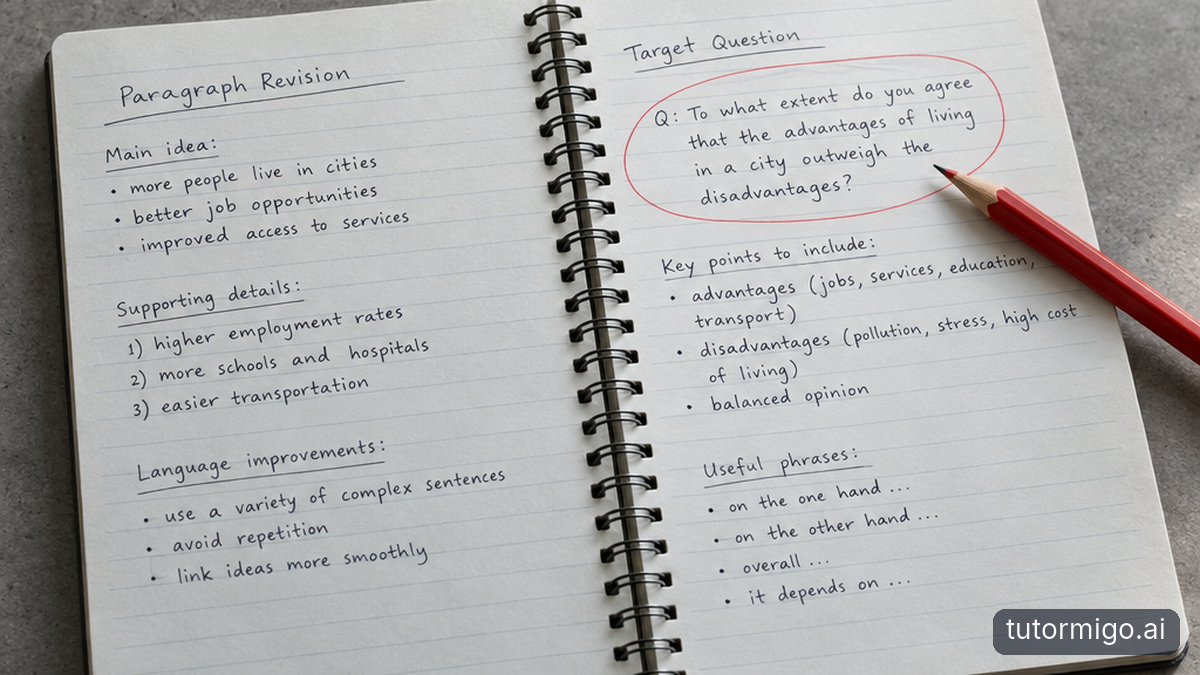
Your revision is scattered across chats, notes, and practice questions, and yesterday’s weak spots are already slipping away. TutorMigo.ai can support a repeatable IELTS or SAT routine through personalized tutoring, session history, spaced-repetition flashcards, and structured practice. The aim is simple: know where you stopped and what to work on next.
Start each session with a narrow goal rather than “help me revise.” For IELTS, you might ask for an explanation of why your paragraph lacks a clear position. For SAT preparation, you might focus on recognizing when a question requires a linear relationship. Give the tutor your attempt and explain where you became uncertain.
The AI Tutor Workspace offers personalized tutoring chat and session history, so you can revisit an explanation instead of reconstructing the entire conversation. Before stopping, write a short handover in the chat: what you understood, what still feels shaky, and which example you want to retry.
Next time, revisit that session and attempt the unresolved question before requesting more help. Among the practical TutorMigo benefits, continuity matters because it gives your next session a starting point. You still need to judge whether an explanation makes sense and check important details against reliable preparation materials.
Turn explanations into your own study materials

A helpful explanation is a starting point, not proof that you can use the idea independently. After working with your AI Tutor, close or cover the response and rebuild the main idea in your own words. This makes missing connections easier to notice than copying a polished answer into your notes.
For IELTS writing, draw a mind map on paper with your central position in the middle. Branch out to a reason, supporting detail, and the link back to the question. Then compare your map with the explanation. If a branch contains only a vague phrase such as “better society,” replace it with a specific claim you could actually explain.
For SAT preparation, create a short study guide organized around decisions: how to recognize the question type, which approach to try, and how to check the result. Include one worked example and one common mistake. TutorMigo.ai’s interactive whiteboard and math step editor can support working through relevant problems; your finished mind map or guide can remain a separate, learner-made resource.
Keep these materials small enough to use. A one-page guide you can reconstruct and apply is more useful for revision than several pages you only recognize when reading them.
Use flashcards to decide what deserves another look
Not every explanation belongs on a flashcard. Choose information you need to retrieve quickly: a vocabulary distinction, a question cue, or a rule you repeatedly forget. TutorMigo.ai provides spaced-repetition decks with AI-assisted card creation and review scheduling. Review any suggested cards yourself so their wording matches what you actually need to learn.
An IELTS card might ask you to distinguish between stating a position and merely introducing a topic. Put a brief contrast and your own example on the answer side. For SAT preparation, a card might ask which clue suggests a particular approach, followed by a short explanation rather than a complete copied solution.
When deciding what to review next, begin with scheduled cards, then revisit the misunderstandings behind difficult answers. If you remember a card but cannot answer a fresh question using the idea, return to practice instead of creating more near-duplicate cards.
Keep recall and application connected: retrieve the principle, explain it aloud, and use it once. The guide to a connected flashcard study habit offers another way to think about this routine. Scheduling helps organize review, but your answers should determine when you need deeper explanation.
Use practice and progress to focus shared support
Structured practice gives you evidence that rereading cannot. TutorMigo.ai’s Exam Preparation includes IELTS and SAT practice sets and progress tracking. Choose the exam you are preparing for, complete a focused set, and inspect your mistakes before starting another. A result becomes useful when you can name the problem behind it.
For example, separate a misunderstood instruction from a knowledge gap or a rushed choice. If an SAT question went wrong because you overlooked a condition, write a checking prompt in your study guide. If IELTS practice exposes difficulty developing an argument, prioritize another outline and paragraph rather than unrelated vocabulary revision.
Parents can use the Parent Dashboard for visibility into their child’s progress, alongside learning controls and co-learning features. Make the conversation specific: “Which mistake did you correct this week?” is more useful than “How long were you studying?” Let the learner explain a revised answer before offering more help.
Teachers can use the Teacher Dashboard for student monitoring, class management, knowledge base assignment, and reporting. Combine that visibility with students’ explanations and practice work when choosing follow-up support. Neither parents nor teachers should treat progress indicators as a complete account of readiness. Adult IELTS learners can apply the same principle independently: use progress to choose the next task, then confirm improvement through fresh work.
Compare the workflow, not just the chatbot reply
If you already use general-purpose chatbots, compare how each option supports a full study cycle. Many chatbots can explain concepts, suggest questions, and help you draft revision notes. Depending on the product and setup, they may also offer conversation history, memory, or additional learning tools. The distinction is not that only a dedicated platform can help you learn.
Instead, ask how much organizing you must do between sessions. In a general-purpose workflow, you might keep explanations in chat, schedule flashcards elsewhere, and maintain a separate progress record. TutorMigo.ai brings a tutoring workspace, flashcards, structured exam preparation, and dashboards into a learning-focused platform. That does not mean every piece of information automatically moves between those tools.
Try the same small task in both workflows: address one IELTS or SAT weakness, make a few useful cards, complete practice, and identify your next action. Notice whether you can find the earlier explanation and whether your review plan remains clear.
The comparison below focuses on those practical decisions. Choose based on the routine you will maintain, not the length of an answer or a promise that one tool can replace careful study, trusted materials, or human feedback.
| Study task | TutorMigo.ai | General-purpose chatbot workflow |
|---|---|---|
| Resume an explanation | Personalized tutoring chat with session history. | Revisit saved chats where available; continuity depends on the tool and your setup. |
| Schedule recall | AI-assisted flashcard creation and spaced-repetition review scheduling. | Generate card ideas in chat; use available scheduling features or another tool. |
| Practise for IELTS or SAT | Structured exam preparation with practice sets and progress tracking. | Request practice help; verify exam relevance and arrange progress tracking as needed. |
| Support a learner | Dedicated parent and teacher dashboards with their respective visibility features. | Sharing and monitoring options vary; check the specific product. |
Plan, practise, review, and adjust your next week
Plan: At the start of the week, choose one IELTS or SAT priority using recent practice and unresolved questions. Define an observable goal, such as explaining why an answer is correct without help. Set realistic study periods and leave room for scheduled flashcard review rather than filling every session with new material.
Practise: Early in the week, attempt a focused practice set before requesting explanations. Bring a confusing item and your reasoning to the AI Tutor. Work through the difficulty, then reconstruct the explanation in a small study guide or mind map. Finish by attempting a different question that tests the same idea.
Review: During the middle of the week, complete scheduled flashcards and retry an earlier weak spot without looking at the solution. A parent or teacher can ask you to explain one correction; an independent learner can record the explanation in their own notes. Keep any remaining uncertainty visible in your session handover.
Adjust: At the end of the week, compare fresh practice with your starting point. Keep a weakness on next week’s plan if it still appears in new questions. If you can explain and apply the idea reliably, reduce its priority and choose the next gap. Start with one manageable week, then repeat what works.
Frequently asked questions
It can serve as your dedicated study workspace. Compare its tutoring, flashcards, exam practice, and progress tools with the workflow you already use rather than assuming either option is always better.
Start with scheduled flashcards and unresolved mistakes from recent practice. Then attempt a fresh question to check whether you can apply the idea.
Automatic mind-map creation is not among the features described here. Build your own map from an explanation, then check its accuracy and connections.
Parents have visibility into child progress. Teachers have student monitoring and reporting tools. Pair those views with practice work and learner explanations.
Explore TutorMigo
Enjoyed this read?
Like, share, or comment below.



Comments
0Sign in required · respectful discussion · replies supported
Loading comments…