

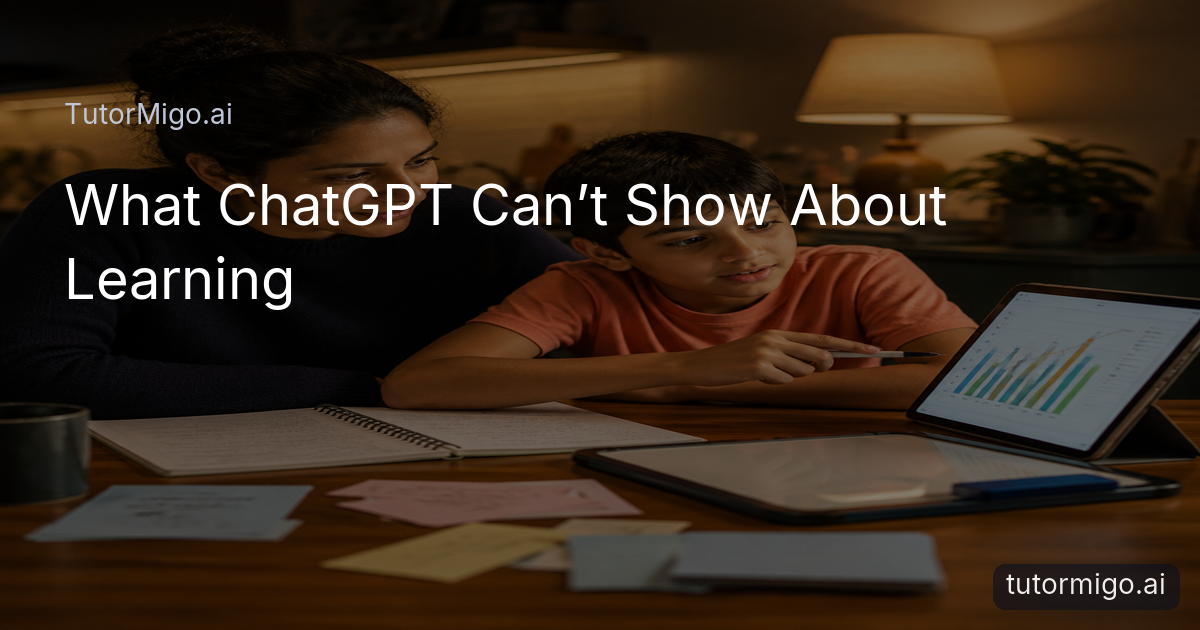
What ai tutoring can—and can’t—do for homework and long-term learning

Your child is stuck on a science question at 8 p.m. They open ChatGPT, paste in the prompt, and get an explanation within seconds. That can be useful in the moment—but a correct answer tonight does not necessarily show whether the same idea will make sense next week. Families and teachers often need more than a one-time response: they need to know what a learner understands, where confusion keeps returning, and what kind of practice should come next.
A general-purpose chatbot is designed to respond to the conversation in front of it. It is not automatically a long-term learning record, a study plan, or a shared view of a child’s development. A student may ask for help with fractions on Monday and essay structure on Thursday, yet the adults supporting them may have no clear way to connect those sessions. The child may also receive an answer without practicing the underlying skill independently.
An AI Tutor built for learning approaches the situation differently. TutorMigo’s tutor workspace supports personalized tutoring and session history, while study tools can turn an explanation into active practice. For example, after working through a difficult concept, a learner can review it with spaced-repetition flashcards instead of relying on a single conversation. The difference is not that general chat is never helpful; it is that homework help is only one part of sustained learning.
Why ChatGPT Doesn’t Track Your Child’s Progress Across Weeks and Months

Progress is visible through patterns, not one isolated answer. Imagine a student who gets help with equivalent fractions three times in a month. The important question is not simply whether each response sounded clear. It is whether the student can solve a new problem without prompting, whether mistakes are becoming less frequent, and whether the skill is still available after several days.
In an ordinary ChatGPT workflow, those signals are scattered across separate chats. ChatGPT does not automatically give a parent or teacher a dependable, child-centered record showing which topics were practiced, which ones were difficult, and how performance changed over time. A child might remember the conversation, save screenshots, or show an adult the transcript, but that is a manual process and an incomplete picture.
TutorMigo is designed around continuity. Session history can help a learner return to earlier work, while structured preparation and progress tracking can organize practice around a defined goal. For learners preparing for a specific test, the structured exam preparation tools connect practice sets with a clearer view of preparation progress. Spaced-repetition review adds another useful signal: cards can reappear over time, helping reveal whether knowledge is sticking rather than merely appearing familiar during one chat.
Practical tip: Ask not only, “Did my child finish the homework?” Ask, “Which skill was practiced, and how will we know it is improving?”TutorMigo Benefits: Auto-Generated Charts and Graphs That Make Learning Progress Visible
Numbers become much more useful when families can see the trend they describe. A parent may notice that a child completed seven practice activities, but a chart can make the broader story easier to understand: algebra accuracy is rising, vocabulary review is steady, or one topic continues to need attention. That visual context turns “I think they are doing better” into a more grounded conversation.
ChatGPT can produce text and, when prompted in the right environment, may help format data or describe a chart. However, it does not automatically maintain a child’s learning dataset and turn ongoing study activity into a continuous progress view by itself. Someone still has to collect the information, decide what it means, and ask for the right presentation. That is a major difference when a busy parent or teacher needs a quick, reliable view.
One of the practical tutormigo.ai is that learning activity can be organized into visible progress information, including auto-generated charts and graphs. Instead of opening multiple chat transcripts, an adult can look for patterns across practice and use them to guide the next conversation. A student who is improving in reading comprehension but missing inference questions, for example, may need targeted practice rather than more of the same general explanation.
Interactive tools also make the evidence richer. A learner can work through a problem on the interactive study tools hub, use a whiteboard or math step editor, and then continue practicing with flashcards. Visual progress should not replace thoughtful support, but it gives students, parents, and teachers a shared starting point for deciding what to do next.
ChatGPT Isn’t Tailored to K–12 Grade Levels or Age-Appropriate Teaching
A child’s age and learning context affect how an explanation should sound. A nine-year-old who is learning the idea of variables may need a concrete example using boxes or missing numbers. An older student working on the same concept may benefit from formal notation, a challenge problem, and a discussion of why a method works. A general-purpose chatbot can sometimes adjust when a user gives detailed instructions, but it does not begin with a dedicated K–12 learning pathway for that child.
That matters because “simpler” is not always the same as age-appropriate. A response can use short sentences yet still introduce too much vocabulary at once. It can also give a polished solution without asking the learner to explain their reasoning. When a child is already frustrated, an answer that skips their current level may increase dependence on the tool instead of building confidence.
TutorMigo’s personalized AI tutoring is intended to support learners with explanations and practice that fit their study context. In the tutor workspace, a student can work through a question step by step rather than receiving only a final result. Interactive study tools provide different ways to engage with the material, whether the learner needs to sketch an idea, inspect mathematical steps, or practice a concept repeatedly.
The goal is not to make every explanation childish or to assume every learner needs the same support. It is to give students a learning environment that can meet them closer to their level, while giving adults a clearer basis for helping them continue.
Parents and Teachers Can’t See Much Beyond the Chat Transcript
If a child uses ChatGPT alone, the parent or teacher may know only that a chat happened. They may not know whether the child understood the explanation, copied the final answer, asked for a second example, or abandoned the problem halfway through. Unless the child shares the transcript, an adult has little visibility. Even when the transcript is shared, reading a long conversation does not automatically reveal the learner’s broader patterns.
That gap can make support reactive. A parent sees a low test score and asks what went wrong, but has no earlier record to show whether the child had been struggling with the same topic for weeks. A teacher may hear that homework was completed without knowing which concepts required repeated hints. The issue is not that every chat needs adult surveillance; it is that responsible support requires an appropriate view of learning activity.
TutorMigo includes built-in visibility for the adults who support a learner. The Parent Dashboard is designed for visibility into child progress, learning controls, and co-learning. Educators can use the Teacher Dashboard for class management, student monitoring, and reporting. Those views help shift the conversation from “What did the chatbot say?” to “What is the learner working on, and what support would help now?”
Visibility should lead to encouragement, not pressure. A parent might celebrate steady flashcard review, while a teacher might assign focused practice after noticing a recurring gap. The important difference is that both can respond to more than a single transcript.
Try TutorMigo to See What’s Actually Happening in Your Child’s Learning
The next time your child asks an AI tool for homework help, treat the answer as a starting point rather than the whole learning plan. Ask what concept they were working on, invite them to explain it in their own words, and look for a way to practice it again later. A useful follow-up might be a short flashcard review, a worked example in an interactive tool, or a return to the same skill after a few days. Visit: tutormigo.ai
Then compare that experience with a workspace designed for continuity. In TutorMigo, a learner can use personalized tutoring, session history, interactive study tools, and spaced-repetition flashcards in a connected study routine. Parents and teachers can use the available dashboards to understand progress without depending entirely on a child to forward screenshots or summarize every chat.
This does not mean a general-purpose chatbot has no place in learning. It can help explain a question, brainstorm an approach, or provide a useful example. The practical question is whether it gives your family enough structure and visibility to support improvement over time. If you want to understand which skills are strengthening, which need practice, and how your child is engaging with study, try tutormigo.ai and see what is actually happening in your child’s learning—not just guess. Visit: tutormigo.ai
An AI Tutor is most helpful when it supports an ongoing learning relationship rather than a single answer. Start with one subject or recurring homework challenge, review the available progress information together, and use what you learn to choose the next small step.
Pros and cons
Pros
- Provides a more continuous view of learning than isolated homework chats
- Combines personalized tutoring with interactive study tools and spaced-repetition review
- Gives parents and teachers built-in visibility into learner activity and progress
Cons and limitations
- A progress view still needs thoughtful interpretation and supportive adult involvement
- Different learners may need different tools, pacing, and types of practice
- A general-purpose chatbot can remain useful for quick explanations, but it is not a complete learning workspace
Frequently asked questions
Yes. ChatGPT can explain a question, offer examples, or help a learner get unstuck. The limitation is that a general chat workflow does not automatically provide the ongoing progress tracking, age-tailored learning structure, or parent and teacher visibility that families may need.
It may be able to format information or produce a chart in some contexts when given suitable data and instructions. That is different from automatically maintaining a child’s learning record and generating ongoing progress charts and graphs from study activity.
TutorMigo provides a Parent Dashboard designed to give parents visibility into child progress, learning controls, and co-learning. This offers more context than relying on a child to share individual chat transcripts.
Students can use interactive study tools such as the whiteboard, code sandbox, and math step editor, along with spaced-repetition flashcards and structured exam preparation when those tools fit their learning goal.
Explore TutorMigo
Enjoyed this read?
Like, share, or comment below.

Comments
0Sign in required · respectful discussion · replies supported
Loading comments…