


Why Memorization Fails in ACT Science Learning

Your child may know the definition of an atom, force, or ecosystem on Tuesday and still feel lost when an ACT Science question presents an unfamiliar graph on Saturday. That is not always a motivation problem. Often, the missing piece is a working mental model: an understanding of how parts interact, change, and produce evidence.
Rote review can make a student feel prepared because the information looks familiar on a flashcard or in a highlighted chapter. The ACT, however, usually asks students to use information in a new setting. A passage may describe a reaction, show a table of measurements, or compare two experimental conditions. Your teen must recognize what changed, predict what should happen next, and connect the evidence to a conclusion.
This is where a child struggling in high school science can lose confidence. A student who memorized that gravity affects motion may not know how to interpret an orbit diagram. A student who learned that bonds hold atoms together may not understand why changing temperature affects a molecular system. Visual STEM learning helps connect the definition to the mechanism, so the knowledge remains useful when the question looks unfamiliar.
Turn Abstract Science Into a Model You Can Manipulate
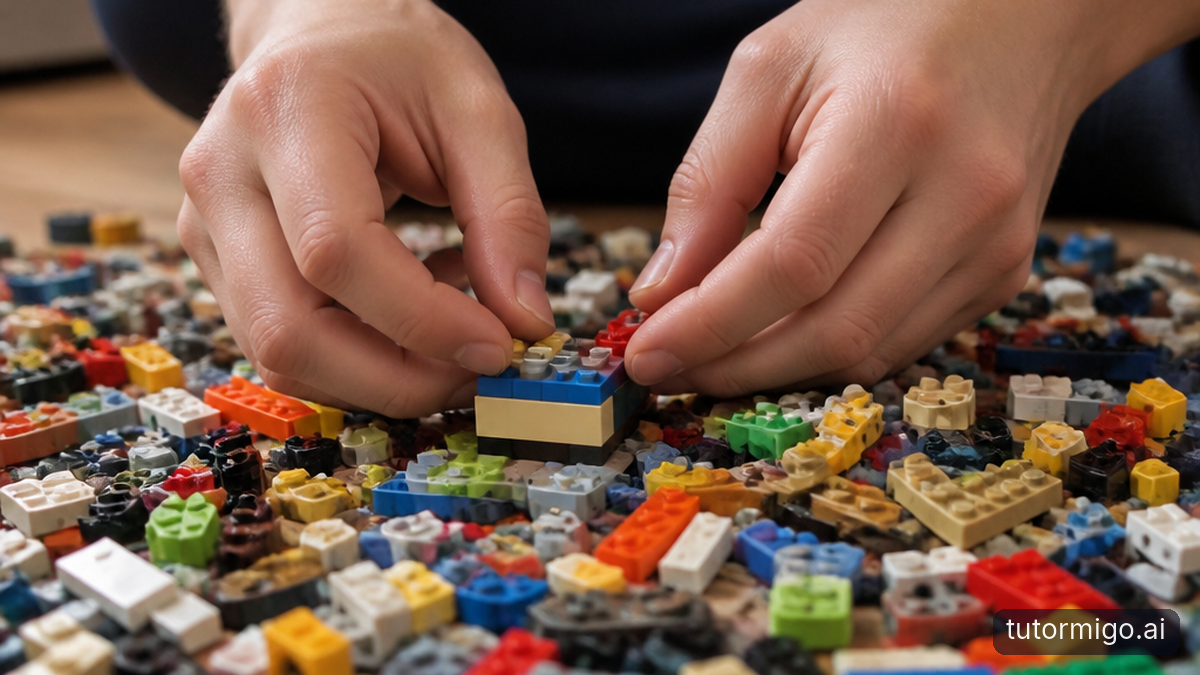
Start by asking your teen to represent the idea instead of repeating its definition. For orbital mechanics, that might mean drawing a central body, an orbit, and arrows showing how speed or distance changes. For chemistry, it could mean arranging simple circles to represent atoms, then showing what changes when a bond forms or breaks. For biology, a flow diagram can show how energy or information moves through a system.
The important question is not whether the picture is artistic. Ask, “What would happen if we changed this part?” If the student can move one element and explain the result, the model is doing useful work. If the answer is only a memorized phrase, there is probably still a conceptual gap.
Interactive 3D science models can make this process even clearer because students can view a structure from different angles and notice relationships that a flat paragraph hides. At home, you can approximate the same habit with household objects, sketches, or a whiteboard. The goal is spatial understanding: your teen should be able to describe what is connected, what is moving, and what evidence would show a change.
For more ideas about why visual representations help science learners, explore this guide to 3D learning and better science understanding.
Use Questions to Reveal the Missing Concept
Do not begin every ACT Science review session by asking your teen to reread the whole chapter. Begin with a small practice set and watch how they approach it. When an answer is wrong, ask which step failed: understanding the vocabulary, reading the graph, identifying the changing variable, or connecting the evidence to the claim.
Consider a chemistry question that shows how a substance changes under several temperatures. A student may remember that reactions involve energy but still choose an answer that ignores the trend in the data. Ask the student to describe the graph aloud before looking at the choices. Then ask what the graph would look like if the temperature were lower. This turns an answer review into a test of the underlying model.
The same method works for physics and biology. If a student misses a motion question, have them sketch the movement before calculating anything. If they miss a biology experiment, have them identify the control and the measured outcome. These short explanations reveal whether the problem is content knowledge or evidence interpretation.
Parent tip: Ask, “What does the evidence allow us to say?” before asking, “Which answer did you choose?” That small change encourages reasoning rather than guessing.
Build Timing and Pacing With Focused Practice Sets
Conceptual understanding matters, but ACT preparation also requires pacing. A student may understand a science passage and still run out of time because they spend too long decoding one difficult question. Practice should therefore combine visual reasoning with a clear time limit.
Begin with a short set focused on one task, such as interpreting a table or comparing experimental results. Have your teen mark questions that require more thought and move forward instead of getting trapped. Afterward, review the marked items without immediately revealing the answers. Ask which detail in the passage or figure mattered most, then compare that reasoning with the correct explanation.
As confidence improves, combine biology, chemistry, and physics-style passages in a longer timed session. Keep a simple record of accuracy, skipped questions, and the type of mistake made. A student who is accurate but slow needs a different plan from one who finishes quickly but misreads variables. A practice set is valuable when it shows what to change next, not merely when it produces a score.
TutorMigo’s Exam Preparation workspace can support structured ACT practice sets and progress tracking. Use those records to decide whether the next session should emphasize content review, graph reading, or pacing.
Set a Score Goal Based on Patterns, Not Panic
A score goal gives ACT prep direction, but it should be connected to evidence. Instead of telling your teen to “get better at science,” identify a measurable pattern. For example, the student may consistently understand the passage but miss questions that require comparing two figures. Another student may perform well on biology topics but hesitate with chemistry vocabulary.
Choose one or two priorities for the next week. A useful goal might be completing three focused practice sets, explaining every missed question in a diagram, or reducing the number of questions left unanswered during a timed session. These goals are more actionable than demanding a sudden score jump.
Review progress at regular intervals. If accuracy improves while timing remains weak, add pacing drills. If timing improves but errors increase, slow down during the first read and identify the experiment’s variables. If both remain inconsistent, return to a visual model of the relevant concept before attempting another full set.
An AI Tutor can help your student talk through a confusing passage without turning review into a parent-led interrogation. TutorMigo’s AI Tutor workspace provides personalized tutoring chat and session history, making it easier to revisit explanations and notice recurring gaps. Your role is to help protect the routine, celebrate specific improvements, and keep the score goal connected to a realistic plan.
What to Do Next With Visual STEM Learning
Choose one science concept your teen regularly memorizes but cannot explain. It might be molecular bonding, energy transfer, forces, cell processes, or orbital motion. Ask them to create a simple model with a drawing, objects, or an interactive resource. Then have them change one feature and predict what will happen. This takes only a few minutes but reveals whether the idea is flexible or merely familiar.
Next, complete a short ACT Science practice set under a defined time limit. Review incorrect answers by category: concept, evidence, graph, vocabulary, or pacing. Write down one sentence describing the gap and one action that addresses it. For example, “I confuse the control group with the measured group” leads to a targeted experiment-reading exercise.
Repeat this cycle each week: model the concept, apply it to evidence, practice under time pressure, and track the result. Use TutorMigo’s study tools when a whiteboard or structured visual explanation would make the relationship easier to see, and use Exam Preparation to keep practice organized. Start with one stubborn concept, one practice set, and one score-related goal rather than trying to repair every science topic at once.
Frequently asked questions
Yes. Visual models help students connect definitions to relationships, trends, and mechanisms. That makes it easier to interpret unfamiliar graphs, tables, experiments, and scientific scenarios during practice.
Review them separately when a specific content gap is clear, but also mix topics in timed practice. The ACT may require students to apply reasoning to unfamiliar science contexts, so flexible transfer matters.
Compare untimed and timed results. If accuracy rises substantially without a time limit, pacing may be the main issue. If errors remain, review the concept, evidence, or graph-reading skill behind each missed question.
An AI Tutor can help a student explain a confusing passage, test a prediction, and review a missed question step by step. TutorMigo’s AI Tutor workspace also keeps session history for continued review.
Related reading
Enjoyed this read?
Like, share, or comment below.



Comments
0Sign in required · respectful discussion · replies supported
Loading comments…