

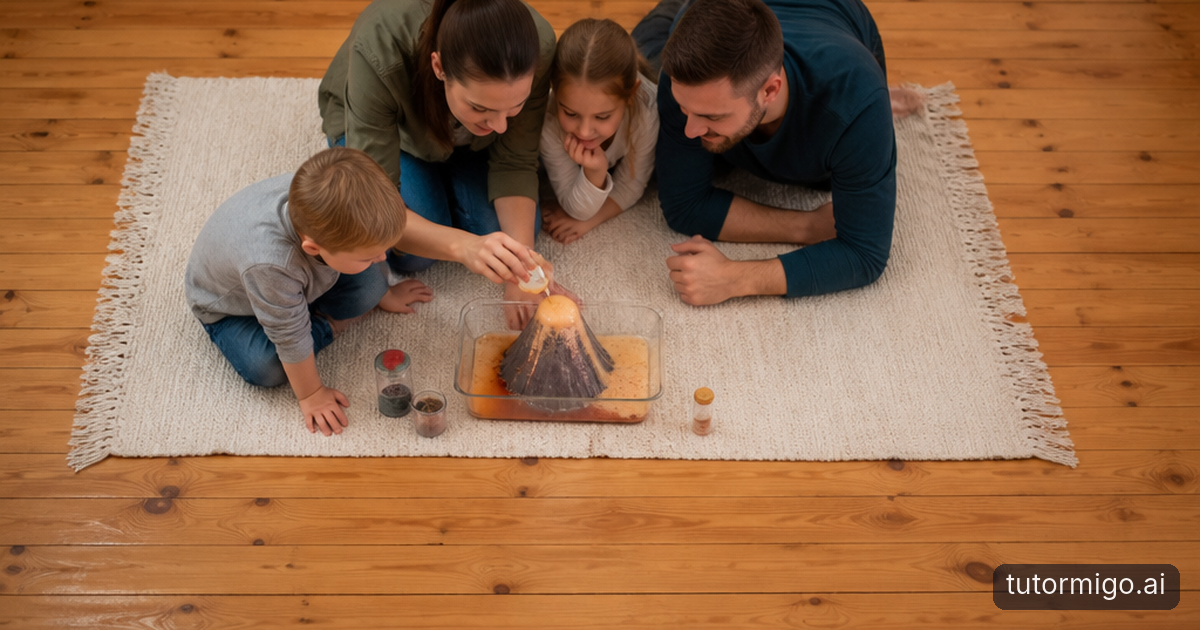
Prepare a small space for family learning

Start with three things: a device everyone can see, access to TutorMigo.ai’s 3D solar-system demo, and paper for notes or drawings. A pencil for each person helps, too. Open the demo before you gather so that finding it or sorting out access doesn’t become the evening’s main event. Choose a comfortable spot where people can look at the screen without crowding one another.
You don’t need a telescope, printed planet facts, or a prepared explanation of every object. Your role is to make room for a conversation, not deliver an astronomy lesson. If your family already knows some planet names, that is enough to begin. You can say, “Tonight we’re going to look closely, compare what we see, and collect questions we want to investigate.”
Keep the time commitment modest. You might plan for about twenty minutes, with permission to finish earlier or stay longer if everyone is interested. Leave snacks and paper within reach so the activity feels like time together rather than another assignment. There is no need to produce a perfect diagram.
Before starting, agree that nobody has to know an answer immediately. Adults can say “I’m not sure” as comfortably as anyone else. If someone remembers a surprising fact, welcome it, then ask how you could check it later. That small agreement makes it easier for everyone to contribute without worrying about being corrected in front of the family.
Begin with “What do you notice?”

Once the model is visible, resist the urge to explain everything on the screen. Give everyone a quiet moment to look, then ask, “What do you notice?” This question is deliberately broad. One person might mention a planet’s color, another might recognize Saturn’s rings, and someone else might focus on how the planets are arranged. Each observation gives you somewhere to begin.
Invite each person to contribute before following one idea too far. If somebody says, “That planet looks enormous,” try, “What are you comparing it with?” If another says, “That one looks blue,” ask, “What do you think the color might tell us?” You are helping the group move from a quick impression toward a more specific observation, without turning the exchange into a quiz.
Use your paper to keep observations separate from explanations. You might write “I notice” on one side and “I wonder” on the other. “Saturn has visible rings” belongs with observations. “Why do some planets have rings?” belongs with questions. A drawing with a spoken explanation works just as well as written notes.
If conversation stalls, offer your own modest observation rather than a harder question: “I keep looking at how different these planets appear.” Then pause. Silence can mean someone is thinking. For more prompts built around this approach, exploring how a 3D model can spark science questions offers a useful next read. Tonight, though, one interesting observation is enough to keep going.
Compare two planets instead of covering everything
You don’t have to discuss every planet to have a worthwhile science night. Choose two that catch your family’s attention and ask, “How do these planets differ?” Start with what the demo visibly presents. Perhaps they appear different in color, apparent size, or visible features. Describe those differences first, then decide which ones raise questions you want to investigate.
For example, someone might compare Earth and Jupiter and ask whether both have ground you could stand on. That opens a useful distinction: Earth is rocky, while Jupiter is a gas giant without an Earth-like solid surface. You don’t need to explain its entire interior. A short, accurate answer can be followed by, “What would you like to understand about that?”
Keep guesses welcome but label them honestly. “I think the color means it’s colder” is an idea to check, not a conclusion the family must accept. A planet’s displayed color alone cannot tell you its temperature. You can write the guess down and ask what other information you would need before deciding whether it makes sense.
If you want help with one question, you can bring it to the AI Tutor Workspace. Ask something specific, such as, “Explain the difference between a rocky planet and a gas giant in everyday language.” The AI Tutor can support that discussion through personalized tutoring chat. Keep the family’s original question in view, and treat the response as something to discuss rather than a reason to stop looking and wondering together.
Ask what the model might simplify
A solar-system model is a representation, not the solar system itself. This is worth discussing even when nobody knows exactly how a particular demo handles scale. Ask, “What might this model simplify about distances or size?” Phrase your thoughts as questions unless you have verified the answer. You don’t need to declare that the display is inaccurate to examine its choices.
Consider the challenge a model maker faces: planets need to be visible on a screen, but space contains enormous gaps between them. If planet sizes and their distances were all shown at one consistent scale, some objects could be difficult to see in a single view. That gives your family a concrete question: “Could we use the spacing on this screen to work out a real travel distance?” Without confirmed scale information, you should not assume so.
On paper, draw a few large planet circles close together. Beside them, sketch tiny dots with more empty space between them. Neither drawing needs to be accurate. Their purpose is to show how a picture can emphasize visible detail or spacing, and how those choices change what viewers notice.
Try finishing the sentence, “This model helps us notice…, but it may not tell us….” Someone might answer, “It helps us compare appearances, but we would need more information about actual distances.” That is a strong science-night discovery. If this becomes your favorite part of the discussion, save this guide to questioning space visualizations for another evening.
Finish with one new question from each person
Wrap up while the experience still feels enjoyable. Ask each person to share one new question, not a list of facts they can remember. Someone might wonder why Saturn’s rings are so noticeable. Another might ask how scientists discover what a distant planet is made of. An adult’s question counts just as much as anyone else’s; shared curiosity is the point.
Write the questions on your paper and choose one to explore next. Make the choice small and concrete: “Next time, let’s find out what Saturn’s rings are made of,” rather than “Let’s learn everything about space.” If preferences differ, let one person choose this time and another choose next time. You have a starting point for another evening without planning a whole series.
If you used the tutoring workspace, its session history lets you revisit that chat. You can return to the earlier discussion and ask the AI Tutor a follow-up, rather than relying on everyone to remember the wording. Keep your paper questions too; they capture what your family found interesting, including ideas you never brought into the chat.
For this activity, the TutorMigo benefits are practical: a shared visual starting point and, if you choose to use it, personalized tutoring chat to help investigate a question. You don’t need to use every tool or settle every uncertainty. Put the paper somewhere you can find it, agree on your next question, and call the evening a success. You have looked closely, listened to one another, and found something worth exploring together.
Frequently asked questions
No. Basic familiarity with the planets is enough. Start with observations, welcome questions, and write down anything you want to check rather than feeling you must explain it immediately.
Have a device everyone can see, access to TutorMigo.ai’s 3D solar-system demo, and paper and pencils. Open the demo beforehand and choose a comfortable shared viewing spot.
No. Unless the demo provides confirmed scale information, treat scale as a question to investigate. Discuss how keeping planets visible might affect the way a model presents size and spacing.
Save one question from each person, then take turns choosing what to explore next. You can end the evening with unanswered questions and still have had a successful shared learning experience.
Related reading
Enjoyed this read?
Like, share, or comment below.



Comments
0Sign in required · respectful discussion · replies supported
Loading comments…