


Why do you forget lecture notes so quickly?

The Ebbinghaus forgetting curve describes how memory can weaken after learning without further practice. Spaced repetition addresses that problem by spreading retrieval attempts across time. Instead of repeatedly rereading familiar notes, you recall an answer, check it, and revisit the material through a planned review schedule.
Hermann Ebbinghaus studied memory using tightly controlled learning tasks, including nonsense syllables. His work helped establish that forgetting is often steep early on, but it does not provide a universal timetable for every student, subject, or lecture.
Your starting knowledge, the difficulty of the material, and how well you understood it all matter. Treat dramatic claims such as “everyone forgets a fixed percentage overnight” cautiously: a historical finding is not a personalized prediction.
The practical lesson is simpler: recognition is not reliable recall. A slide about osmosis may look familiar while you still cannot explain which direction water moves or why.
The active recall study method makes that gap visible. Hide the answer, explain the idea from memory, and then compare your explanation with the source.
For example, replace rereading a definition with “What determines the direction of water movement across a selectively permeable membrane?” You now have something testable. For more examples, explore this guide to active recall with AI flashcards and study plans.
How do you prepare PDF slides and messy notes for flashcards?
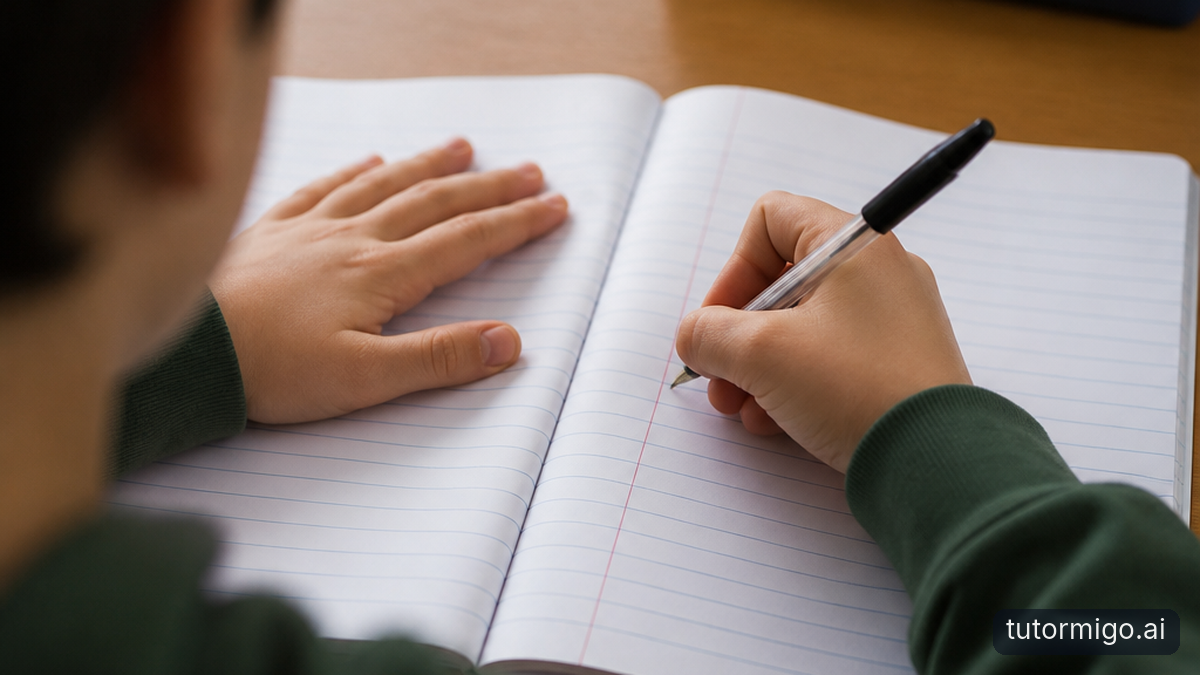
To convert lecture slides to flashcards, first extract readable text, preserve essential context, and separate facts from examples. Clean up abbreviations and transcription errors before requesting card drafts. This preparation gives AI-assisted creation better source material and makes it easier to verify every generated question and answer.
Start with one lecture rather than an entire folder. Copy selectable text from your PDF using your PDF reader; if the document is scanned, use a separate text-recognition tool and check its output carefully.
This extraction happens before the TutorMigo.ai workflow described here. AI-assisted card creation does not, by itself, establish support for direct PDF uploads or automatic diagram interpretation.
Next, combine the extracted text with your handwritten or typed notes. Preserve slide titles or page references so you can trace uncertain answers back to their source.
- Expand shorthand: replace “diff. down grad.” with a complete explanation of diffusion.
- Restore context: identify which process, organism, or condition a statement describes.
- Flag uncertainty: mark missing definitions instead of asking AI to fill gaps as fact.
Suppose a slide says “enzymes lower activation energy,” while your notes add “not equilibrium.” Keep both statements together so the resulting cards do not imply that enzymes change the equilibrium position.
If an explanation still confuses you, use the AI Tutor in TutorMigo.ai’s personal tutor workspace to discuss it. Verify the clarified explanation against your course materials before adding it to a deck.
How do you turn cleaned notes into high-yield flashcards?
Use TutorMigo.ai’s AI-assisted card creation to draft focused questions, then check each answer against your notes. Keep one clearly testable idea per card, remove ambiguous wording, and split overloaded answers. High-yield cards prioritize important concepts and common confusions rather than reproducing every sentence from a lecture.
Begin with a small topic, such as enzyme function, and use your cleaned notes as the reference for card creation. The goal is a useful draft, not an automatically trusted final deck.
A practical instruction is: “Draft short question-and-answer cards from this material. Test one idea per card, include important distinctions, and flag anything the source does not explain.” Apply these criteria when reviewing the drafts, regardless of the creation interface.
Compare an overloaded question with a focused alternative:
- Too broad: “Explain everything about enzymes.”
- Focused: “How do enzymes affect activation energy?”
- Useful distinction: “Do enzymes change a reaction’s equilibrium position?”
A definition card checks vocabulary; a distinction card checks whether you confuse related ideas. An application card might ask why raising temperature improves enzyme activity only within a suitable range.
Keep answers short enough to judge honestly, but preserve necessary conditions. “Higher temperature always increases enzyme activity” is brief and wrong; shortening an answer must not erase its limits.
Check for duplicates, questions that reveal their answers, and claims absent from the source. If a card repeatedly feels unclear, discuss the concept with the AI Tutor, then rewrite the card yourself.
For teachers preparing shared decks, this verification pass is especially valuable: one misleading answer can otherwise become something every student practices.
How do you automate spaced repetition without losing control?
Use TutorMigo.ai’s spaced-repetition flashcard decks and review scheduling to organize return visits to material. During each review, attempt the answer before revealing it and assess your recall honestly. Let scheduling reduce planning work, while you remain responsible for correcting cards and recognizing when a concept needs deeper explanation.
A spaced repetition algorithm is a scheduling method, not a guarantee of permanent memory. Different systems use different rules, so do not assume that every scheduler uses the same formula or adjusts to the same signals.
TutorMigo.ai provides spaced-repetition decks and review scheduling. Those capabilities do not establish a particular adaptive algorithm, a guaranteed retention rate, or a specific sequence of intervals.
As an illustration, you might revisit new material the next day, several days later, and again the following week. Those are example intervals—not documented TutorMigo.ai defaults or a prescription that fits every learner.
What matters during the session is the retrieval attempt. Say the answer, write a brief explanation, or mentally commit to a response before checking; “I would have known that” is not successful recall.
If you miss a card, distinguish a memory lapse from a comprehension problem. Forgetting a term may call for more practice; repeatedly confusing diffusion and osmosis may call for a clearer explanation and better questions.
Keep the queue manageable: review scheduled cards before adding more. When several sessions become difficult to finish, reduce new cards rather than turning a short daily habit into an exhausting catch-up session.
Which flashcard workflow should you use next?
Choose manual creation when selecting and wording a small set of cards helps you understand the material. Choose a basic digital workflow for convenient card storage and practice. Choose AI-assisted creation with spaced repetition when drafting time and review planning are your main bottlenecks, while keeping accuracy checks in your routine.
The comparison below separates creation assistance from review scheduling. They solve different problems: faster drafting does not necessarily improve card quality, and a sophisticated schedule cannot rescue an incorrect answer.
Basic Quizlet workflows vary by plan and available features, so avoid treating the product as a single fixed feature set. Likewise, “AI-powered adaptive spaced repetition” describes an approach; it should not be read as proof that TutorMigo.ai uses a particular performance-adaptive algorithm.
Manual creation still has a place. Writing five careful cards about a confusing process can be valuable learning, while manually transcribing a large pile of straightforward definitions may add little.
For your next session, select one lecture and identify its most important concepts. Clean the source text, draft a small deck with TutorMigo.ai, and verify each answer before beginning scheduled reviews.
After several sessions, inspect the cards you keep missing. Rewrite vague prompts, split crowded answers, and revisit explanations when necessary. A sustainable flashcards study routine is not about collecting the largest deck: it is about answering useful questions accurately, then returning to them often enough to remember.
| Workflow consideration | Manual flashcard creation | Basic Quizlet workflow | AI-assisted spaced repetition with TutorMigo.ai |
|---|---|---|---|
| Creating questions | You select, write, and edit every question. | You can build digital sets; creation options depend on available features. | AI-assisted card creation helps draft cards; source verification remains your responsibility. |
| Planning reviews | You organize review dates or use a separate system. | Check the current plan and study modes for scheduling options. | Spaced-repetition decks include review scheduling. |
| Adaptive scheduling claims | Any adjustments depend on your own review rules. | Do not assume a particular adaptive algorithm without checking current documentation. | Review scheduling is supported; a specific performance-adaptive algorithm is not established by the listed features. |
| Accuracy control | Check your wording and answers against the source. | Verify self-made and shared cards against your course material. | Check AI-assisted drafts for unsupported claims, ambiguity, and missing conditions. |
| When it fits | Small decks where writing each card supports understanding. | Students seeking a digital set-based practice workflow. | Students seeking help with card drafting and scheduled spaced review. |
Frequently asked questions
Yes. AI-assisted card creation can help draft questions and answers from prepared notes. TutorMigo.ai offers AI-assisted flashcard creation, but you should verify each draft against your source, remove duplicates, and split cards that test several ideas.
Extract readable text with a PDF reader or separate text-recognition tool, check the result, and organize it by topic. Use that material to guide AI-assisted card creation. Do not assume direct PDF uploading or automatic diagram interpretation is supported.
There is no universal best schedule. Suitable intervals depend on difficulty, prior knowledge, and recall. Use scheduled reviews consistently, attempt answers before revealing them, and address unclear concepts rather than relying on timing alone.
Not automatically. AI assistance can reduce drafting work, while handwriting can encourage careful selection and processing. Either approach needs accurate answers, focused questions, active recall, and spaced review to produce a useful learning routine.
Enjoyed this read?
Like, share, or comment below.



Comments
0Sign in required · respectful discussion · replies supported
Loading comments…