
Struggling to Remember What You Study? Start with Active Recall

Have you ever spent hours highlighting a textbook, only to realize the next day that you can’t remember a single thing you read? This is a common frustration known as the "illusion of competence." When you read and re-read your notes, the information becomes familiar to your eyes, but it doesn't necessarily stick in your brain. You feel like you know it because you recognize the words, but when the exam paper lands on your desk, your mind goes blank. This happens because passive studying doesn't challenge your brain to actually work.
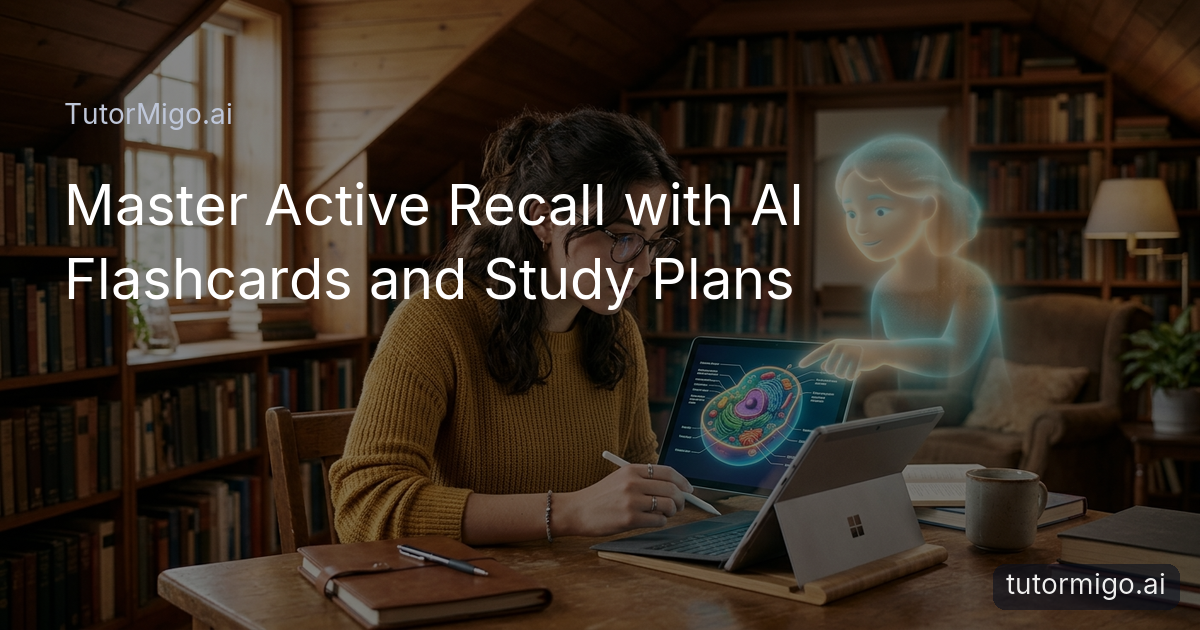
To break this cycle, you need to switch to active recall. Active recall is the practice of testing yourself on the material you are trying to learn. Instead of looking at the answer, you force your brain to retrieve the information from memory. This process strengthens the neural pathways associated with that knowledge. Imagine you are studying biology; instead of reading a list of cell parts, you look at a blank diagram and try to name every part from memory. It’s harder, yes, but that extra effort is exactly what makes the memory permanent. By using an AI Tutor to facilitate this process, you can move away from passive reading and toward a dynamic learning experience that actually yields results.
The beauty of active recall is that it reveals exactly what you don't know. When you struggle to remember a fact, your brain flags it as important, making it more likely that you will remember it the next time you see the answer. This is the foundation of effective learning, and it is the first step toward transforming your study habits from a chore into a high-impact activity.
Use AI to Turn Dense Lessons into Clear, Useful Summaries
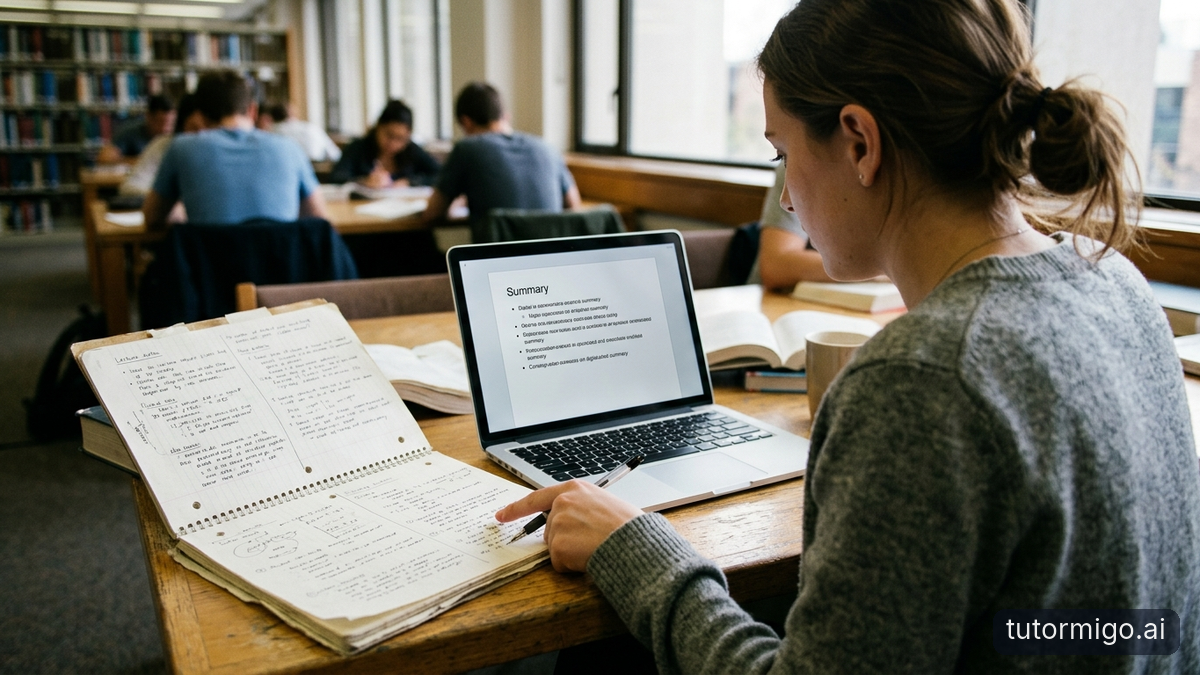
One of the biggest hurdles in studying is the sheer volume of information. When you're faced with a fifty-page chapter on the Industrial Revolution or a complex scientific paper, it’s easy to get overwhelmed. You might find yourself trying to write down everything, which is just another form of passive learning. This is where AI becomes a game-changer. By using AI to generate summaries, you can quickly distill dense lessons into their most essential components, allowing you to focus on the "big picture" before diving into the details.
An AI Tutor can analyze your text and pull out the key concepts, dates, and definitions that are most likely to appear on an exam. For instance, if you are studying literature, you can use AI to summarize the themes and character arcs of a novel, giving you a clear framework to build upon. This isn't about taking shortcuts; it's about creating a roadmap for your brain. Once you have a clear summary, you can use it as a prompt for your active recall sessions. You can look at a summary point and ask yourself, "Can I explain the reasoning behind this event?"
Understanding the core of a lesson is vital for smooth lesson understanding. When you use AI to strip away the fluff, you are left with the high-value information that actually matters. This allows you to spend less time reading and more time engaging with the material. Instead of getting lost in the weeds of a textbook, you can spend your energy on the actual work of learning and remembering, ensuring that every minute of your study session counts toward your final grade.
Build a Flashcards Study Deck That Tests What You Actually Know
Once you have your summaries, the next logical step is to turn that information into a flashcards study deck. Flashcards are one of the most powerful tools for active recall, but only if they are designed correctly. Many students make the mistake of putting too much information on a single card, which leads to "recognition" rather than "recall." If a card has a whole paragraph on the back, you might read the first few words and think, "Yeah, I know the rest," without actually proving it to yourself.
AI helps you avoid this trap by breaking down your notes into "atomic" flashcards—cards that focus on a single, specific concept. For example, instead of a card that asks, "Describe the process of photosynthesis," an AI-generated deck might have five separate cards: "Where does photosynthesis occur?", "What are the primary reactants?", and "What is the main byproduct?". This forced specificity ensures that you are testing your knowledge of every individual component. When you engage in a flashcards study session, you are building a robust network of facts that are easy to retrieve under pressure.
Using a digital platform like TutorMigo.ai allows you to carry your entire library of knowledge in your pocket. You can flip through a few cards while waiting for the bus or during a lunch break. Because the AI helps you create these cards instantly from your uploaded notes, you save hours of manual writing. This means you can start the actual process of memorization much sooner, giving you a significant head start on your exam preparation. The goal is to make the retrieval process as seamless and frequent as possible.
Create Practice Questions That Reveal Your Knowledge Gaps
Flashcards are excellent for facts and vocabulary, but for deeper understanding, you need practice questions. Practice questions force you to apply what you’ve learned in new contexts, which is exactly what happens on a real exam. If you only study flashcards, you might know the definition of a concept but struggle to use it to solve a problem. AI can bridge this gap by generating a variety of question types—multiple-choice, short answer, and even essay prompts—based on your specific study material.
Imagine you are preparing for a history exam. You can ask the AI to generate questions that compare two different historical figures or ask you to analyze the causes of a specific conflict. This level of engagement goes beyond simple memorization; it requires synthesis and critical thinking. When you get a question wrong, the AI doesn't just give you the answer; it can explain *why* you were wrong and provide the context needed to fix the misunderstanding. This immediate feedback loop is essential for closing knowledge gaps before they become a problem on test day.
For students tackling high-stakes assessments, using AI to simulate the exam environment is a proven strategy for IELTS success or other standardized tests. By seeing how questions are phrased and learning to navigate different formats, you build the confidence needed to perform well. Practice questions act as a "stress test" for your knowledge, ensuring that your understanding is deep enough to withstand the pressure of a timed exam. It turns your study sessions into a series of small victories that build toward your ultimate goal.
Use Spaced Repetition and a Personalized Study Plan to Strengthen Retention
Even the best active recall session won't help if you only do it once. Human memory follows a predictable pattern called the "forgetting curve." We lose a significant portion of what we learn within 24 hours unless we review it. To combat this, you need spaced repetition. Spaced repetition is the practice of reviewing information at increasing intervals—first after one day, then three days, then a week, and so on. This technique "tricks" your brain into moving information from short-term to long-term memory.
Manually tracking when to review hundreds of flashcards is nearly impossible. This is where a personalized study plan powered by AI becomes indispensable. The AI tracks your performance on every card and question. If you get a card right easily, it schedules the next review for several days later. If you struggle, it brings the card back into your rotation the very next day. This ensures that you are always focusing on your weakest areas while maintaining your strengths. It’s the most efficient way to study because it prevents you from wasting time on things you already know perfectly.
For long-term goals, such as a 6-week SAT prep strategy, this systematic approach is the difference between cramming and true mastery. A personalized plan takes the guesswork out of your schedule. You don't have to wonder, "What should I study today?" The AI tells you exactly which topics are due for review. This structure reduces study anxiety and ensures that by the time your exam arrives, you have reviewed every single piece of material at the optimal time for maximum retention.
Make Your Next Review Count with Better Habits and AI Feedback
The final piece of the puzzle is consistency. Even the most advanced AI tools can't help if you don't use them regularly. Building a habit of daily review is the key to academic success. Try to set aside a specific time each day for your flashcards study and practice questions. Even fifteen minutes of focused active recall is more effective than three hours of passive reading on a Sunday night. When you make studying a daily habit, the material becomes a part of your long-term knowledge base rather than something you are just trying to "rent" for an exam.
During these sessions, don't be afraid to ask for help. If you encounter a concept that simply won't stick, use your AI Tutor to explain it in a different way. You can ask it to "explain like I'm five" or provide a real-world analogy. This interactive feedback ensures that you aren't just memorizing words you don't understand. True learning happens when you can connect new information to things you already know. The AI acts as a supportive coach, providing the hints and explanations you need to overcome mental blocks without giving away the answers too easily.
To get started, pick one subject you are currently struggling with. Upload your notes to TutorMigo.ai, generate a summary, and create your first deck of flashcards. Commit to reviewing them for just ten minutes tomorrow morning. Once you see how much more you remember compared to your old methods, you’ll never want to go back to passive studying again. Your brain is a muscle—start giving it the workout it deserves, and watch your grades reflect your hard work.
| Method | Effort Level | Retention Rate | Best Use Case |
|---|---|---|---|
| Re-reading Notes | Low | Low | Initial exposure to new topics |
| Highlighting Text | Low | Low to Medium | Identifying key vocabulary |
| Flashcards Study | High | High | Memorizing facts and formulas |
| Practice Questions | Very High | Very High | Exam preparation and application |
Pros and cons
Pros
- Drastically reduces time spent on manual note-taking.
- Automates the complex scheduling of spaced repetition.
- Provides instant, objective feedback on your knowledge gaps.
Cons and limitations
- Requires high-quality source material for accurate AI generation.
- Initial setup of a study plan takes time and discipline.
- Risk of focusing too much on memorization over deep conceptual understanding.
Frequently asked questions
Active recall is the process of challenging your brain to retrieve information from memory rather than just looking at it. It is more effective than re-reading because it builds stronger neural connections, making the information easier to recall during high-pressure situations like exams.
AI helps by analyzing your performance on each card. It identifies which concepts you find difficult and schedules those for more frequent review, while pushing back the cards you know well. This ensures you spend your time where it is needed most.
Yes, AI can generate a personalized study plan by looking at your exam dates and the volume of material you need to cover. It breaks the content into manageable daily tasks and incorporates spaced repetition to ensure you don't forget early lessons as you move forward.
Explore TutorMigo
Enjoyed this read?
Like, share, or comment below.


Comments
0Sign in required · respectful discussion · replies supported
Loading comments…