

Homework Help: Find the Learning Gap When Explanations Don’t Work

You have explained the homework twice, but your child still stares at the page. Repeating yourself more slowly is not helping. A guided conversation with an AI tutor can make practice interactive: uncover the confusing step, offer a small hint, and adjust the next question to what your child actually understands.
Before opening a chat, ask your child to show where the problem stops making sense. Try, “What is this question asking?” followed by, “Show me the first thing you would do.” Listen without correcting immediately. A wrong answer gives you more useful information when you can hear the reasoning behind it.
Notice whether the difficulty involves the instructions, an unfamiliar word, a missing skill, or choosing a method. A child who can explain fractions using a drawing but struggles with symbols needs different support from one who cannot identify equal parts. These are clues, not a diagnosis.
Write one narrow goal for the session: “Explain why fraction pieces must be the same size before adding them.” That gives you something clearer to work toward than “finish the worksheet.” If your child is exhausted or upset, take a break first; frustration can hide what they already know.
How an AI Tutor for Kids Can Adapt to Your Child’s Understanding and Pace

Personalization is easiest to understand as a repeating cycle: ask, listen, adjust. A conversational tool uses the instructions and responses you provide to shape its next explanation or question. It does not read your child’s mind, and a confident response does not prove it has identified the right learning gap.
Start with useful context rather than a whole worksheet. You might write, “My child recognizes equal parts in a picture but adds fraction denominators. Ask one question at a time and use a drawing-based explanation before symbols.” Share only the learning details needed, not identifying information.
If your child answers comfortably, request a slightly different problem. If the answer reveals confusion, ask for a smaller step or a different representation. If the explanation becomes too wordy, request one short question and wait while your child works on paper.
This is personalized learning at home in practical terms: changing the support in response to evidence, rather than assigning more of the same. You still set the pace. Pause the conversation whenever your child needs thinking time, and avoid treating a quick reply as a deadline to respond. Slower, thoughtful work can be more useful than a rapid exchange.
Ask for Hints and Follow-Up Questions, Not Homework Answers
Set the ground rules before entering the homework question. Ask the tool to withhold the final answer, offer one hint at a time, and wait for your child’s attempt. These instructions can help, but they are not guaranteed safeguards. Stay nearby and redirect the conversation if a full solution appears.
A useful starting prompt is: “Help my child think through this problem. First ask what they notice. Then offer the smallest useful hint. After each attempt, ask them to explain their reasoning. Do not complete the problem for them.” Let your child speak or write the response rather than answering on their behalf.
Good follow-up questions uncover thinking: “Why did you choose that step?” or “What would your drawing look like?” Avoid a string of leading questions that makes the answer obvious. Your child should still have a genuine decision to make. For more examples, see this guide to getting unstuck with hints instead of answers.
When a hint does not help, do not simply request a bigger hint. Ask your child which word or step remains confusing. That response may show that you need to return to an earlier idea rather than reveal more of the solution.
A Fractions Homework Example: Adjusting Practice Based on Your Child’s Responses
Suppose the homework asks your child to calculate . They write because they have added both the numerators and denominators. Rather than asking the tool to correct it, ask it to explore what the denominators mean using equal-sized paper circles.
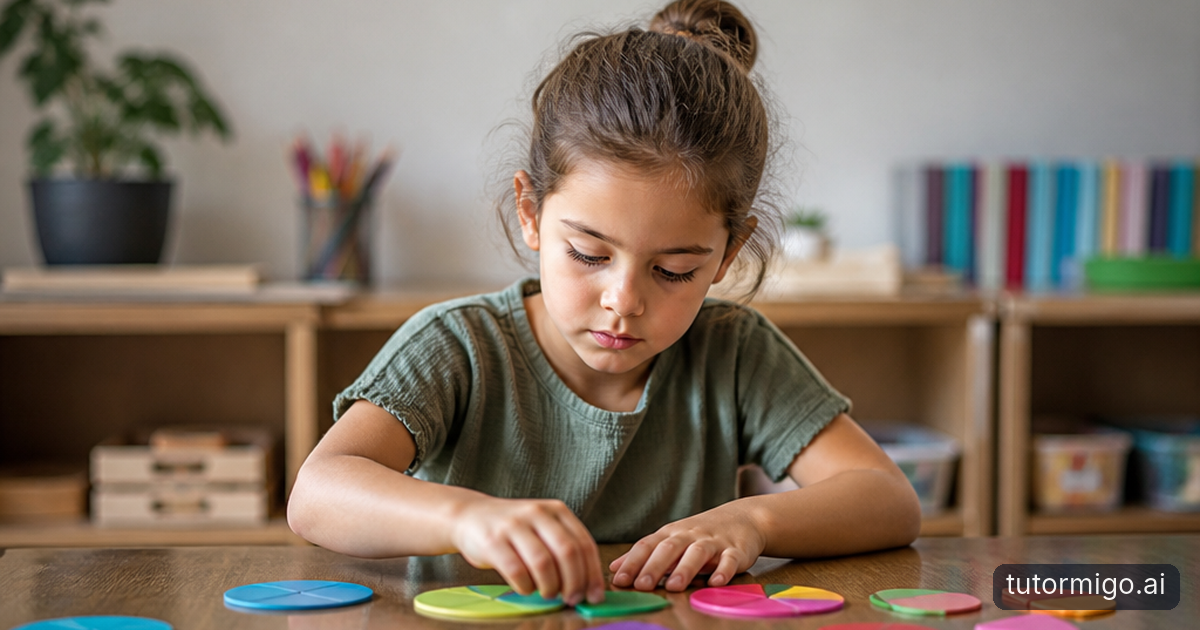
Have your child divide one circle into halves and another into quarters. Ask, “Are these pieces the same size?” Then invite them to divide the half-circle piece into quarters. The key discovery is that . Once they see matching pieces, they can work toward .
Now adjust the practice. If your child cannot explain why the half became two quarters, stay with folding and matching pieces. Request another visual question, not a harder calculation. If they explain it clearly but make a counting error, keep the concept steady and practice counting equal parts.
If they solve it independently, try and ask what must change before adding. Do not introduce several new difficulties at once. This next response tells you whether the idea transfers or whether your child was copying the previous steps. Keep the paper models available, but let your child decide whether to use them.
Check the AI’s Accuracy While Keeping Your Child in Charge of the Thinking
AI explanations can be wrong, incomplete, or poorly matched to the method taught in class. Check the question was entered correctly, including any diagram or instruction. Compare the suggested method with your child’s class notes or textbook. If they differ, pause to understand the difference rather than assuming either method is automatically wrong.
For the fractions example, use a drawing and a size check. Adding a positive quarter to a half should produce an amount larger than a half but smaller than a whole. That estimate helps your child question a result without relying solely on another generated explanation. Asking the same tool “Are you sure?” is not an independent check.
Keep ownership visible: your child holds the pencil, explains the next step, and decides whether the answer makes sense. You can ask, “What evidence supports that?” instead of announcing that the screen is correct. If neither of you can verify a claim, mark it for the teacher.
Modern study tools for students are most useful when they support reasoning rather than replace it. Follow school rules on outside help, and close or cover the explanation before your child attempts a fresh problem. Keep private school documents out of the chat.
Look for Real Understanding, Not Just More Correct Answers
A completed page can hide a shaky idea. To judge whether the session helped, compare what your child can do before and after support. At the start, note the mistake and how much prompting they need. At the end, use a similar but unfamiliar problem without leaving the worked example visible.
Ask for an explanation as well as an answer. “Why do the pieces need matching sizes?” reveals more than “Did you get it?” Your child might explain through words, a drawing, or paper pieces. What matters is whether the explanation connects the method to its meaning, not whether it sounds polished.
You can also show an intentionally incorrect solution and ask your child to find the problem. In the fractions example, ask why adding denominators changes the size of the pieces. If your child only repeats a rule, return to the model rather than counting that repetition as mastery.
Check again the next day with one short question. A useful progress note might say, “Explained equal parts independently; still needed a reminder to rename the fraction.” Look for less prompting, clearer explanations, and successful transfer over several attempts. One good session is encouraging evidence, not proof of lasting understanding.
Try One Supervised Homework Session, Then Review What Your Child Learned
Choose one sticking point and set aside about fifteen minutes, rather than handing over an entire homework routine. Begin with your child’s own attempt. Ask what feels confusing, agree on a small goal, and tell them the conversation is for exploring their thinking—not racing to finish or avoiding mistakes.
Spend the middle of the session on one guided example. Request a question, wait for your child’s response, and adjust the support accordingly. Keep paper or simple objects nearby. If frustration rises, pause; a shorter session that preserves curiosity is more useful than pushing through several problems with increasing help.
Finish with one independent attempt and a brief review: “What makes more sense now? What still needs work?” Record the skill, the support needed, and one question to revisit tomorrow. Ask your child which explanation helped, too. That feedback gives you a practical starting point for the next session and something specific to share with their teacher if confusion persists.
If you want a place to continue these supervised conversations, TutorMigo.ai offers a personalized tutoring workspace with session history. Whatever tool you choose, keep the same test: can your child explain and apply the idea with less help afterward?
Frequently asked questions
For your first session, stay alongside your child to check explanations, notice confusion, and prevent the conversation from becoming answer-copying.
Cover the solution, restate the request for one hint at a time, and use a fresh problem to check independent thinking.
Keep a specific example of the difficulty and discuss it with their teacher. More generated practice is not always the right next step.
Explore TutorMigo
Enjoyed this read?
Like, share, or comment below.



Comments
0Sign in required · respectful discussion · replies supported
Loading comments…