

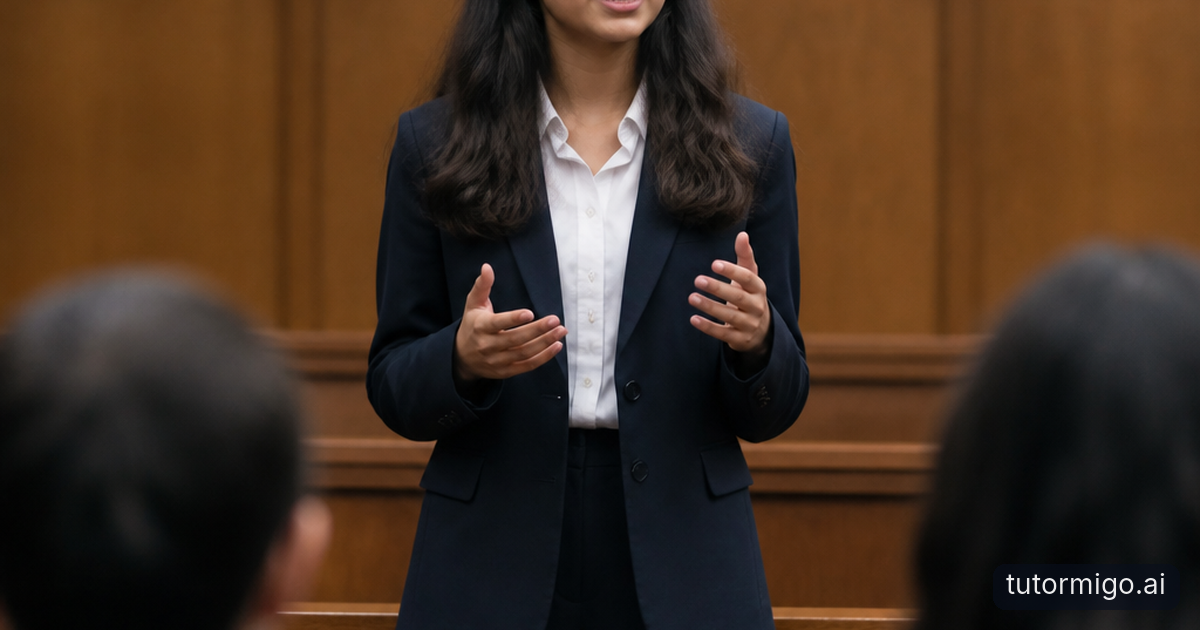
Why Strong Essays Don’t Always Translate Into Confident Public Speaking

You know your argument until someone asks you to defend it aloud. Suddenly, your carefully organized ideas disappear behind a racing heartbeat. AI debate practice can give you a manageable way to rehearse that moment: explain a position, face a challenge, and try again without making every attempt a public performance.
A persuasive essay gives you time to revise. Speaking asks you to organize your thoughts while someone else is listening. You must remember your point, choose clear language, and respond to what was actually said. Struggling with those demands does not mean your ideas are weak; it means you need practice delivering them under different conditions.
Imagine defending a later school start time. On paper, you have three polished paragraphs. Out loud, someone asks how the change would affect after-school transport, and you lose your place. The missing skill is not necessarily knowledge. It may be recovering your structure when an unexpected question interrupts your plan.
Start with a smaller goal than sounding fearless. Aim to state one claim, explain one reason, and finish without apologizing for speaking. Parents and coaches can support that goal by asking, “What point did you make clearly?” before discussing mistakes. Confidence becomes more believable when you can identify a specific improvement rather than simply being told to feel confident.
How Spontaneous Debate Builds Critical Thinking and Faster Responses

Spontaneous argumentation makes you do more than retrieve a prepared speech. You have to identify the other person's strongest point, decide whether it challenges your claim, and choose a relevant response. That repeated shift between listening, evaluating, and explaining exercises cognitive flexibility: the ability to change your approach when new information arrives.
Consider a debate about restricting phones during lessons. You argue that restrictions reduce distractions. Your counterpart raises emergency communication. A weak response repeats that phones are distracting. A stronger response acknowledges the concern, distinguishes classroom use from emergency access, and proposes an exception. You have refined your position instead of simply defending its original wording.
Faster responses should come from a reliable thinking routine, not pressure to speak immediately. Pause, summarize the objection fairly, and answer its central point. You might say, “Your concern is that students need emergency access. My proposal limits routine use, not access through the school office.” That opening shows you listened and gives your answer direction.
A useful critical thinking AI practice routine also includes switching sides. After defending phone restrictions, explain the strongest argument against them. You may discover an assumption you overlooked. Coaches can extend this exercise using a structured classroom debate format, so private rehearsal leads into discussion with real listeners.
TutorMigo Benefits in Action: Start AI Debate Practice with Voice Match
Voice-based debate has an appealing workflow: choose a topic, turn on voice mode, and defend your position against a responsive counterpart. However, TutorMigo.ai's confirmed feature list does not establish a Debate feature, a Voice Match toggle, or live audio debate. If you are searching for Voice Match learning, check current product availability rather than assuming those controls exist.
You can still build a practical rehearsal around the confirmed AI Tutor Workspace, which provides personalized tutoring chat and session history. Choose a focused question such as, “Should our school limit phone use during lessons?” Then ask the AI Tutor to challenge your position with one counterargument at a time. Keep the topic narrow enough to address in a short practice round.
Read each challenge, respond aloud away from the keyboard, and then type a faithful summary of your answer. Do not polish the summary into the speech you wish you had given. Keeping it close to your spoken response makes the next discussion more useful. This is a text-supported speaking exercise, not a claim of built-in voice interaction.
One of the relevant TutorMigo.ai benefits is session history: you can revisit the conversation and review earlier arguments before another attempt. Keep a brief note of your own speaking goal, such as answering the objection before adding another example. That gives the next rehearsal a clear purpose.
What the AI Judge’s Final Verdict Reveals About Your Logic, Rhetoric, and Evidence
A final verdict can feel satisfying, but “you won” tells you less than a clear explanation of what worked. TutorMigo.ai's confirmed features do not establish an automated debate judge or scoring system. In a tutoring chat, you can instead request an assessment of the argument you supplied, treating the response as feedback to inspect rather than an official result.
Ask for three separate lenses: logic, rhetoric, and evidence. Logic concerns whether your reasons support your conclusion. Rhetoric concerns how clearly and persuasively you express those reasons. Evidence concerns whether your factual support is relevant, trustworthy, and sufficient. Separating these lenses helps prevent a confident delivery from hiding a weak argument.
For example, “Everyone learns better without phones” is clear but overbroad. Your logic needs to account for legitimate classroom uses, and your evidence needs to support the learning claim. A more defensible position might restrict noninstructional use while allowing teacher-directed activities. That revision narrows the claim instead of merely making it sound stronger.
Give the AI Tutor a specific request: “Identify my strongest reason, one unsupported assumption, and the counterargument I did not answer.” Verify factual claims against reliable sources yourself. Also remember that typed summaries cannot establish how your voice sounded, how long you paused, or whether your delivery connected with a live audience.
How to Use Debate Feedback to Improve Public Speaking Skills
Feedback becomes useful when it changes your next attempt. Resist the temptation to fix your evidence, structure, vocabulary, pace, and posture all at once. Choose one argument goal and one delivery goal. For example, answer the main objection directly, then deliver that answer slowly enough for a listener to follow.
Suppose feedback suggests that your response about school phone rules ignored accessibility needs. First, revise the substance: acknowledge that some students need devices for specific learning or communication purposes. Next, rehearse a concise response that includes an appropriate exception. Your improvement is not just smoother speaking; it is a position that accounts for a real concern.
Use a short repeat-and-compare routine. Speak your revised answer aloud, write down the central claim you actually delivered, and compare it with your earlier version. Ask whether you addressed the objection sooner and whether your example supported the claim. Repeating the same challenge can reveal progress more clearly than constantly switching topics.
Parents and coaches can add the human feedback that text cannot provide. Ask a listener to summarize your position after you speak. If their summary differs from your intended message, clarify the structure before adding more detail. To improve public speaking skills, measure understandable communication—not just fewer pauses. The same principle underlies building learning confidence through small, manageable successes.
Your Next Step: Choose a Topic and Argue Your Side Out Loud
Your next practice session does not need a tournament motion or an audience. Choose a question you understand well enough to discuss without inventing facts. School phone policies, homework expectations, or student participation in school decisions can work if you keep the question specific. Write your position in one sentence before you begin.
Open TutorMigo.ai's AI Tutor Workspace and request a focused challenge: “I support allowing students a role in school policy decisions. Give me one strong counterargument, then wait for my response.” Say your answer aloud before typing its summary. This preserves the speaking practice while using the confirmed chat-based workspace, rather than assuming live audio controls are available.
After a few exchanges, ask which objection you handled least effectively and why. Check any factual claims you relied on, revise that answer, and speak it again. Finish by noting one improvement and one target for the next session. A useful target is observable: “I will explain how my evidence supports my claim,” rather than “I will sound more impressive.”
Then take the argument to a parent, coach, or teammate and invite a follow-up question. Private rehearsal is preparation for that human exchange, not a replacement for it. Start with one topic and one spoken response today. The goal is not to become unshakeable overnight; it is to learn that you can face a challenge, reconsider your reasoning, and keep speaking.
Frequently asked questions
The confirmed feature list supplied for this article does not establish Voice Match, live audio debates, or an automated debate judge. Check current product availability before expecting those functions. The confirmed AI Tutor Workspace supports personalized tutoring chat and session history.
Ask for one counterargument, answer it aloud, and then type an accurate summary of what you said. Use feedback on that summary to revise your reasoning, and ask a human listener for feedback on your delivery.
Treat it as a perspective to examine, not an authoritative verdict. Ask for specific reasoning, verify factual claims with reliable sources, and distinguish feedback on your argument from feedback on vocal delivery.
Agree on one small practice goal and let the student finish before offering feedback. Identify one clear strength, ask one genuine follow-up question, and choose one improvement for the next attempt.
Related reading
Enjoyed this read?
Like, share, or comment below.



Comments
0Sign in required · respectful discussion · replies supported
Loading comments…