

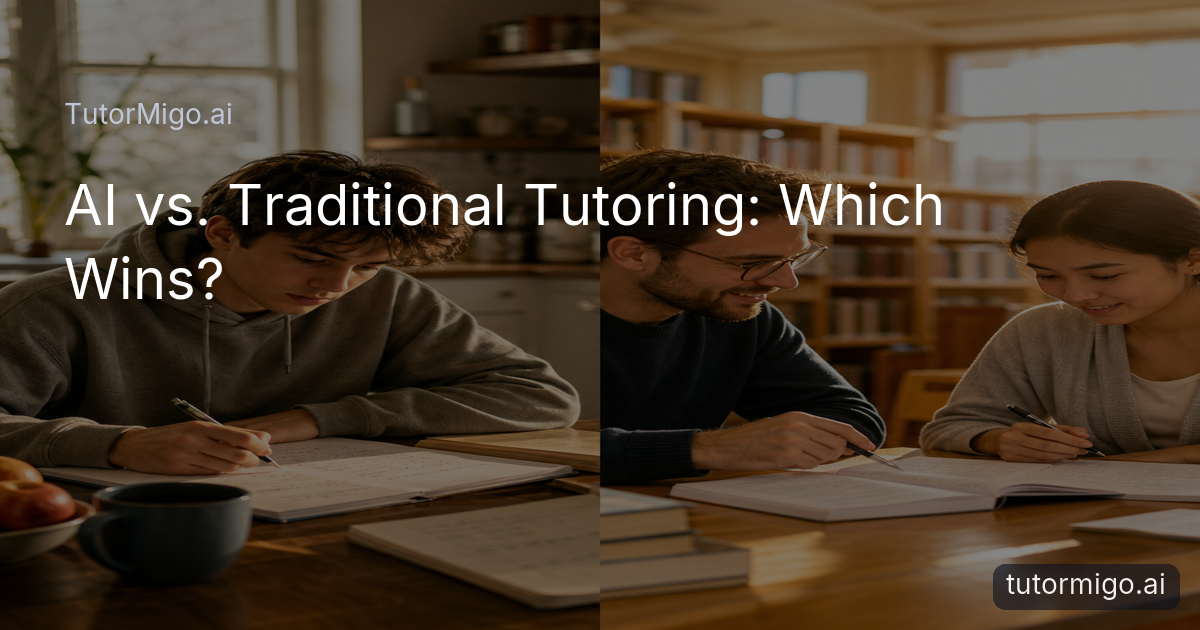
The real choice: finding your fit with tutormago ai

If you are deciding between AI tutoring and traditional tutoring, the hardest part is usually not finding options. It is figuring out which kind of support will help you keep going when a topic feels confusing, your schedule changes, or you need feedback right away. The better choice depends on how you learn and what kind of problem you are trying to solve.
Traditional tutoring gives you a person who can notice hesitation, change an explanation on the spot, and respond to emotional or motivational cues. AI tutoring gives you immediate access to explanations, practice conversations, and repeated help without arranging another appointment. Neither option is automatically better for every learner.
For example, a student who needs weekly accountability before a major assessment may benefit from a regular human relationship. An adult learner studying after work may value being able to ask the same question at 10:30 p.m. without waiting for an open time slot. Start by naming your main need: understanding, practice, accountability, confidence, or expert judgment. Then compare each option against that need instead of asking which technology is most impressive.
Availability and cost change the calculation

Access is one of the clearest differences. Traditional tutoring usually depends on a tutor’s schedule, a shared location or video appointment, and enough time to make each session worthwhile. That structure can be helpful because it creates a commitment, but it can also make short questions feel too expensive or inconvenient to ask.
AI tutoring is generally more flexible for quick explanations and repeated attempts. You can revisit a difficult idea, ask for a simpler example, or work through a problem when your concentration is strongest. This is especially useful when your study pattern is uneven: perhaps you have twenty minutes before work on Tuesday and a longer session on Sunday.
Cost deserves a careful comparison rather than a simple “cheaper is better” conclusion. A human tutor may provide deeper intervention in one session, while an AI tool may offer more frequent low-friction practice. Consider the total value of the support you will actually use. If you regularly postpone scheduled lessons, flexibility may matter more than a lower hourly rate. If you need someone to keep you accountable, the structure of scheduled sessions may justify the expense.
Practical tip: Track when you get stuck for one week. Note the time, subject, and kind of help you needed. Your pattern will reveal whether access or personal guidance is the bigger issue.
Personalization is not the same as personal attention
Both approaches can be personalized, but they personalize in different ways. A traditional tutor can listen to your explanation, notice that you are guessing rather than understanding, and decide to change the lesson immediately. They may use a story, draw a diagram, or pause to ask what feels unclear before continuing.
AI tutoring can personalize the conversation by responding to your questions, adjusting an explanation, and offering different ways to approach the same idea. A workspace with session history can also make it easier to return to earlier discussions rather than starting from nothing each time. Expert personas may help you request a particular style of explanation, such as a patient coach or a concise subject specialist.
Still, personalization depends on the quality of your input. “I don’t get algebra” gives less useful direction than “I can expand the brackets, but I lose track of the negative sign.” Be specific about what you tried and where you became uncertain. Also remember that personal attention includes nonacademic support: a human can notice anxiety, avoidance, or overconfidence in ways an automated exchange may not reliably detect. Choose AI for responsive practice and explanations; choose a person when observation and judgment are central to the problem.
Feedback, mistakes, and confidence need different support
Feedback is valuable only when it helps you make a better next attempt. AI tutoring can respond quickly, which makes it useful for checking your reasoning while the steps are still fresh. You can ask why an answer is wrong, request a worked example, and try again immediately. That short feedback loop can prevent a small misunderstanding from becoming a week-long gap.
Traditional tutors bring a different strength: they can interpret the mistake in context. If you repeatedly choose the wrong method, a tutor may realize that the issue is not the current exercise but a missing foundation. They can decide whether to slow down, revisit prerequisite knowledge, or give you a challenge that tests whether the idea has transferred.
Confidence also matters. Some learners ask more questions when there is no fear of embarrassment, making AI a comfortable place to rehearse. Others need a person to recognize effort, challenge avoidance, and provide encouragement that feels genuinely relational. A useful routine is to attempt a problem independently first, request a hint rather than the answer, and explain the final solution in your own words. If you still cannot identify the source of the error, bring that specific attempt to a human tutor or teacher.
Where each approach works best
AI tutoring is often strongest for on-demand support: defining an unfamiliar term, comparing two concepts, generating another example, or practicing a skill through several variations. It can be a good companion for learners who already know their goal and can judge whether an explanation makes sense. The ability to revisit a conversation is useful when you want to review how you reached a solution rather than only seeing the final result.
Traditional tutoring is often strongest when the path is uncertain. A human can diagnose a broad pattern of difficulty, design a sequence of lessons, and hold you responsible for returning prepared. This matters when motivation is low, the material is cumulative, or the stakes make reliable oversight important. A tutor can also coordinate explanations with what a teacher or course expects.
Many learners do best with a hybrid routine, even if they use one approach more heavily. You might use AI support for short daily practice, then meet a human tutor every week to review recurring errors and set a realistic plan. Or you might begin with a tutor to build foundations and use AI afterward for independent rehearsal. The point is not to divide every task evenly. Match the tool to the task: rapid repetition for quick support, human judgment for diagnosis, accountability, and complex decisions.
A practical way to make your decision
Before choosing, write down one goal that can be observed. “Get better at math” is too broad; “solve ten linear-equation problems and explain each step without prompts” gives you something to evaluate. Then list the obstacles likely to interfere: limited time, inconsistent motivation, confusing feedback, cost, or difficulty finding a qualified specialist.
Run a small trial rather than making a permanent decision from a single impressive session. For one week, use AI tutoring for three short study blocks. Record whether you received a useful explanation, corrected a mistake, and returned to practice. If you are considering traditional tutoring, ask for a sample conversation about your goal and find out how the tutor checks understanding between sessions.
Use these questions to compare the results:
- Did the support help you attempt the next problem independently?
- Could you explain what you misunderstood and how it was fixed?
- Was the format easy enough to use consistently?
- Did you receive the kind of accountability or reassurance you actually need?
If you want flexible, repeatable help with clear questions, an AI workspace may be a sensible next step. If your main challenge is diagnosis, motivation, or high-stakes guidance, traditional tutoring may be worth prioritizing. TutorMigo.ai offers an AI Tutor Workspace for learners who want personalized tutoring conversations, expert personas, and session history in one place.
| Factor | AI tutoring | Traditional tutoring |
|---|---|---|
| Availability | Usually available on demand for short questions and repeated practice | Depends on a tutor’s schedule, appointment length, and location or video access |
| Personalization | Can respond to questions, adjust explanations, and use expert personas | Can observe hesitation, change methods in real time, and tailor lessons from personal context |
| Continuity | Session history can help you return to earlier conversations | A regular tutor can build a longer-term plan and remember patterns across meetings |
| Feedback | Fast responses support quick retries and low-friction practice | Human judgment can diagnose recurring misconceptions and missing foundations |
| Accountability | Requires you to set goals and return consistently | Scheduled sessions create an external commitment and personal follow-up |
| Best fit | Flexible explanations, review, and frequent independent practice | Diagnosis, motivation, high-stakes guidance, and relationship-based support |
Pros and cons
Pros
- AI tutoring offers flexible access for short questions and repeated practice.
- Traditional tutoring provides human observation, accountability, and contextual judgment.
- A blended approach can match each task with the kind of support it needs.
Cons and limitations
- AI tutoring may not reliably detect emotional needs or broad learning patterns.
- Traditional tutoring can be harder to schedule and may cost more per session.
- The best option depends on your goal, consistency, confidence, and need for oversight.
Frequently asked questions
Not universally. AI tutoring is often better for flexible, repeated explanations and practice, while traditional tutoring is often better for diagnosis, accountability, emotional support, and complex learning decisions.
It can replace some routine support, but it may not replace a human’s ability to observe behavior, interpret broader learning patterns, or provide personal accountability. Your goal and learning habits should guide the choice.
Define one measurable goal and run a short trial. Track whether the support helps you understand mistakes, attempt the next task independently, and study consistently.
Traditional tutoring is especially useful when you need a learning diagnosis, a structured plan, regular accountability, or guidance that depends on observing your confidence and study behavior.
Enjoyed this read?
Like, share, or comment below.



Comments
0Sign in required · respectful discussion · replies supported
Loading comments…