


Why a solved problem can fool you
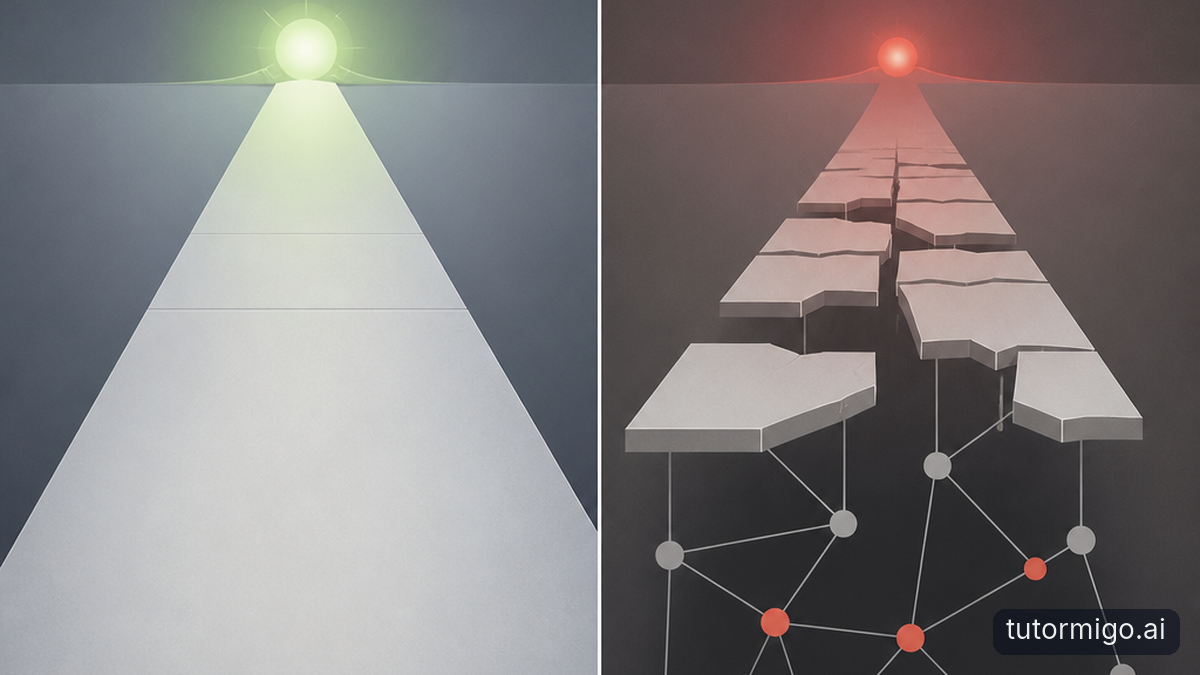
You read a worked algebra proof or watch a chemistry calculation unfold, and every step feels familiar. That feeling is not the same as being able to produce the solution yourself. Recognition is easier than recall: when the steps are already visible, your brain can say, “Yes, that makes sense,” without proving that you know what to do next.
This is the illusion of competence. It often appears after a long study session because exposure feels productive. For example, you might follow a quadratic-factorisation example and understand why the factors multiply to the original expression. Then, on a test, you see and cannot remember whether to factor, complete the square, or use the quadratic formula. The issue is not always missing knowledge; it may be an untested retrieval gap.
The cure is to move quickly from looking at solutions to reconstructing them. The Blank Page Test gives you a simple diagnostic: hide the worked example, start with an empty page, and rebuild the reasoning without copying. An AI Tutor can help analyse the gap afterward, but it should act as a mirror for your thinking, not an answer key that removes the struggle.
Run the Blank Page Test correctly

Choose one problem that represents the skill you are studying. Do not begin with the hardest question in the chapter; select a typical example, such as solving a system of two linear equations or finding the acceleration from a force-and-mass scenario. Read the prompt once, close the solution, and place a blank page in front of you.
Write everything you can recall: the known information, the target, a diagram if one helps, the rule you think applies, and each step in order. If you get stuck, leave a visible gap instead of opening the answer immediately. Write a short note such as “I do not know which quantity to isolate” or “I am unsure why this equation is rearranged.” Those notes are more useful than a page that looks complete but contains copied reasoning.
Set a modest limit, such as eight to twelve minutes, depending on the problem. When time ends, compare your attempt with the solution in three colours: correct reasoning, minor execution error, and missing or unjustified step. The purpose is not to score yourself harshly. It is to distinguish what you can retrieve independently from what only feels familiar while reading.
Helpful rule: Keep the original worked solution out of sight until you have made a genuine attempt. Productive difficulty is the measurement tool.Use AI as a diagnostic mirror
After your blank-page attempt, ask an AI Tutor to inspect your reasoning without immediately solving the problem for you. Paste your work and give a precise instruction: “Identify the first step where my reasoning becomes unsupported. Ask me one question that helps me diagnose it, but do not provide the complete solution.” This keeps the conversation focused on your thinking rather than on producing a polished answer.
Suppose your physics work uses , but you substitute a distance where the problem gives a mass. A useful response should help you notice the units, the meaning of each variable, and the information the question actually provides. You can then revise the step yourself. If you ask only for the answer, you may leave with a correct result and the same misconception.
Follow up with a second prompt: “Classify my gap as a concept gap, setup gap, algebra gap, or attention gap. Give me one short practice question for that category.” Treat the classification as a hypothesis, not a final judgment. Check it by attempting the new question from a blank page. The value of an AI Tutor is the responsive questioning and continuity of the session, while you remain responsible for retrieving, explaining, and checking the reasoning.
For a broader method of locating weak spots, you can also use this guide to finding gaps in your understanding alongside the test.
Separate concept gaps from execution gaps
Not every wrong answer means you need to relearn the entire topic. A concept gap means you cannot explain the principle or choose an appropriate model. An execution gap means you understand the model but make a sign error, arithmetic slip, unit mistake, or skipped algebra step. The Blank Page Test helps you tell these apart because it captures the point where your independent reasoning breaks.
Consider a biology question about enzyme activity. If you cannot explain how temperature affects protein structure, that is a concept gap. If you explain the effect correctly but label the graph’s axes incorrectly, that is an execution gap. The remedies differ: the first calls for a simpler explanation and a new example; the second calls for slower checking and targeted practice.
Ask your AI Tutor to make the distinction visible: “Compare my answer with the target process. List the first missing idea, then list any later calculation or notation errors separately.” Rewrite the missing idea in your own words. For a math problem, explain why the chosen equation fits before substituting values. For science, connect the observation to the mechanism instead of memorising an isolated sentence.
Keep a short error log with three columns: problem type, first breakdown, and next action. “Kinematics, selected the wrong model, classify variables before calculating” is more actionable than “I am bad at physics.” Review the log before your next practice set so the same gap becomes a deliberate target.
Repeat retrieval until the solution travels
One successful blank-page attempt is encouraging, but it does not guarantee durable mastery. Repeat the same skill after a delay, then vary the surface details. For example, solve one linear-system problem today, another tomorrow with different coefficients, and a third later in a word-problem context. You are testing whether the method travels beyond the exact example you just studied.
Spaced-repetition flashcards are useful for the small pieces that support full solutions. Instead of making a card that asks for a definition only, create prompts such as “What clues suggest conservation of momentum?” or “What must be checked after factoring a quadratic?” Include a separate card asking you to explain a common wrong turn. A good answer requires reasoning, not recognition.
Use the flashcard schedule to bring back the prerequisite ideas, then use the Blank Page Test for integrated performance. If a card repeatedly fails, do not simply press through the queue. Ask your AI Tutor for a simpler example, answer it without help, and add the corrected explanation to the card. If you use TutorMigo’s flashcards, AI-assisted card creation can turn your error log into review prompts, while spaced repetition schedules later retrieval.
At the end of each session, rate the problem honestly: recalled independently, recalled with a hint, or recognised only after viewing the solution. The middle category is progress, not mastery. It tells you exactly what to revisit.
Make the reasoning visible with interactive tools
Some STEM gaps stay hidden because your written work is too compressed. An interactive workspace can slow the process down and make each decision inspectable. On a whiteboard, draw the forces, label the known quantities, or map the stages of a biological process before calculating. In a math step editor, enter one transformation at a time instead of jumping from the original expression to the final result.
Imagine solving . Rather than writing immediately, record the subtraction of , then the division by , and check each resulting equation. The simple example is not about difficulty; it trains you to expose the operations that become invisible in a harder problem. If your error begins at one transition, you can correct that transition rather than rereading an entire chapter.
For programming, use a code sandbox to test a short hypothesis and observe where the output differs from your expectation. Before running it, predict the result and explain the relevant variable changes. Then compare the prediction with what happens. That sequence preserves the Blank Page Test: retrieve first, use the tool second, and explain the difference third.
TutorMigo’s interactive study tools fit this workflow because the whiteboard, code sandbox, and math step editor support different kinds of visible reasoning. They do not replace the need to think. They give you a clearer record to inspect with an AI Tutor or teacher.
Turn mistakes into a focused exam plan
Before an exam, students often respond to uncertainty by doing more random questions. A better approach is to organise Blank Page Test results into a short plan. Record the topic, question type, first breakdown, confidence level, and next review date. Then choose practice that matches the breakdown. If you repeatedly misread what a question asks, practise identifying the target before touching the formula. If your setup is sound but your arithmetic fails, include slower, fully written calculations.
Structured exam preparation can make this process easier when your assessment is the SAT, ACT, AP, or IELTS. Use practice sets to identify patterns, then apply the blank-page method to representative questions rather than passively reviewing explanations. Progress tracking is most useful when it shows movement in a specific skill: for example, fewer unsupported setup steps or more questions completed without hints.
Build each study block around three phases: retrieve one earlier skill, attempt a new problem from a blank page, and review only the first meaningful error. Finish by scheduling the next attempt. A 30-minute block with one diagnosed gap can be more valuable than an hour of unfocused answer checking.
You can compare this approach with a longer six-week SAT preparation strategy if you are planning a formal study schedule. The key is to use the schedule to revisit evidence-based gaps, not merely to accumulate completed questions.
Keep progress visible to supporters
Students often say “I studied for two hours,” while parents and teachers need to know what changed during those two hours. A useful progress conversation focuses on evidence: which problem was attempted independently, where did the reasoning break, what hint was needed, and what will be retried next? The Blank Page Test creates that evidence without turning every session into a high-pressure performance.
A parent can ask, “Show me one step you can now explain that was unclear yesterday,” rather than asking only about a score. With appropriate visibility into learning progress and controls, a parent dashboard can support that conversation and help families notice whether review is consistent. The goal is co-learning and encouragement, not taking over the solution.
Teachers can use recurring error categories to decide what needs a mini-lesson or a small-group prompt. If several students choose the right formula but cannot explain the variables, the class may need a modelling activity. If one student has a strong concept explanation but repeated notation errors, targeted feedback is more efficient than assigning the whole unit again.
When using an AI Tutor, share the student’s own attempt and the diagnostic question, not just the final answer. That makes the support more transparent. TutorMigo’s parent and teacher dashboards can provide visibility into progress and assigned learning, while the learner still performs the central act: reconstructing the reasoning.
Choose an AI learning tool for thinking, not shortcuts
General-purpose generative chatbots can be useful for explanations and brainstorming, but choosing an AI learning tool requires looking at the complete study loop. Can you return to a personal tutoring session, see the context of earlier questions, practise the skill again, and track what remains difficult? Can the same workflow support recall, interactive work, and structured preparation instead of producing a single polished response?
Use a simple comparison test. Give the tool a problem you partly understand and ask it not to solve the problem immediately. See whether you can continue the diagnostic conversation, preserve your attempt, and request a similar question later. Then check whether you can turn the mistake into a scheduled review item. The strongest fit is the tool that helps you do more independent work, not the one that gives the fastest final answer.
TutorMigo benefits are clearest when you connect its features: a personalised AI Tutor session for questioning and continuity, interactive tools for visible reasoning, flashcards for spaced retrieval, and exam preparation for structured practice and progress tracking. Parents and teachers can use visibility features to support the learner without replacing the learner’s work.
Start small. Choose one recurring STEM error, run the Blank Page Test three times across a week, and record whether you needed no hint, a prompt, or a full explanation. That evidence will tell you more about mastery than how familiar a solution looked while you were reading it.
Frequently asked questions
It is a retrieval practice method: hide a worked solution, start with an empty page, and reconstruct the problem setup, reasoning, and answer from memory. You compare with the solution only after making a genuine attempt.
Attempt the problem first, then ask the AI Tutor to identify the first unsupported step or ask a diagnostic question. Request a hint or similar practice problem before requesting a complete solution, and retry the problem independently afterward.
Flashcards are useful for definitions, principles, clues, and common errors, but they do not replace full problem solving. Combine spaced-repetition review with Blank Page Tests and interactive work that requires you to set up and explain complete solutions.
Ask the student to reconstruct one representative problem and explain the first decision, not just report study time or a final score. Progress visibility can support this conversation, especially when reviews show whether the student solved independently or needed hints.
Related reading
Enjoyed this read?
Like, share, or comment below.



Comments
0Sign in required · respectful discussion · replies supported
Loading comments…