

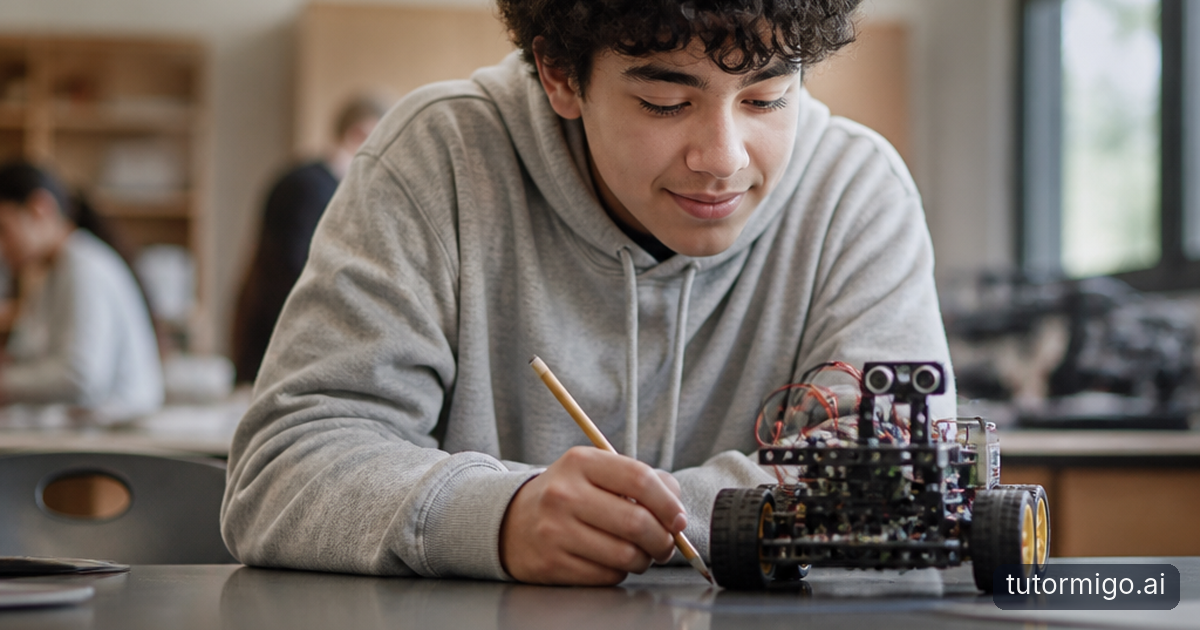
Why helpful chatbots with adaptive ai personas can still lose students

Your student opens a tutoring chat, gets a technically correct answer, and closes it. The problem may not be the subject alone: the interaction feels like another worksheet. Personality-driven AI can offer a more inviting starting point, especially when a learner needs patience, playfulness, or a reason to care before attempting the next question.
A dry interface can make the first few sessions feel repetitive: ask, receive a wall of explanation, repeat. For a reluctant learner, that can reinforce screen fatigue rather than relieve it. More screen time is not necessarily more engagement, and a cheerful greeting cannot rescue an explanation that is too long or poorly paced.
The useful promise behind adaptive AI personas is not that every student needs a cartoon friend. It is that tone, pacing, examples, and the amount of explanation can influence whether a learner participates. One student wants a calm walkthrough; another needs a surprising question before concentrating.
TutorMigo.ai’s AI Tutor Workspace supports expert personas, personalized tutoring chat, and session history. These are concrete starting points for a more individual experience. When comparing TutorMigo benefits, look beyond whether a conversation feels friendly. Ask whether your student attempts another problem, explains an idea, or returns with a question. Those behaviors matter more than enthusiasm about a character.
Rapport makes room for questions, not just answers

Reluctance often protects a student from embarrassment. “This is boring” can be easier to say than “I still do not understand.” A tutoring interaction that welcomes uncertainty may make it easier to expose a misconception before it grows. Emotional safety here means room to ask, revise, and disagree—not a promise that an AI understands feelings like a person.
Imagine your student repeatedly confusing two steps in a math problem. A blunt correction can feel like another failure. A more helpful response might say, “That step trips people up. Show me where the explanation stopped making sense.” The difference is not empty praise; it is an invitation to reveal the sticking point.
Humor can help when it lowers the stakes, but it should never make the student the joke. Tailored encouragement is also more useful when specific: “You checked your reasoning before moving on” gives better feedback than constant declarations of brilliance. An AI Tutor should support thinking rather than make approval the main reward.
For parents and educational psychologists, the practical question is whether rapport changes participation. Does the learner ask a previously avoided question? Can they challenge an answer? Our discussion of why different AI buddy styles can suit different learners offers a useful companion perspective. Warmth matters when it opens a route back to learning.
Sage and Zera: calm structure or curious exploration
Personalized AI learning companions are easier to evaluate through concrete examples. The four names used here describe illustrative companion styles, not confirmed TutorMigo.ai characters or a verified eleven-buddy roster. TutorMigo.ai supports expert personas; check the available choices in the workspace rather than assuming a particular named character is included.
A “Sage” style would be methodical, patient, and visually oriented. For a student who feels anxious about math, you might request: “Give one step at a time, explain why it works, and pause for my attempt.” Pair that conversation with the whiteboard or math step editor in TutorMigo.ai’s Study Tools Hub, so the learner can work through reasoning rather than only read it.
Suppose your student freezes when a problem looks unfamiliar. The useful test is whether a calm explanation helps them identify the first manageable action. Patient tutoring should make space for effort, not quietly complete every step.
A “Zera” style would open science through curiosity and storytelling. Instead of beginning with a definition, ask, “What might happen to a plant kept beside a dim window?” Then have the learner predict, explain, and reconsider. The story provides an entrance; the science supplies the substance. These styles address different moments, not fixed learner categories. A student may want curiosity today and careful structure tomorrow.
Foxy and Nurah: playful practice or reflective inquiry
A “Foxy” style represents high-energy language practice built around imaginative roleplay. A learner who resists isolated vocabulary drills might willingly pretend to order lunch, ask directions, or help a fictional traveler. The practical request is straightforward: “Roleplay a café conversation, keep your replies short, and correct one mistake after each exchange.” This is a suggested tutoring activity, not a claim that TutorMigo.ai includes a separate game system.
Playfulness works best when the learning target stays visible. After the exchange, ask your student to reuse a new phrase without copying it. If the adventure continues but the language never improves, simplify the scenario. A lively persona should create more opportunities to practice, not bury practice beneath entertainment.
A “Nurah” style would approach history reflectively, using cause-and-effect questions rather than a stream of dates. For example: “How might a poor harvest affect food prices, public trust, and political decisions?” Follow with, “What evidence would support that explanation?” The learner has something to reason about, not merely memorize.
Neither approach should become a permanent label. Avoid deciding that your student is “the playful one” or “only learns through stories.” Preferences can change with confidence, energy, and the task. When exploring TutorMigo AI buddies, judge the interaction by what it enables: a fuller answer, a thoughtful question, or another willing attempt.
Keep the personality, check the teaching
A compelling persona is a delivery style, not evidence of instructional quality. Any tutoring tool—including a general-purpose chatbot—should be judged on the accuracy of its explanations, the usefulness of its feedback, and whether the student does meaningful work. Specialized tools and general chatbots can both vary in these respects; branding alone does not settle the comparison.
Standards alignment deserves the same care. Do not assume that every buddy is aligned to Common Core, NGSS, or your state’s academic standards simply because the conversation sounds educational. Check the actual assignment, expected learning objective, and applicable standard with your student’s teacher. The supported feature information does not establish universal standards alignment across TutorMigo.ai personas.
For example, if an assignment asks for an evidence-based scientific explanation, a charming story is only the opening. Your student still needs to connect a claim to observations and reasoning. Ask the tutor to explain its reasoning, then compare important details with class materials. An AI Tutor can be helpful without being an unquestionable authority.
Session history in the AI Tutor Workspace can help you revisit an earlier explanation instead of treating every interaction as unrelated. However, history is not proof that a system has diagnosed a misconception or accurately inferred a mood. Our overview of responsible AI and guided learning provides context for keeping human judgment involved.
Find a fit through one small learning experiment
Start with one task your student usually avoids, not an entire evening of homework. Offer a choice between two approaches: “Would you rather have a calm step-by-step explanation or a playful challenge?” Then keep the learning goal the same. This makes the comparison about support, rather than whether one session happened to cover easier material.
Try a brief session and finish with a small independent attempt. For language practice, that might mean using a phrase in a new sentence. For history, it might mean explaining one cause without rereading the conversation. Ask, “What helped you keep going?” rather than “Did you like the AI?” Enjoyment is useful information, but it is not the whole outcome.
If recall is the obstacle, TutorMigo.ai’s spaced-repetition flashcards offer scheduled review and AI-assisted card creation. If your student needs to show their thinking, the interactive whiteboard or math step editor may be more useful than extending the chat. Parents can also use the Parent Dashboard for visibility into progress, while recognizing that a conversation about effort adds context that a dashboard cannot supply.
Explore the available expert personas in TutorMigo.ai’s AI Tutor Workspace with your student. Choose a style, try one real task, and review what changed. Better student engagement in EdTech should mean more willing, increasingly independent learning—not simply a longer conversation.
Frequently asked questions
The supported product information confirms expert personas, but not an eleven-character roster or the specific names Sage, Zera, Foxy, and Nurah. Here, those names illustrate tutoring styles. Check the workspace for available choices.
No treatment claim is established here. Patient explanations may make practice feel more approachable, but persistent distress deserves support from a teacher or qualified professional.
Look for a willing attempt, a more specific question, or an independent explanation afterward. Enjoying the conversation is encouraging, but it does not demonstrate learning by itself.
Not necessarily. Let the task and your student’s feedback guide the choice. Calm structure may help with one assignment, while curiosity or roleplay may suit another.
Related reading
Enjoyed this read?
Like, share, or comment below.
Comments
0Sign in required · respectful discussion · replies supported
Loading comments…