


Minutes 1–2: Gather tools and list topics for spaced repetition
This morning’s lesson on the forgetting curve explained that memories fade, while spaced reviews give you chances to strengthen them.
Now put that idea to work. You need ten minutes, paper or a phone calendar, and one upcoming test date. Put the test date at the top of your page. Count back to today so you can see your available review days. Your schedule should fit the time you actually have, not the time you wish you had.
Next, list the topics on the test. Use your teacher’s topic list, textbook headings, or recent lessons. Keep each topic small enough to check in a short session. “Chemistry” is too broad. “Atoms and their parts” is useful because you can name a clear question to answer. If a topic contains several different skills, split it before scheduling it.
Choose your first topic now. Pick something you recognize but cannot explain confidently without help. Write one sample question beside it. That question will become your first recall check. Do not spend your ten minutes decorating the page or copying every lesson title: a rough, usable list beats a perfect unfinished one.
Minutes 3–4: Put review days on your calendar

Start with this simple pattern: Day 1, Day 2, Day 4, Day 7, and Day 14. Day 1 means your first review, which can be today. The gaps grow as you get more chances to remember. This is a starting point, not a rule, and it does not guarantee that every topic will be ready for the test.
Write actual dates beside those day numbers. Then check each date against your test and other commitments. If your test is in one week, use the reviews that fit before it. Do not squeeze a later review into a crowded evening just to complete the pattern. A schedule is useful only when you can follow it.
Start different topics on different days. Your first topic might begin today, while another begins tomorrow. Keep early reviews close enough that you can catch confusion before it settles in. Leave some space near the test for topics that turn out to need extra attention.
Add a small, realistic time window to each appointment, such as after your afternoon snack. Write the topic and the action, not just “study.” “Recall the parts of an atom” tells you exactly how to begin when that reminder appears.
Minutes 5–6: Make every review a recall check
For each appointment, write what you will do with your notes closed. You could answer three flashcards, sketch a diagram from memory, explain an idea aloud, or solve a representative question. The important part is trying to produce an answer before looking. Rereading can help you check a mistake afterward, but it should not replace the attempt.
For atoms, try this: draw a simple atom and label its main parts without checking your book. Then compare your answer with your class materials. If something is missing, correct it and explain the correction in your own words. Finish by trying a similar question rather than immediately repeating an answer you have just seen.
Afterward, mark the topic green, yellow, or red. Green means you answered accurately and could explain why. Yellow means you needed a hint, hesitated, or missed part of the answer. Red means you could not get started or had a major misunderstanding. These colors describe today’s performance, not your ability.
Write one short note beside yellow and red marks: “mixed up particle locations,” for example. If you use an AI Tutor, bring that exact difficulty to the session. A specific question gives your next practice a clearer purpose than “help me with chemistry.”
Minutes 7–8: Fill in this chemistry example
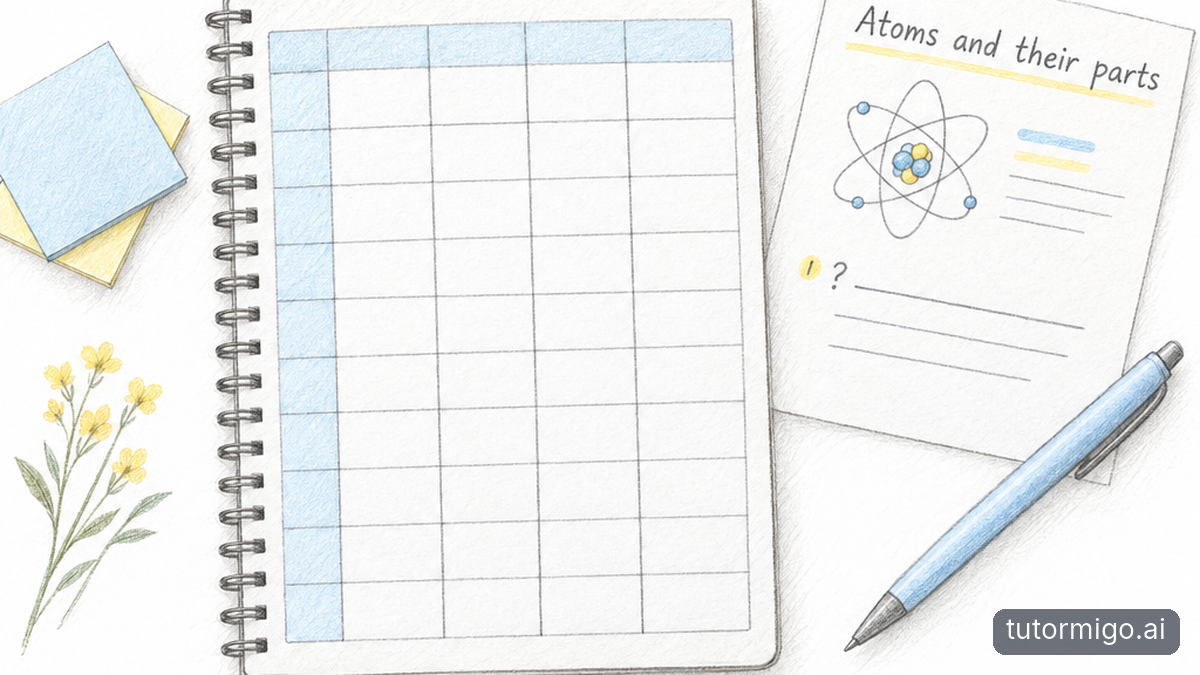
Imagine your chemistry test is fourteen days from today. Today is Day 1, so the test falls on Day 15. Your five topics are atoms, elements, compounds, mixtures, and physical versus chemical changes. The table below spreads their starting days instead of putting every topic into one large session.
Copy or print this markdown schedule template. Replace the day labels with calendar dates, then fill each blank with your color and a short correction after reviewing. The topic names are examples; swap them for the headings your teacher has given you. Keep the schedule somewhere you will see before your usual study time.
| Topic | Review days | Recall task | Color / correction |
|---|---|---|---|
| Atoms | 1, 2, 4, 7, 14 | Draw and label | __________ |
| Elements | 2, 3, 5, 8 | Explain with examples | __________ |
| Compounds | 3, 4, 6, 9 | Explain with examples | __________ |
| Mixtures | 1, 2, 4, 7, 14 | Describe separation methods | __________ |
| Physical/chemical changes | 2, 3, 5, 8 | Classify and explain | __________ |
Notice that later-starting topics do not reach the pattern’s final review before the test. That is fine: do not schedule preparation after the exam. Leave Day 13 available for a short check of yellow and red topics. Add another earlier review if a difficult topic needs it.
For each recall task, prepare one question now. For mixtures, you might explain how to separate sand from water and why that method works. Your answer should show understanding, not just recognition of a familiar flashcard.
Minute 9: Fix the pileup, then try a harder version
Here is the deliberate mistake: scheduling every topic on the same review days. It looks tidy until Tuesday brings five difficult topics, homework, and an evening commitment. You postpone the whole block, and your neat schedule becomes another Sunday cram. The problem is the pileup, not a lack of effort.
Fix it by shifting some starting days and checking the total work on each date. Two short topics can share a day. Five demanding topics probably need spreading out. If you miss a session, move the unfinished topic to your next realistic opening rather than doubling everything tomorrow. Keep the plan manageable enough to restart.
Now try three tasks in order. First, schedule one topic and write its recall question. Next, schedule a full subject, checking for overloaded dates. Finally, add a second subject with an overlapping test. Protect time for both and move reviews where necessary; do not simply stack a second complete timetable onto the first.
Level up using your colors. Bring a red topic back sooner, perhaps tomorrow, with a smaller question and help on the confusing step. Keep yellow topics relatively close. After successful recall, let green topics wait longer. Color changes should come from fresh attempts, not from how familiar your notes look.
Minute 10: Choose your next review
Your schedule is ready when you can point to your next topic, next review time, and first question. Check those three things now. If anything is vague, make it specific before closing the calendar. The goal is not to fill every spare minute. It is to make starting your next useful review easier.
Key Takeaways: Space your attempts, recall before checking, and record green, yellow, or red afterward. Treat the starter pattern as adjustable. When a topic stays red, change the practice or get help rather than repeating the same unsuccessful attempt. When it turns green, check it again after a longer gap.
Your next step 👉 Keeping green/yellow/red tracking going by hand can get messy. TutorMigo.ai’s adaptive practice helps with the “what to review next” part through spaced-repetition flashcard review scheduling. Start a practice session on your reddest topic at TutorMigo.ai. Use its personalized AI Tutor for step-by-step guidance on the point you cannot yet explain.
Among the practical TutorMigo benefits are scheduled flashcard reviews and tutoring session history. Keep your calendar’s test date in view: neither a schedule nor a conversation replaces checking what you can recall independently. Your next color should reflect what you can actually do.
Tomorrow morning: why rereading your notes is the least effective way to study.
Comment question: Which topic went on your red list?
| Review task | Paper or phone calendar | TutorMigo.ai Flashcards |
|---|---|---|
| Prepare recall prompts | Write your own questions and answers. | Use AI-assisted flashcard creation, checking cards against your class materials. |
| Schedule repeat reviews | Enter review dates and adjust them yourself. | Use spaced-repetition flashcard review scheduling. |
| Track this lesson’s colors | Record green, yellow, or red beside each topic. | Keep this color key separately; the lesson does not depend on a built-in traffic-light tracker. |
Frequently asked questions
Use the reviews that fit before the test, such as Days 1, 2, 4, and 7 if timing allows. Do not force the full fourteen-day pattern into one week.
Choose one small part of the most important topic. Review an explanation, attempt a manageable question without notes, and check your answer before moving on.
Yes. Green means successful recall today, not permanent mastery. Give it a longer gap, then check again without looking at the answer first.
Enjoyed this read?
Like, share, or comment below.



Comments
0Sign in required · respectful discussion · replies supported
Loading comments…