


Build a study schedule around your actual week
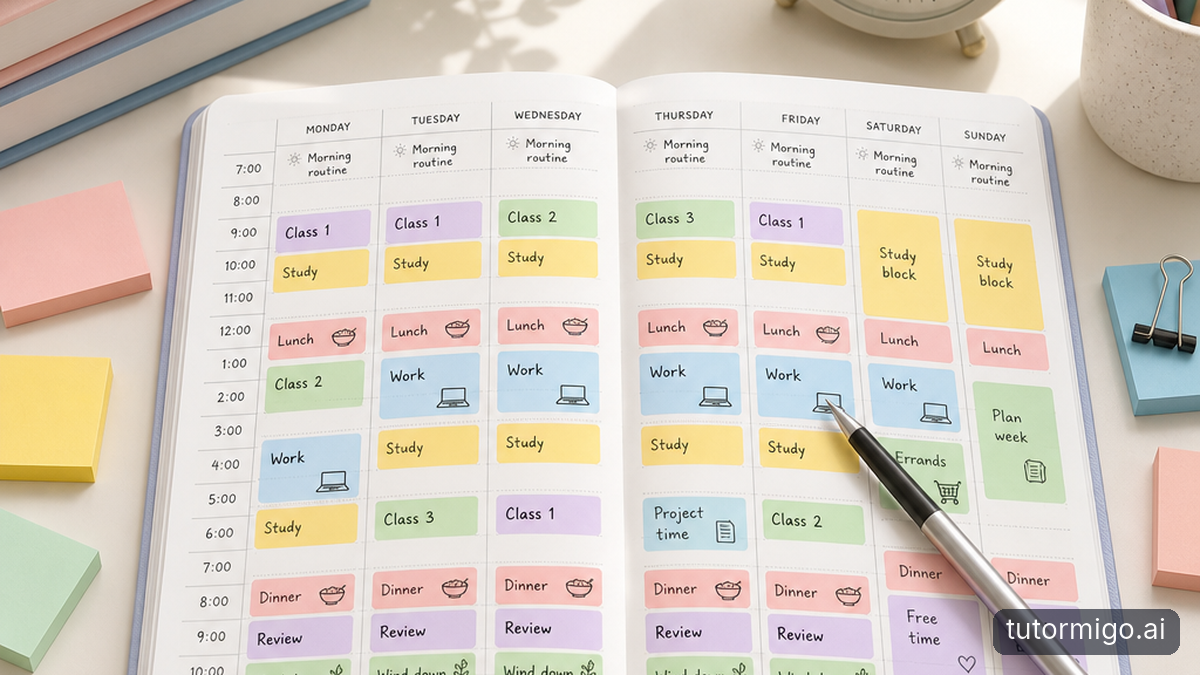
Before choosing study times, mark your existing commitments: classes, work, meals, travel, and rest. Then find a few realistic openings. If you usually feel drained after dinner, don’t make that your main slot for difficult material. Put demanding work where your attention is strongest, even if that window is shorter.
Start smaller than you think you need. For example, reserve Monday and Wednesday afternoons for thirty minutes of focused practice, then Saturday morning for a longer review. Keep one additional opening unassigned so a missed session has somewhere to go. That buffer makes the plan resilient rather than fragile.
Give the week a clear priority, too. “Understand the chapter well enough to explain its main ideas” is more useful than “study more.” If a deadline is approaching, work backward from it and distribute practice across several days. Your schedule should show what matters without filling every free minute.
Give every session a task and a stopping point
A calendar entry that says “study” leaves you another decision to make. Replace it with an observable task: explain one confusing concept, attempt five practice questions, or revisit yesterday’s mistakes. Finish by noting what you completed and the next question to tackle. You’ll spend less time restarting each session.
In TutorMigo.ai, the AI Tutor Workspace offers personalized tutoring chat and session history. You can revisit the earlier conversation, then ask your AI Tutor to focus on the step you still don’t understand. For example, begin Wednesday by checking whether you can now explain Monday’s sticking point without help. This ongoing study workflow makes continuity part of your routine.
Match the activity to the task: sketch on the whiteboard, test an idea in the code sandbox, or work through a solution in the math step editor. General-purpose chatbots can support studying too; when comparing tools, check how easily you can revisit context and move from explanation into practice.
Schedule recall, not just another reading session
Reading can make material feel familiar without showing whether you can retrieve it. Build short recall sessions into your week: close your notes, answer a question, then check your response. Use the result to choose what needs another explanation and what simply needs occasional review.
TutorMigo.ai’s flashcards combine spaced repetition with review scheduling and AI-assisted card creation. Give those reviews a regular place in your calendar rather than treating them as something to do only before a deadline. Keep cards focused on one idea, and check AI-assisted cards against your learning materials. For practical examples, explore using flashcards for recall and study.
If you’re preparing for an exam, reserve a separate block for practice sets and error review. TutorMigo.ai’s structured exam preparation includes practice sets and progress tracking. Use that progress to choose your next focus rather than spreading time equally across everything. A repeated mistake deserves attention; a familiar topic may need only a brief check.
Review your week and choose your next session
Set aside ten minutes at the end of the week to inspect your plan. Ask what you completed, what you can now do without help, and what kept getting postponed. If you missed the same evening slot twice, move it or shorten it. Don’t respond by adding more hours to an already unrealistic calendar.
Use evidence beyond time spent. Can you explain a concept from memory or solve a similar problem independently? Your AI Tutor can support another explanation, but your own attempt shows what to schedule next. During exam preparation, progress tracking can help you identify where to concentrate practice.
If you’re supporting a learner, agree on one useful check-in rather than monitoring every session. TutorMigo.ai’s Parent Dashboard provides progress visibility, while its Teacher Dashboard supports student monitoring and reporting. Turn those observations into one manageable adjustment. To begin today, choose your next available slot, name one task, and leave a short note about where to resume.
Frequently asked questions
Start with a length you can repeat, such as twenty to thirty minutes. Choose one concrete task, then adjust the duration based on your attention and workload.
Use your buffer slot or move the highest-priority task forward. Avoid doubling every remaining session; that can make the rest of the week harder to sustain.
You can discuss a study plan in its personalized tutoring chat. Choose calendar times yourself, using your commitments, energy, and deadlines as constraints.
Review it weekly and make small adjustments. Change a time slot or task when your results show a problem, rather than rebuilding the whole routine after one difficult day.
Enjoyed this read?
Like, share, or comment below.



Comments
0Sign in required · respectful discussion · replies supported
Loading comments…