


When One Lesson Leaves Some Students Behind and Others Unchallenged
One lesson can leave some students confused while others finish without stretching their thinking. Differentiated instruction with AI helps you keep the objective steady while changing support and challenge. Use readiness evidence to shape tutoring prompts, reinforce ideas in several formats, and check classroom progress before choosing your next intervention.
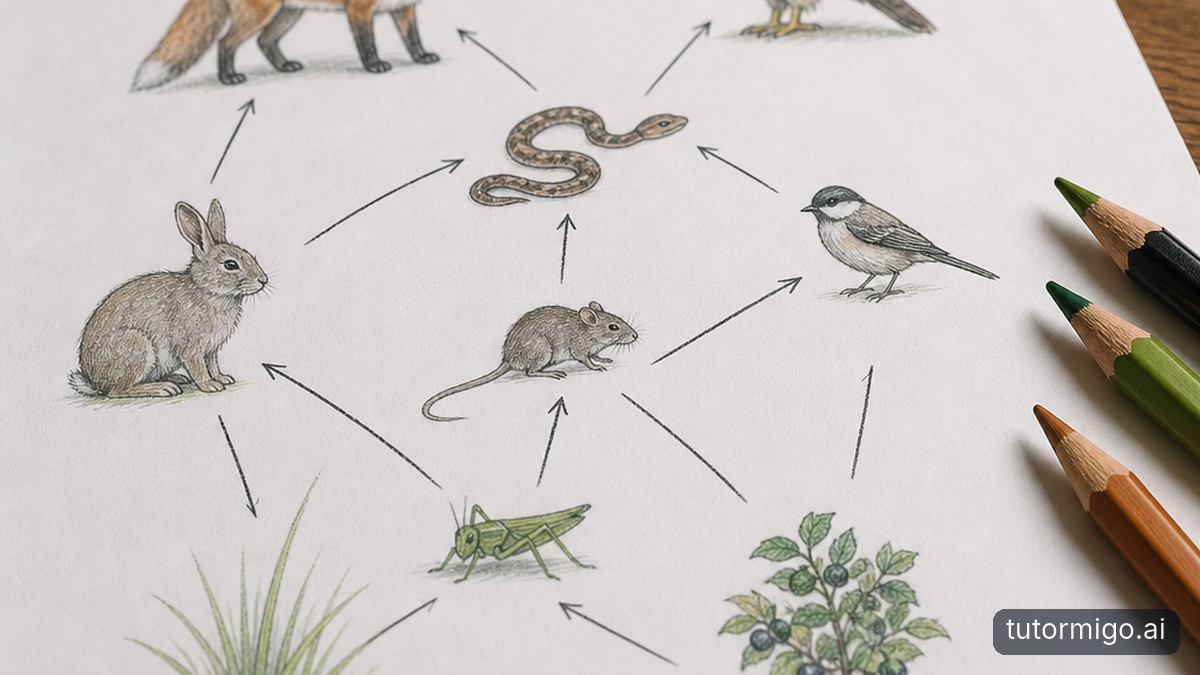
Start with an assignment you already use. In a science lesson about food webs, every student might need to explain how a change in one population affects another. Some students still confuse predators and prey; others identify relationships correctly but cannot explain indirect effects. A third group can already defend a prediction.
Keep that shared objective, but vary the route toward it. One group needs vocabulary and a worked explanation. Another needs guided practice connecting evidence to a claim. Students who are ready for more can test a prediction against a competing explanation. These are temporary readiness groups, not permanent labels.
Before introducing AI, use a short entry task: identify a relationship, predict a change, and explain why. Sort responses by the missing understanding rather than by speed or total score alone. Your existing lesson remains the anchor; differentiation changes the help students receive and the reasoning you ask them to demonstrate.
Set Up Differentiated Instruction With AI: Match Readiness Groups to TutorMigo’s 11 Buddies

Start with readiness, not a buddy count. TutorMigo.ai’s supported AI Tutor Workspace provides personalized chat, expert personas, and session history; the supplied feature information does not establish a roster of eleven buddies. Treat the requested “11 buddies” framing as a planning idea, rather than assuming eleven distinct tools or readiness levels.
When considering AI buddies for teachers, match the tutoring interaction to a specific learning need. For your foundation group, prompt the AI Tutor to explain one food-web relationship in plain language, ask a short question, and wait. For developing learners, request questions that connect a population change to evidence. For students ready to extend, request competing explanations and questions that challenge their assumptions.
Use the Teacher Dashboard for class management and knowledge base assignment. Keep the reference material consistent across groups wherever possible, so different supports do not become different factual foundations. Give students a clear task, a starting prompt, and a stopping point, such as producing their own explanation after the conversation.
Begin with three flexible groups rather than creating eleven separate assignments. Revisit placement after an independent response. A student who needed vocabulary help today may be ready for a more demanding reasoning task tomorrow.
Compare Assignment Approaches: Socratic Mode for Advanced Learners vs. Step-by-Step Scaffolding
Choose the approach according to the thinking students can currently manage independently. Use Socratic questioning when learners have enough background knowledge to evaluate ideas without needing the explanation supplied first. Use step-by-step scaffolding when missing vocabulary, unfamiliar procedures, or weak connections prevent them from entering the task. These are instructional approaches you can request through tutoring prompts, not verified platform mode switches.
For an advanced food-web group, try: “Ask me to defend my prediction about a declining predator population. Ask one question at a time. Challenge unsupported assumptions without giving me the conclusion.” The challenge comes from explaining and revising reasoning, not simply answering more questions.
For learners needing support, try: “Help me trace one feeding relationship. Explain the first connection, ask me to predict the next effect, and wait for my answer.” Ask the AI Tutor to reduce assistance after a successful response, rather than continuing to supply every step.
Check both groups with the same independent exit question. If a student succeeds only while receiving hints, keep the scaffold and plan another check. If a student explains accurately without help, increase the reasoning demand. For more on balancing challenge and prerequisite knowledge, see faster pacing without foundation gaps.
| Decision | Socratic questioning | Step-by-step scaffolding |
|---|---|---|
| Readiness | Secure foundations; ready to defend reasoning | Needs help entering or connecting task steps |
| Tutoring prompt | Challenge my prediction with one question | Model one connection, then ask me to continue |
| Independent check | Explain and defend a prediction | Explain and defend the same prediction |
| Implementation | Request through workspace chat; not a verified mode switch | Request through workspace chat; not a verified mode switch |
Reinforce One Learning Objective With Flashcards, Mind Maps, and Audio Lessons
Use different formats to reinforce the same understanding, not to create three unrelated activities. Flashcards can support retrieval of essential vocabulary, mind maps can expose relationships, and audio lessons can provide another opportunity to hear an explanation. The supplied TutorMigo.ai feature list does not verify built-in tools for these formats, so use teacher-prepared materials or tools already available in your classroom.
For the food-web objective, prepare a small flashcard set covering producer, consumer, predator, and prey. Include application prompts alongside definitions: ask students to identify the role of an organism in the class example. Keep the set short enough that retrieval practice leaves time for explaining relationships.
Next, have students draw a mind map connecting the same organisms. Ask them to explain each connection aloud or in writing. A missing connection gives you something specific to investigate; a neat diagram alone does not demonstrate understanding.
Use a short teacher-recorded audio explanation of that same food web for review, with a written equivalent available. Pause before the prediction and ask students to supply it themselves. These differentiated instruction strategies vary access and practice while preserving the objective. Finish every route with the same evidence-based explanation, so you can compare understanding fairly.
Use Mastery Tracking and Teacher Dashboard Reports to Plan Targeted Interventions
Define mastery before interpreting progress. For this assignment, your criteria might be accurate relationship identification, a plausible prediction, and an explanation supported by the food web. Track those criteria using your existing assessment record. TutorMigo.ai’s Teacher Dashboard supports student monitoring and reporting, but the supplied features do not establish automatic mastery scoring or misconception detection.
Use dashboard monitoring and available reports alongside students’ independent responses. Do not treat participation or a completed tutoring conversation as proof of learning. A student may engage extensively and still reverse a feeding relationship; another may need little tutoring and produce a strong explanation.
Turn each pattern into a specific response. If several students identify relationships correctly but miss indirect effects, gather them for a brief teacher-led model. If one student still confuses key vocabulary, revisit the flashcards and check those terms in context. If a group explains the original example accurately, introduce a changed condition and ask whether its reasoning still holds.
Keep reporting concise: note the criterion, the evidence, the intervention, and the next check. Review the result after the next lesson rather than leaving students in yesterday’s group. For a related planning approach, see turning misconceptions into targeted teaching plans.
Your Next-Lesson Checklist: Adapt an Assignment, Monitor Understanding, and Plan Follow-Up
For your next lesson, adapt one existing assignment rather than rebuilding the unit. Write down the shared objective and choose a brief entry question that reveals readiness. Prepare two tutoring prompts: one that supplies a manageable first step, and one that challenges students to defend their reasoning. Keep the independent assessment common across groups.
Set up the relevant class and knowledge base assignment in the Teacher Dashboard. Give students the same reference example, with different support instructions where needed. Reuse a small vocabulary set, one relationship diagram, or a short audio explanation only if it addresses an actual barrier. You do not need every format in every lesson.
During work time, choose a monitoring checkpoint. Ask students to show a prediction and its evidence before continuing. Combine that classroom evidence with dashboard monitoring and reporting; record only what will change your teaching decision. A short note such as “accurate relationship, unsupported prediction” is more useful than a lengthy activity summary.
After the exit task, identify who needs reteaching, who needs another independent attempt, and who is ready for extension. Assign a specific follow-up and check it next lesson. Keep the preparation small and the instructional response precise.
Keep one objective and a common exit task.
Match support to current evidence.
Check understanding during the assignment.
Record the next intervention and reassessment.
To support independent study at home, share our student guide to spaced repetition for exam revision without cramming.
Frequently asked questions
No. Regroup when independent work shows a changed need. Students may need different support for different objectives.
Use it when prerequisite knowledge is secure. Provide a brief scaffold if a specific gap blocks reasoning.
No. Interpret reporting alongside independent responses assessed against clear learning criteria.
Enjoyed this read?
Like, share, or comment below.



Comments
0Sign in required · respectful discussion · replies supported
Loading comments…