


Getting Correct Answers but Still Unable to Explain Them?
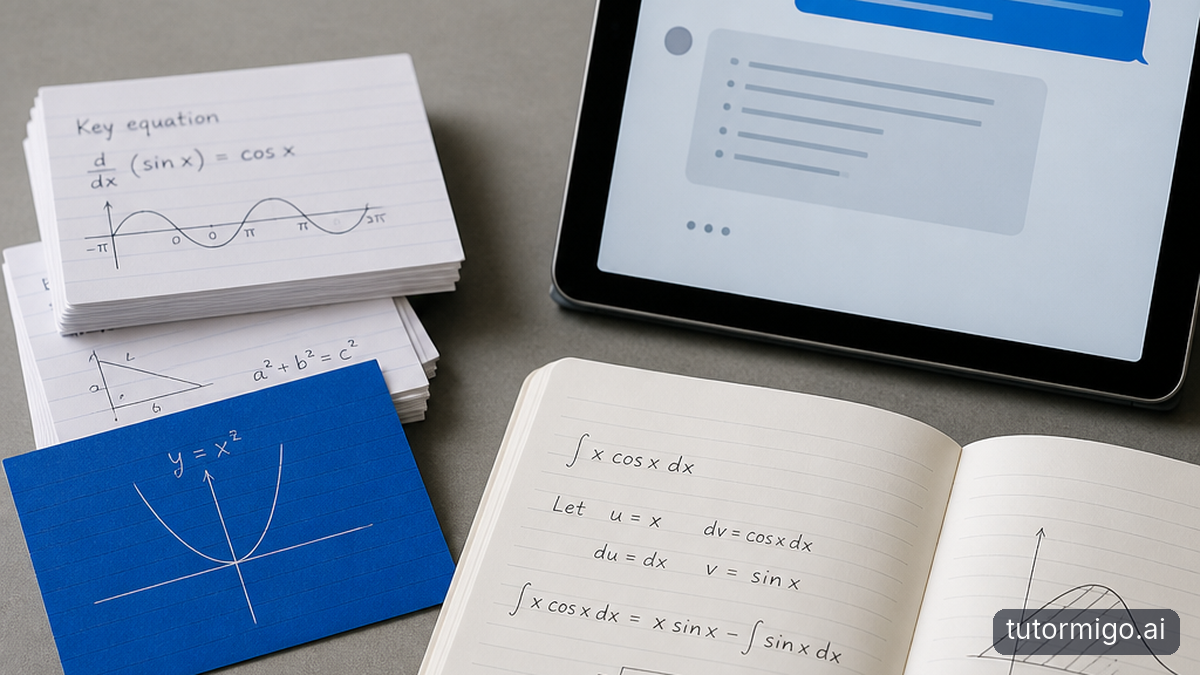
You get the right answer from a chatbot, recognize every step, and feel ready. Then you close the conversation and cannot explain why the method works. The missing piece is often retrieval: using hints, studying a worked example, and practicing independently before turning the lesson into flashcards you revisit.
Recognition and understanding can feel surprisingly similar while the explanation is visible. Reading that osmosis involves water moving across a selectively permeable membrane might seem straightforward. But can you predict what happens to a cell in a different surrounding solution, explain your prediction, and identify what information you need?
Use that gap as a guide rather than a verdict on your ability. Before requesting more explanation, make a brief attempt from memory. Say what you know, where you became uncertain, and which step you cannot justify. That gives you a specific learning problem instead of a vague feeling that the whole topic is difficult.
Your goal is not to avoid help. It is to make help temporary. A useful study session leaves you able to explain something without the conversation open, then retrieve it again after a delay. Flashcards become valuable when they preserve those explanation and application challenges, not just the answer you copied.
When to Ask for a Hint—and When a Worked Example Helps

Ask for a hint when you understand the question and have a plausible starting point, but one decision blocks you. Try: “Do not solve it yet. Ask one question that helps me choose the next step.” For an osmosis question, a useful hint might direct your attention to the membrane and the surrounding solution.
After receiving the hint, stop reading and attempt the next step yourself. If you immediately request another hint, you can accidentally turn a sequence of small prompts into a full solution. Explain what changed in your thinking first. That explanation shows whether the hint unlocked a principle or merely suggested a move.
A worked example helps when the method itself is unfamiliar or repeated hints leave you guessing. Request one example with a reason for each decision. Before reading each next step, predict it. Afterward, cover the explanation and reconstruct the reasoning in your own words, including why an alternative approach would fail.
Then answer a similar question with one important detail changed. If you studied a cell losing water, consider a situation where it gains water instead. Turn your sticking point into a flashcard: “What must I compare before predicting water movement?” This connects immediate support to a review task that tests the same underlying idea.
Build Flashcard Decks That Test Understanding, Not Just Memorization
Build a small deck around the concept you actually struggled with, rather than converting every sentence of your notes. Start with a few prompts covering the essential definition, the reasoning behind it, and an application. A focused deck makes weak understanding easier to spot and keeps reviews manageable enough to repeat.
For osmosis, one card could ask for the definition without showing any keywords. Another could ask why the membrane matters. A third could describe a new cell scenario and ask you to predict the outcome and justify it. These prompts test different parts of understanding instead of repeatedly asking for the same phrase.
Keep each card focused enough that you can judge your response honestly. Put the expected answer and its key reasoning on the reverse, but do not require an exact script. If your explanation gets the mechanism wrong, count that as a miss even when the final prediction happens to match.
TutorMigo.ai’s Flashcards supports AI-assisted card creation and spaced-repetition decks. Review suggested cards before studying: check accuracy against your materials, remove accidental clues, and split overloaded questions. For more on turning source material into useful prompts, see spaced-repetition flashcards from notes. Keep cards that reveal what you can retrieve, not what you can recognize.
Plan Your Flashcards Study Sessions With Spaced Repetition and Active Recall
A useful flashcards study routine starts with an attempt, not a reveal. Read the front, answer aloud or on paper, and commit before checking the reverse. If you flip the card while still thinking, familiarity with the answer can disguise the fact that you could not produce it independently.
Use TutorMigo.ai’s review scheduling to support spaced practice rather than repeatedly drilling the whole deck in one sitting. Spacing gives you opportunities to retrieve knowledge after some forgetting. There is no single interval that guarantees retention for everyone; the important habit is returning and responding honestly when recall is incomplete.
When you miss a card, diagnose the miss. Did you forget a term, confuse two concepts, or fail to apply the principle? A forgotten term may need another retrieval attempt. A conceptual mix-up may need a comparison card. An application error may call for a fresh example before the next review.
Keep a lightweight record of recurring errors and revisit those patterns weekly. If you explain definitions easily but struggle with changed scenarios, add application prompts rather than more definition cards. After an interruption, restart spaced repetition with one concept instead of trying to clear everything at once. Consistent, thoughtful retrieval is more useful than a large review total earned by guessing.
How TutorMigo’s Personalized Tutoring and Session History Compare With General-Purpose Chatbots
A general-purpose chatbot can provide hints, explain examples, and ask practice questions when you give clear instructions. Some also retain conversations or offer other learning tools. The useful comparison is therefore not “chatbots answer, tutors teach.” It is how easily your chosen workflow helps you move from explanation to independent recall.
TutorMigo.ai’s AI Tutor Workspace combines personalized tutoring chat, expert personas, and session history. You can state your current understanding and request support at that level: “I remember the definition, but I confuse the direction of movement. Give me one hint, then wait for my attempt.” Personalization works best when you make your uncertainty explicit.
Session history gives you a previous explanation to revisit when the same confusion returns. For example, compare today’s answer with an earlier discussion about membranes. Identify the misconception that persisted, then write a better flashcard. Do not assume that an earlier conversation proves mastery or that every difficulty is automatically diagnosed.
The practical TutorMigo benefits come from pairing that AI Tutor conversation with dedicated flashcard review and interactive study tools. You still need to attempt the work, check important claims against trusted materials, and judge your explanations honestly. A dedicated learning workflow can support those habits; it cannot substitute for them.
Check Understanding With Interactive Tools and Structured Exam Practice: What You, Parents, and Teachers Can Monitor
Use an interactive tool when a flashcard answer could hide shallow understanding. In TutorMigo.ai’s Study Tools Hub, use the whiteboard to draw a membrane and explain your predicted water movement. Start from a blank drawing rather than tracing a completed diagram. The explanation matters more than how polished the drawing looks.
For relevant subjects, the math step editor or code sandbox offers another way to make reasoning visible. Reconstruct a solution step by step or test a small program, then explain why it works. Bring the resulting mistake back into your deck as a focused prompt rather than saving only the finished result.
For structured exam practice, use questions from your existing exam materials and organize a short cycle yourself: attempt without assistance, check the reasoning, classify errors, and review related cards later. Keep practice questions separate from memorized examples. Success on a familiar prompt is weaker evidence than success when the wording or context changes.
You, a parent, or a teacher can monitor concrete evidence together: independent explanations, repeated misconceptions, delayed recall, and performance on unfamiliar questions. Share a selected conversation, drawing, or simple error log during a check-in. Do not assume automatic dashboard access or reporting. Ask, “What can you explain now without help?” rather than judging progress only by time spent or cards completed.
Try a Hint–Example–Practice Routine, Then Test What You Can Explain Without Help
Choose one concept from a recent mistake and attempt a question before opening a chat. Write your explanation, even if it is incomplete. Then ask for one hint targeted at the point where you stalled. Try again immediately, keeping the rest of the solution hidden so the hint still leaves you meaningful work.
If you remain stuck, study one worked example. Pause before each decision and predict what comes next. Close it afterward and explain the method from memory. Your explanation should include why the approach fits the question, not just the order of the steps. Reopen the example only to check a specific uncertainty.
Next, solve a fresh question independently and create a few flashcards from the mistakes that remain. Include a recall prompt, a “why” prompt, and a changed-scenario prompt where useful. Review them through spaced repetition, answering before revealing. Keep the deck small enough that you can give each response genuine attention.
At your next review, test the result: can you explain the concept without cues, use it in a new situation, and notice when it does not apply? If not, request a narrower hint or revise the card. Your next step is simple: choose one shaky concept today and complete the cycle before collecting more answers.
Frequently asked questions
No. Use concise recall cards for essential facts, then add explanation and application cards for concepts you need to use.
Treat that as partial understanding. Study the reasoning, then attempt a changed question without help.
No. It records prior discussion. Delayed recall and independent application provide stronger evidence of learning.
Enjoyed this read?
Like, share, or comment below.



Comments
0Sign in required · respectful discussion · replies supported
Loading comments…