

How Adaptive Learning Helps Kids Solve Math Instead of Copying Answers

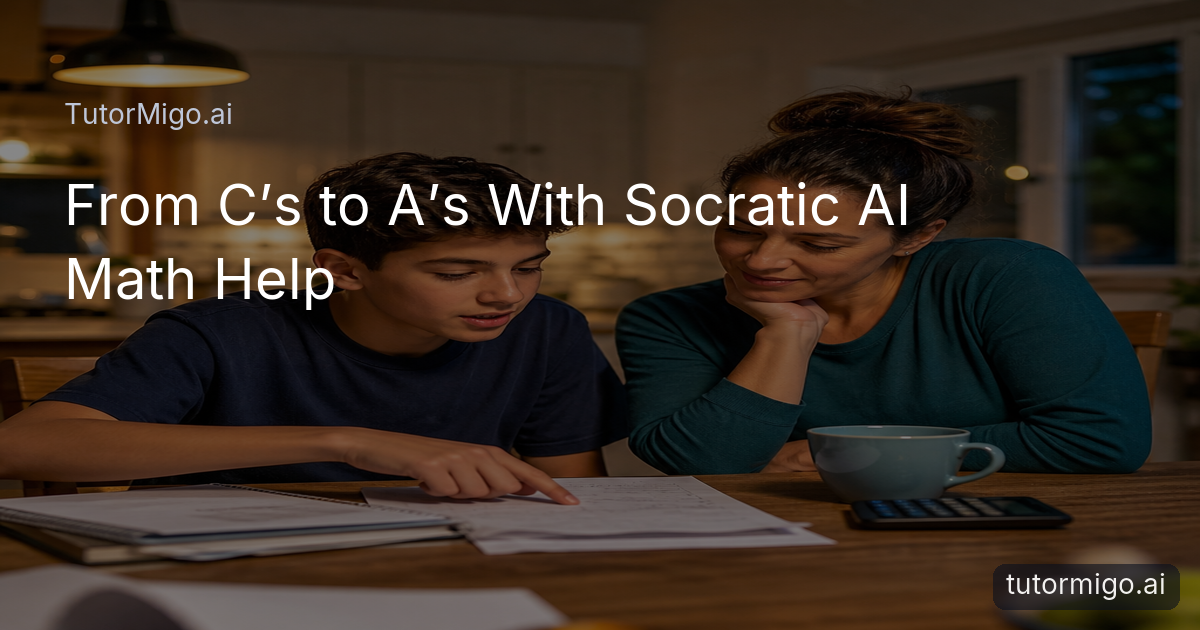
A child stares at a page of algebra homework, tries one step, and gets stuck. After a quick search or a request for help, the answer appears. The work gets finished, but the confusion remains. Many students move from uncertainty to copying because they are rushing, embarrassed, or afraid that asking questions means they are bad at math. Better prompts can change that outcome.
The goal of an AI math tutor should not be to make homework disappear. It should help a student slow down, notice patterns, and make the next reasonable move. When an AI Tutor responds with a useful question instead of an instant solution, the student has to participate in the thinking.
For example, rather than displaying the result of , guided help might ask what needs to be undone first and why. That small pause can reveal whether the student understands inverse operations or is simply copying a familiar-looking step. The same approach works when a student is checking work: the tutor can ask which line changed and whether that change follows from the previous one.
This is the difference between answer-hunting and math learning. A correct answer is useful, but understanding why it is correct is what helps a student handle the next problem. In TutorMigo.ai, personalized tutoring and session history can support that continuity instead of treating every question as an isolated emergency.
What Socratic AI Math Tutoring Is and Why It Builds Independent Thinking

Socratic AI prompting is a way of asking an AI tutor to guide reasoning through questions. Instead of immediately giving the solution, the tutor asks what the student notices, what information is known, and which strategy might fit. It does not mean refusing to help. It means giving the right amount of help at the right moment.
Imagine a student working on the area of a triangle. A direct answer may provide a formula and a number. A Socratic exchange might ask, “Which measurements are given?” and “What shape are we working with?” Then it can ask the student to identify the base and height before checking the calculation. Each response gives the tutor evidence about what the student understands and where a small explanation is needed.
This supports independent thinking because the student practices choosing, explaining, and revising a method. Over time, those habits make it easier to begin unfamiliar problems without waiting for someone else to demonstrate every step. The student is not memorizing a conversation; they are building a repeatable process.
TutorMigo.ai’s AI Tutor Workspace is designed for personalized AI tutoring chat and session history. Used thoughtfully, an AI Tutor can act like a patient practice partner: available for homework help, willing to revisit a missed idea, and focused on helping the learner explain the reasoning.
Practical Socratic Prompts for Homework, Word Problems, Mistakes, and Test Prep
Good prompts make the student an active part of the session. For general homework help, try: “What is the first thing you notice about this problem?” “What information do we already know?” and “What is the question asking us to find?” These questions help a student sort the problem before choosing an operation or formula.
For equations and multi-step work, use prompts such as: “What formula or strategy might fit here?” “Can you explain why that step works?” and “Show me one step at a time and ask me questions along the way.” For a word problem, add: “Which details matter, and which are extra?” or “What could the variable represent?” This connects the symbols to the situation instead of turning the problem into a guessing game.
Mistakes are especially valuable. Ask, “Can you help me find the first step where my reasoning changed?” or “What would happen if we tried a different approach?” During test prep, students can request a hint first, attempt the question, and then ask for feedback on the method. Afterward, they can review the missed question with a flashcard rather than simply recording the correct answer.
The best prompt depends on the learner’s need. A student who is overwhelmed may need one question at a time; a confident student may benefit from comparing two strategies. That flexibility is one of the practical TutorMigo benefits for step-by-step learning.
A Step-by-Step Math Walkthrough: Guiding a Student Without Giving Away the Answer
Consider the problem: find the value of when . A student might ask for the answer immediately. A Socratic AI tutor can keep the problem manageable while asking the student to do the important thinking.
- Notice the structure. The tutor asks, “What is happening to in this equation?” The student identifies that is added after is multiplied by .
- Choose the first move. The tutor asks, “Which operation could we undo first to get closer to ?” The student suggests subtracting $7 from both sides.
- Explain the reason. The tutor asks, “Why should the same operation happen on both sides?” The student connects the move to keeping the equation balanced.
- Finish and check. The student reaches , then . The tutor asks the student to substitute into the original equation and verify that .
The tutor has not hidden the method or withheld necessary support. It has divided the work into decisions the student can make. If the student says subtracting first is the right move, the tutor can ask what equation that would create and whether it isolates the variable. The mistake becomes a chance to reason, not a reason to shut down.
This kind of guided exchange is useful in the spaced-repetition flashcards review that follows: the student can save the balancing principle and later explain it from memory.
How Guided AI Tutoring Improves Understanding, Confidence, and Grades Over Time
Grades tend to improve when students understand the ideas underneath procedures. A learner who knows why a linear equation stays balanced is better prepared for a new equation than one who memorized a sequence of clicks. Understanding supports transfer: the ability to recognize a familiar structure in a differently worded homework question or exam problem.
Guided prompts also improve retention because students retrieve information, explain choices, and correct misconceptions. A short review of a missed question can become a useful learning cycle: identify the error, explain the correct idea, try a similar problem, and revisit it later. Spaced practice and interactive tools can reinforce that cycle without requiring a parent to create every activity from scratch.
Confidence grows from evidence. When a student successfully starts a difficult word problem, catches an arithmetic error, or explains a formula aloud, they see that progress comes from a process rather than luck. That can reduce frustration and make it more likely that they will ask for help before giving up.
Better grades are therefore an outcome of stronger habits, not a promise produced by instant answers. Homework becomes more accurate, test preparation becomes more focused, and class participation can improve as the student builds language for explaining ideas. TutorMigo.ai can support this with personalized sessions, interactive math tools, and structured progress tracking when exam preparation is relevant. The key measure is not how quickly the AI responds, but how much the learner can do independently afterward.
How Parents Can Use TutorMigo.ai for Patient, Personalized Math Support at Home
Parents do not need to become the family’s full-time math teacher. Start by setting a simple expectation: the student should try the problem, ask for hints before answers, and explain the final reasoning in their own words. A prompt such as “Please guide me with one question at a time, do not solve it immediately, and ask me to check my work” creates a productive structure.
Step in when the child is emotionally stuck, repeating the same error, or unable to understand the tutor’s language. You might say, “Tell me what you know so far,” then help the student restate the question. If the child is making progress, give them space. Hovering can unintentionally turn guided learning into another performance test. A calm check-in after ten minutes is often more useful than taking over at the first mistake.
Ask for an explanation out loud: “Why did you choose that operation?” or “How do you know your answer is reasonable?” Listening reveals more than a completed page. It also helps you notice whether the problem is a missing prerequisite, unclear directions, or simple carelessness. If a misconception keeps returning, save it for a later review rather than pushing through frustration.
For families comparing an AI tutor for parents with general-purpose chat, practical differences matter: TutorMigo.ai includes a tutor workspace with session history, interactive study tools, and a parent dashboard for visibility into progress and learning controls. The goal is not to monitor every answer. It is to support patient, personalized practice while keeping the student responsible for the thinking. Try one homework problem tonight with guided prompts and see what the student can explain tomorrow.
| Approach | What the student does | Likely learning result |
|---|---|---|
| Answer-hunting | Copies a result or sequence of steps | Finishes the immediate task but may struggle with a similar problem later |
| Socratic prompting | Identifies information, chooses a strategy, explains steps, and checks the result | Builds understanding, retention, confidence, and more independent problem-solving |
| Guided review | Revisits a mistake, practices a related problem, and explains the correction | Turns an error into targeted practice for future homework and tests |
Pros and cons
Pros
- Encourages students to explain reasoning instead of copying
- Supports step-by-step learning, mistake review, and independent practice
- Can provide patient homework help and session continuity
- Gives parents visibility into progress through TutorMigo.ai’s parent tools
Cons and limitations
- Students still need to do the thinking and should not treat AI feedback as a substitute for checking class instructions
- A prompt may need to be adjusted if the student needs a simpler explanation or a different example
- Instant answers can remain tempting, so families should agree on a hint-first routine
Frequently asked questions
It should prioritize hints, questions, explanations, and work-checking before revealing a complete solution. If an answer is eventually shown, the student should still explain the method and verify the result.
Ask the AI tutor to start with one small question, identify the known information, or explain the relevant concept briefly. Parents can help the child restate the problem without taking over the solution.
Yes. Students can use them to review missed questions, compare strategies, practice explaining answers, and identify topics that need more work before a test.
Ask the child to solve a similar problem without assistance and explain each step aloud. Look for improved reasoning, fewer repeated mistakes, and greater willingness to begin—not only a completed homework page.
Related reading
Related reading
Related reading
Enjoyed this read?
Like, share, or comment below.


Comments
0Sign in required · respectful discussion · replies supported
Loading comments…