


Build math confidence by changing the conversation

Start by acknowledging what your child is experiencing without agreeing with their verdict about their ability. “That question felt frustrating” leaves room for improvement; “Yes, maths has never been your thing” turns a difficult moment into an identity. You don’t have to insist that maths is easy or fun. Your aim is to show that difficulty is something you can investigate together.
Choose a calm moment to ask what makes maths uncomfortable. Is it being watched, working against the clock, not knowing where to start, or worrying about a wrong answer? A child who understands a method at home but freezes when called on needs different support from one who cannot explain what the question means. Listen before offering a solution.
Watch your own language, too. Instead of “I was terrible at maths as well,” try, “Some parts took me longer to learn. Drawing things helped.” This makes struggle ordinary without suggesting it is permanent. If your child regularly calls themselves incapable, these ideas for responding when your child says they’re bad at maths can help you keep the conversation specific and hopeful.
Find the exact point where understanding breaks down
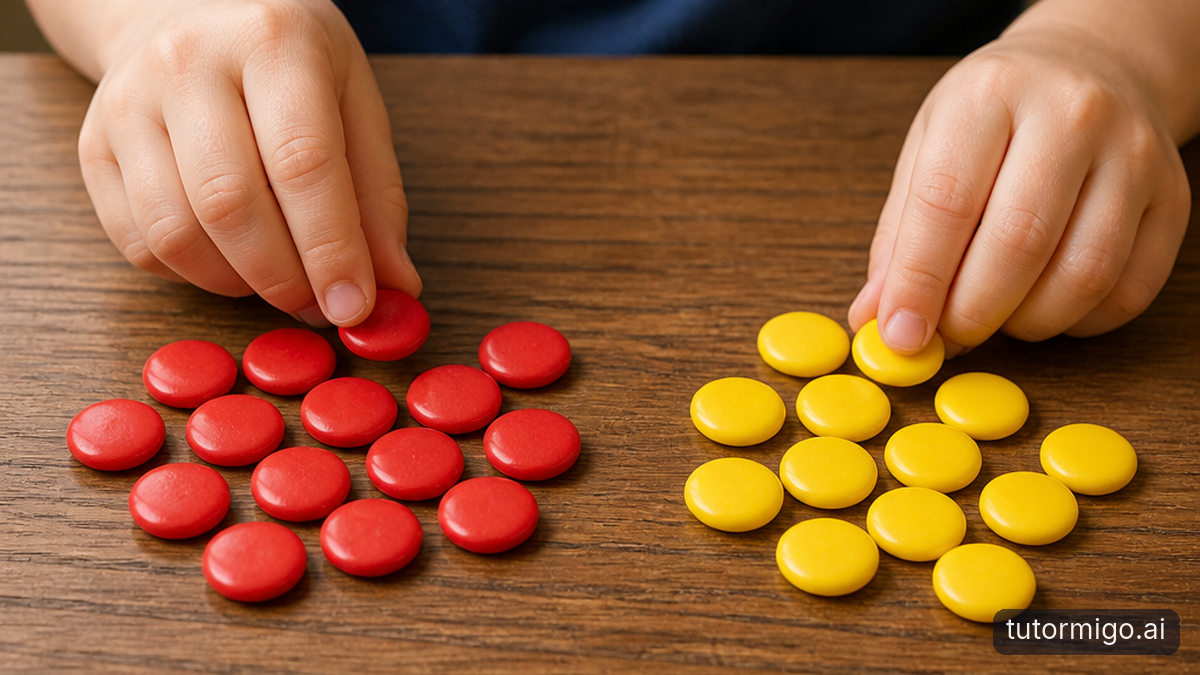
A page of unfinished questions can make the problem look bigger than it is. Sit beside your child and choose one example rather than reviewing the whole worksheet. Ask, “What is this asking us to find?” and “Which part makes sense so far?” Their explanation may reveal that the obstacle is one unfamiliar word, a forgotten number fact, or a step they cannot yet picture.
For example, if equal-sharing questions cause trouble, put a small collection of counters on the table and share them between toy animals. Let your child move the counters themselves, then explain how the sharing connects to the written question. Objects, sketches and spoken explanations can make an idea visible before symbols become comfortable.
Keep this exploration separate from judging performance. You are looking for a starting point, not collecting evidence of what your child cannot do. If the difficulty keeps returning, contact their teacher with a precise observation: “They can make equal groups with counters, but they’re unsure how to record what they did.” That gives the teacher something useful to work with and helps you avoid repeatedly practising a method your child does not yet understand.
Make practice short enough to finish successfully
Confidence grows when your child can recognise progress, not simply when they spend more time working. Begin with a question they can manage, move to something slightly less familiar, and finish by revisiting what became clearer. A short session with one useful discovery is often more constructive than an evening that ends in exhaustion. Agree on a stopping point before you start, such as ten minutes or a small set of carefully chosen questions.
Suppose your child is learning to combine quantities. Start with objects they can count, try a drawing, then connect that drawing to the written calculation. Change one feature at a time rather than suddenly increasing the numbers, changing the layout and adding a word problem. This makes it easier to tell which new demand needs attention.
Let your child help choose the routine: before dinner or after a snack, at the table or with counters on the floor. Keep the learning goal clear while offering choices about how to approach it. On a difficult day, shorten the task rather than turning the agreed session into a battle. Returning calmly tomorrow is more valuable than completing every question tonight.
Treat mistakes as clues and praise what actually helped
When an answer is wrong, pause before correcting it. Ask your child to show how they reached it, then look for the first point where the reasoning changed direction. “You grouped these carefully; let’s check what happened when you counted them” is more useful than announcing that the whole answer is wrong. It preserves the parts of the work that make sense and gives them a manageable correction.
You can model this yourself without staging a performance. If you miscount while measuring ingredients, say, “That doesn’t match what I expected. I’ll check it another way.” Your child sees that checking is part of doing maths, not proof that someone is bad at it. Avoid making speed the main measure of success, especially when they are still building understanding.
Make praise specific and believable. Instead of “You’re a maths genius,” try, “Your drawing helped you keep track,” or “You noticed that answer didn’t fit and checked it.” Effort matters, but effort without a useful strategy can become draining. If your child has tried repeatedly and is still stuck, acknowledge the persistence and help them change approach. The message is not “keep struggling”; it is “we can find another way in.”
Offer support without doing the thinking for them
It is tempting to step in as soon as your child hesitates, especially when homework is taking longer than expected. But giving the next step too quickly can accidentally teach them to wait for your instructions. After asking a question, leave quiet thinking time. A pause does not always mean they are lost; they may be deciding how to begin.
Use a small ladder of support. First ask, “What could you try?” If needed, point them towards a tool: “Would a sketch help?” Then offer a limited choice: “Would you rather draw the groups or use counters?” Explain one step only if they still need it, and let them take over again as soon as possible. For more on this balance, see building confidence without taking over.
If your child becomes tearful, unusually quiet or angry, pause the work rather than pushing through. Once they feel calmer, decide whether to return to an easier example or stop for the day. Persistent distress, physical complaints around maths, or difficulties that continue despite targeted help deserve a conversation with their teacher. Ask what they notice and agree on a consistent approach, rather than assuming your child needs more practice.
Choose one small next step for this week
You do not need to overhaul every homework session. Choose one change that matches your child’s main difficulty: a calmer response to “I can’t,” a shorter practice session, or a better way to uncover the confusing step. Tell your child what you are changing so they know the goal is to make learning more manageable, not to test them more often.
For the next week, notice evidence beyond correct answers. Did your child begin with less prompting, explain a strategy, ask a specific question, or recover after a mistake? Mention one observation naturally: “Yesterday you wanted me to start that question; today you drew a picture yourself.” Avoid turning every attempt into a score or comparing them with siblings. Confidence can develop unevenly, so one difficult evening does not erase earlier progress.
At the end of the week, ask what helped and what still felt hard. Keep the useful change, adjust what did not work, and involve their teacher if the same obstacle persists. If you would like a shared place to follow progress, TutorMigo.ai’s Parent Dashboard offers parent visibility into learning progress, learning controls and co-learning features. Use that visibility to guide supportive conversations, not to monitor every mistake.
Frequently asked questions
Acknowledge the feeling without accepting it as a permanent fact: “This feels hard right now. Show me the part that stopped making sense.” Then find one manageable starting point together. Avoid arguing that the work is easy or immediately supplying the answer.
Start with a short, predictable session that your child can manage, such as ten minutes, and adjust around their needs and school expectations. Focus on understanding one idea rather than finishing a large number of questions. If practice regularly ends in distress, discuss the workload and approach with their teacher.
Ask your child to explain an example from class, and use any guidance their teacher has provided. You can still help them read the question, organise materials and describe where they are stuck. Ask the teacher for a worked example rather than insisting on a different method.
Speak with the teacher when the same difficulty persists, your child becomes consistently distressed, or homework is much harder than expected. Share specific examples of what your child can do independently and where they need help. Ask which underlying skill to focus on and how to practise it consistently.
Explore TutorMigo
Enjoyed this read?
Like, share, or comment below.



Comments
0Sign in required · respectful discussion · replies supported
Loading comments…