


How Artificial Intelligence Is Changing One-Size-Fits-All Learning

If a lesson moves too quickly, you fall behind; if it moves too slowly, you switch off. Artificial intelligence is changing education by making explanations, practice and feedback more adaptable. The opportunity is real, but better learning still depends on accurate information, thoughtful teaching and your own effort.
Instead of giving everyone the same worksheet, an adaptive system can use your responses to suggest what to practice next. If you repeatedly misunderstand fractions, for example, it might return to visual models before introducing harder problems. A conversational tool can explain the same idea through a recipe, a diagram description or a worked example.
That flexibility is useful only when the system identifies the right problem. A wrong answer might reflect a misconception, a reading difficulty or a momentary lapse in attention. You need opportunities to explain your thinking, not just receive another exercise based on a score.
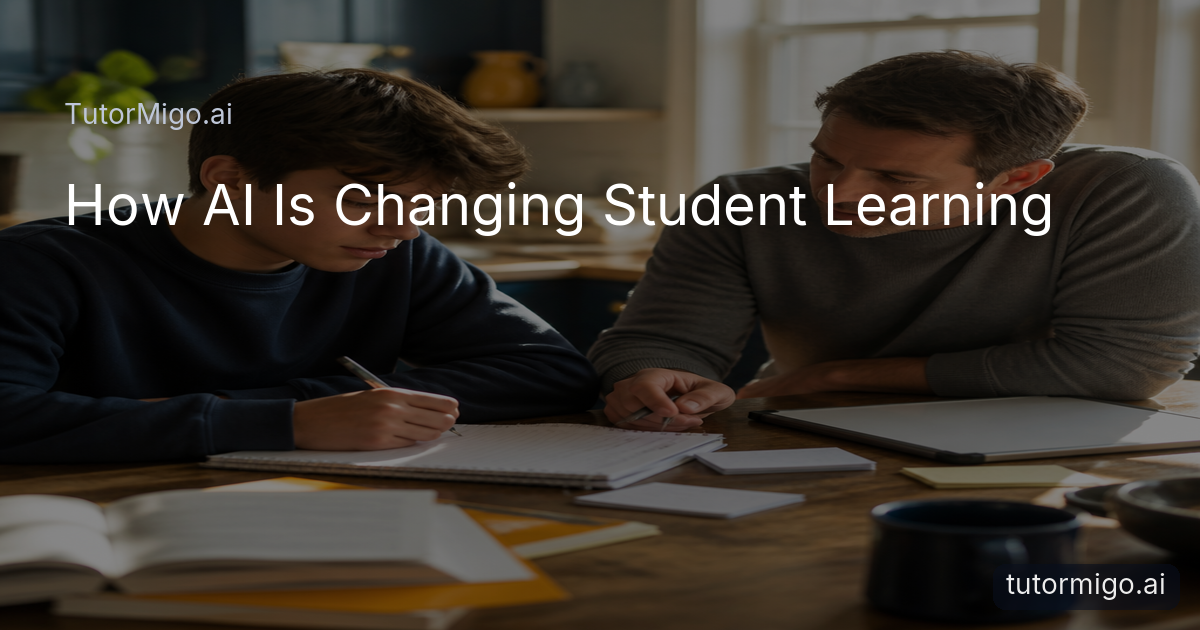
Try asking for one hint at a time, then attempt a similar question without help. Revisit it later to check whether the learning stuck. If you can follow an explanation but cannot solve a fresh problem, you need more independent practice. For more on these everyday changes, explore how AI is changing student learning. The goal is support that gradually becomes less necessary, not an endless stream of assistance.
How AI Helps Teachers Plan Lessons and Spend More Time Teaching

For teachers, the most useful applications often involve preparation rather than classroom spectacle. AI can suggest discussion questions, produce alternative examples or help adapt an existing explanation. Starting from a rough draft may leave more time for checking understanding and talking with learners, although reviewing weak output can erase those savings.
Imagine you are preparing a lesson on evaluating historical sources. You could request two contrasting accounts of an imaginary event and questions about perspective, evidence and missing information. You would then inspect the material, label it as fictional and adjust the difficulty. Generating convincing text is not the same as finding trustworthy historical evidence.
Specific instructions make this process more manageable. Tell the tool the learning objective, what learners already know, likely misconceptions and practical constraints. Asking for a short activity that uses paper and discussion is more useful than asking for an entire lesson with no context.
Keep the final decisions with the teacher. Check factual claims, cultural assumptions, accessibility and alignment with the curriculum. Do not enter identifiable student work or confidential records into an unapproved service. A sensible starting point is one repetitive preparation task, followed by an honest comparison: did the tool save time after corrections, and did the resulting activity actually help learners understand?
Where AI Can Make Education More Accessible—and Where Gaps Remain
AI can make learning materials easier to approach when the original format creates a barrier. Depending on the tool, you may be able to hear text aloud, obtain captions, translate instructions or request a clearer explanation. These options can give you another route into the same idea without changing the learning goal.
Suppose you understand a science concept but struggle with unfamiliar vocabulary in the reading. A plain-language explanation and a short glossary may help you participate in the discussion. However, simplifying the passage should not quietly remove essential qualifications or replace technical terms you eventually need to learn.
Accessibility is not automatic. Captions can mishear specialist vocabulary, translations can distort meaning, and a conversational interface may work poorly with assistive technology. Test the actual tool and ask the person using it whether the alternative helps. AI support should complement, not replace, required accommodations and accessible teaching materials.
Access also depends on reliable connectivity, suitable devices and cost. If an assignment assumes everyone has a paid service and quiet space at home, it can widen existing gaps. Offer an equivalent non-AI route, provide time with shared resources where possible, and avoid grading access as though it were ability. The meaningful question is not whether a tool exists, but whether you can use it reliably and on fair terms.
What You Need to Know About AI Errors, Bias, Privacy and Cheating
A fluent answer can still be wrong. Generative AI may invent a quotation, confuse dates or cite a source that does not exist. Treat its output as something to examine, not an authority to repeat. For an important claim, locate the original source and check whether it actually supports the statement.
Bias requires a similar habit of inspection. A generated account of a historical event may center one perspective while overlooking others. Ask whose experience is represented, which assumptions shape the explanation and what evidence is missing. Requesting a balanced response can help, but it does not guarantee fairness or completeness.
Privacy decisions should happen before you paste information into a chat. Remove names, contact details, health information and confidential feedback. Check the service's data policies and your institution's rules, including whether the tool is approved for the intended users. If those answers are unclear, use a fictional example rather than real personal information.
For academic integrity, distinguish support from substitution. Asking for feedback on your reasoning may be permitted; submitting generated work as your own may not be. Read the assignment rules, ask when uncertain and disclose assistance as required. Keep notes or drafts showing your process. Responsible use means being able to explain both the work and how you produced it—not merely editing an answer until it sounds personal.
Why Future Assessments Will Need to Measure Thinking, Not Just Answers
When software can produce a polished response quickly, the response alone becomes weaker evidence of understanding. This does not make essays, problem sets or projects pointless. It means assessment needs a clearer connection between what you submit and what you can explain, apply and do independently.
Consider a science assignment asking you to interpret an experiment. Alongside the final explanation, a teacher could ask you to justify a choice of method, identify an uncertainty and predict what would happen under changed conditions. A brief conversation can reveal whether you understand the reasoning or have only reproduced convincing language.
Different assessment conditions can serve different goals. An independently completed task can check foundational knowledge, while an explicitly AI-permitted project can assess how well you question suggestions, verify evidence and improve a result. The rules should state which kind of learning is being measured and what assistance is allowed.
Fairness still matters. Oral explanations need accessible alternatives, and process documentation should not become excessive surveillance. AI-detection scores should not be treated as proof of misconduct because they can misclassify writing. A stronger approach combines clear expectations, work completed over time and opportunities to demonstrate understanding. For you as a learner, the practical test is simple: can you defend your choices and tackle a related task when the tool is unavailable?
Your Next Steps: Try AI for Learning Without Replacing Human Judgment
Start with one learning problem rather than a promise to transform everything. Perhaps you need a clearer explanation of a difficult passage or feedback on why an attempted solution failed. Choose a small task whose quality you can check using your course materials, a trusted reference or a knowledgeable person.
Make your first attempt before asking for help. Then request a hint or a question that helps you notice the gap. After using the explanation, close the tool and try a new example. Return to the topic later without assistance. This separates the feeling of understanding from the ability to recall and apply what you learned.
Set boundaries at the same time. Decide what information you will never upload, check the relevant rules and identify situations that call for human advice. If a tool repeatedly confuses you or makes you less willing to think independently, change how you use it—or stop. More frequent use is not itself a sign of progress.
If coding is where you want to put this independent-practice approach into action, TutorMigo.ai's Code Challenge Hub offers Python and JavaScript challenges by difficulty that you can solve in your browser. Whatever resource you choose, judge success by whether you can explain more, remember more and need less help over time.
Frequently asked questions
AI can support explanations, practice and preparation, but it does not remove the need for teachers' judgment, relationships and responsibility for learners. Its value depends on how well people select, check and use it.
Try a related task without assistance and revisit the material later. If you can explain the idea, recall it and apply it in a new situation, you have stronger evidence of learning than a polished AI-assisted answer provides.
No. It depends on the assignment and institutional rules. Check what assistance is permitted, disclose use when required and do not present generated work as your independent work.
Avoid identifiable student records, contact details, health information and confidential feedback unless the service and intended use have been explicitly approved under the applicable policies. Use fictional or anonymized examples when possible.
Explore TutorMigo
Enjoyed this read?
Like, share, or comment below.


Comments
0Sign in required · respectful discussion · replies supported
Loading comments…