

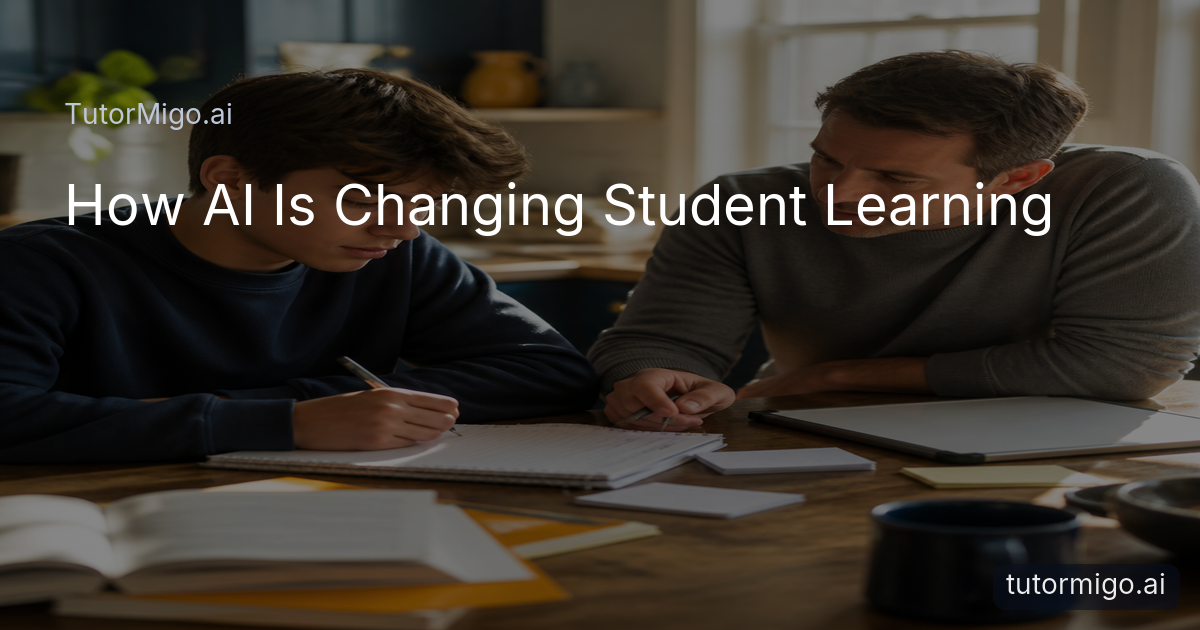
AI in education starts with a more personal learning path

If you have ever reread the same explanation without understanding it, waited for homework feedback, or forgotten a topic just before a test, you know that learning rarely follows a perfect schedule. AI in education can help by adapting practice and explanations to your questions, pace, and recent work. The goal is not to replace teachers or effort; it is to make the next useful learning step easier to find.
Personalized learning might mean receiving a simpler explanation of fractions before moving to mixed numbers, or getting an extra vocabulary review after several missed terms. A capable AI tutor at tutormigo.ai can respond to the question you ask now while using session context to keep the conversation focused. That is different from treating every learner as if they need the same worksheet.
Personalization should remain visible and manageable
Good personalization is not a mysterious score. You should be able to see what you are studying, change the level of support, and check whether you can solve a similar problem independently. The U.S. Department of Education’s 2023 report on artificial intelligence in teaching and learning emphasizes human oversight, privacy, and clear evidence of learning. Those principles matter: use AI to suggest practice, explanations, and questions, then verify important facts and make the final judgment about your progress.
AI tutoring can make feedback faster and more useful

One practical benefit of AI tutoring is timely feedback. Imagine writing a short explanation of photosynthesis and asking why it feels incomplete. Instead of waiting for the next class, you can receive a response that identifies a missing idea, asks a follow-up question, and invites you to revise the explanation. Instant feedback does not guarantee a correct answer, but it can shorten the gap between confusion and productive practice.
An AI Tutor at tutormigo.ai is most helpful when it explains the reasoning behind a correction rather than simply revealing an answer. In algebra, for example, it might ask which operation should be undone first and then check each step. In language learning, it can point out a pattern in verb use and provide a new sentence to try. You remain responsible for doing the work, while the system helps you notice where your reasoning changed direction.
Session continuity reduces repeated setup
Learning also becomes more efficient when you can return to a previous question instead of starting from zero. A tutor workspace with session history can keep related discussions together, so you can revisit an earlier explanation, continue a problem, or ask for a different example. This continuity is one of the practical TutorMigo benefits for learners who study in short sessions. Still, treat feedback as guidance: compare claims with class materials, trusted references, or a teacher when accuracy is important.
Interactive study tools help turn explanations into practice
Reading an explanation is only one part of understanding. Difficult concepts often become clearer when you represent them, manipulate them, and explain them back. AI-supported study tools can make that process more active. A math step editor, for instance, gives you a place to work through an equation line by line. If your answer is wrong, reviewing the first incorrect step is usually more useful than copying a completed solution.
The same principle applies beyond mathematics. A whiteboard can help you map the causes and effects in a history topic or sketch the parts of a science process. A code sandbox can give you a focused environment to test a small program, inspect the result, and revise one idea at a time. These tools do not turn practice into passive consumption; they create a record of what you tried and where you became stuck.
Ask for hints before asking for solutions
A useful routine is to request a hint, attempt the next step yourself, and then ask for feedback on that attempt. For example, when studying a quadratic equation such as , first try identifying two factors whose product is and whose sum is . The point is not the specific equation; it is the habit of making a prediction before receiving assistance. That habit helps you test whether an explanation has become understanding.
Spaced repetition helps AI-supported learning last longer
Personalized explanations are valuable, but remembering a topic requires returning to it. Spaced repetition schedules reviews across increasing intervals instead of concentrating every question in one long session. AI-assisted flashcards can help you turn a lesson into smaller prompts, then bring difficult cards back more often while allowing stronger memories more time before review.
Consider a student preparing for a biology unit. After learning cell structures, the student reviews a card asking for a function, answers without looking, and marks whether the response was confident and correct. A strong deck should ask for recall, not just recognition. Cards such as “What does the mitochondrion do?” are useful, but a card asking the learner to distinguish two similar structures may reveal a deeper gap.
Use scheduled review with active recall
Keep cards short, specific, and connected to the material you actually need. If one card contains an entire page of notes, split it into several questions. Pair review with explanation: after answering, say why the answer is correct and give a small example. This approach makes AI tutoring more than a stream of responses; it combines immediate help with a repeatable memory routine. It also gives parents, teachers, and learners a clearer view of which ideas still need attention.
Structured exam preparation turns practice into a progress plan
For a major exam, asking isolated questions is not the same as following a plan. Structured exam preparation can organize practice sets, show progress, and help you identify which areas deserve another session. A student preparing for the SAT, ACT, AP, or IELTS might begin with a baseline practice set, review missed question types, and schedule targeted practice rather than repeating the same comfortable topics.
Progress tracking is most useful when it leads to a decision. If reading questions take too long, your next step might be timed practice followed by an error review. If vocabulary is fading, add short flashcard sessions between longer study blocks. Look for patterns over several attempts rather than treating one score as a permanent label. An AI Tutor can help explain a missed question, but you should still check the method against official guidance and instruction from a qualified educator.
Visibility supports better conversations
Parents and teachers also need an appropriate view of learning. A parent dashboard can make progress and learning activity easier to discuss at home without requiring a parent to sit beside every session. A teacher dashboard can support student monitoring, assignment decisions, and reporting. Used well, these views prompt specific questions such as “Which reading skill are you practicing?” rather than vague pressure to study more.
Choose AI learning tools with judgment and human support
General-purpose generative chatbots can be useful for brainstorming an explanation or asking a one-off question. A learning-focused platform is designed around the wider study process: continued tutoring sessions, practice tools, review scheduling, structured preparation, and progress visibility. That difference is about organization and learning context, not a claim that general-purpose tools are incapable of helping students. You should compare how clearly each option supports the routine you need.
Before relying on any AI learning tool, ask four practical questions: Can you see and correct the learning path? Does it encourage you to attempt problems? Can you return to earlier work? What information is visible to a parent or teacher, and what controls are available? Also watch for confident errors. Ask the system to show reasoning, verify important information with course materials, and involve a teacher when a concept remains unclear.
Start with one measurable learning goal
To try TutorMigo.ai, choose a narrow goal such as explaining one science process, completing ten vocabulary reviews, or improving a particular exam question type. Use the AI tutor to ask for an explanation and a hint, practice in an interactive tool, and review related flashcards later. At the end of the week, check what you can do without help. That simple comparison turns AI from an answer shortcut into a structured aid for independent learning. Visit: tutormigo.ai
Frequently asked questions
AI in education refers to using artificial intelligence to support learning activities such as tutoring conversations, personalized practice, feedback, review scheduling, and progress tracking. It should supplement teachers, course materials, and the learner’s own effort rather than replace them.
An AI tutor can adapt explanations, examples, hints, and practice suggestions to the questions you ask and the mistakes you make during a session. Personalization works best when you attempt the work, review feedback, and check important information against trusted instructional sources.
Yes. You can ask for a simpler explanation, a worked example, a hint instead of a solution, or a different representation. Interactive tools such as a whiteboard, math step editor, or code sandbox can then help you apply the idea. If confusion continues, ask a teacher or qualified educator for support.
TutorMigo.ai combines personalized tutoring and session history with spaced-repetition flashcards, interactive study tools, structured exam preparation, and visibility options for parents and teachers. These features can make study more organized, but progress still depends on active practice, review, and thoughtful guidance.
Explore TutorMigo
Enjoyed this read?
Like, share, or comment below.

Comments
0Sign in required · respectful discussion · replies supported
Loading comments…