

The Difference Between a Coach and a Ghostwriter

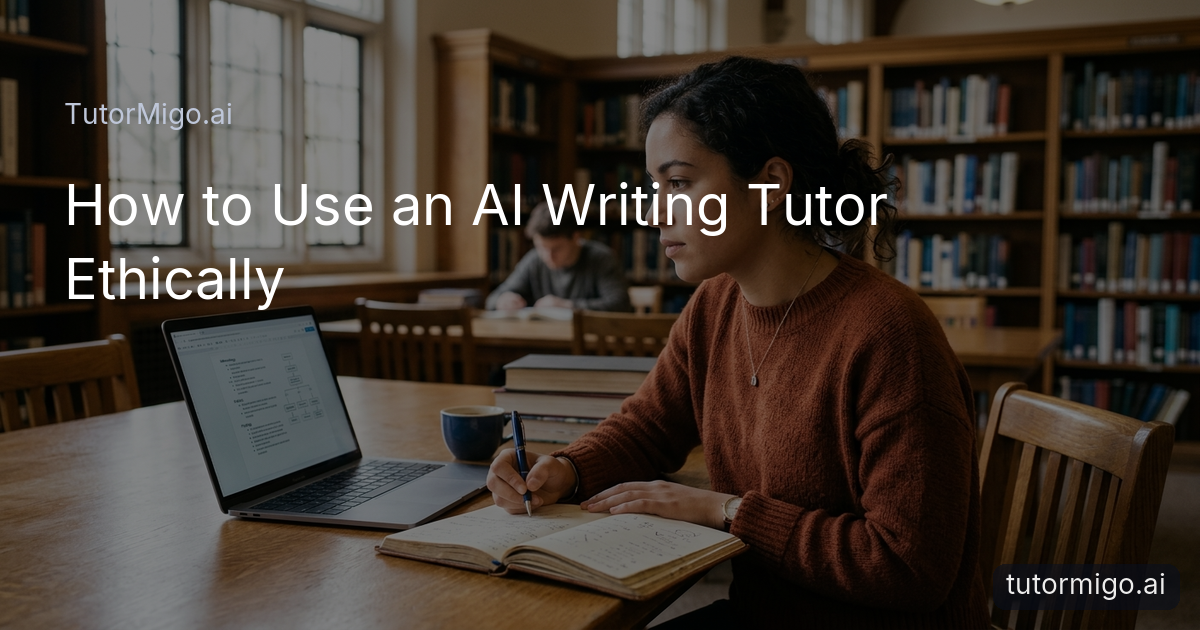
When you sit down to write a college essay, the pressure can be overwhelming. You might be tempted to find a tool that simply "does it for you," but that is where the line between learning and academic dishonesty is crossed. Choosing an AI writing tutor like TutorMigo means you are choosing a coach, not a ghostwriter. A ghostwriter takes your topic and hands you a finished product, leaving your brain out of the loop. A coach, on the other hand, stands on the sidelines, pointing out where your footwork is messy or where your strategy could be stronger.
In the AI Tutor Workspace, your AI Tutor acts as a sounding board. It’s the difference between asking someone to run a marathon for you and having a trainer help you build the muscle to run it yourself. When you use AI to explore responsible guided learning, you are engaging in a process that clarifies your thoughts. You are still the author, the researcher, and the final decision-maker. The AI is simply there to ensure your logic holds up under scrutiny and your grammar follows the rules of the road. This distinction is vital for your long-term success; you aren't just trying to get a grade, you're trying to become a person who can communicate effectively in the real world.
Green-Light vs. Red-Light: Setting the Boundaries

To use an AI writing tutor ethically, you need to understand which activities are "green-light" (helpful for learning) and which are "red-light" (cheating). Green-light uses involve the process of writing. For example, if you have a pile of research notes but don't know how to organize them, asking the AI to help you create a reverse outline of your current thoughts is a fantastic use of the tool. You are the one who gathered the info; the AI is just helping you see the structure. Similarly, asking for an explanation of why a specific comma is needed helps you learn a rule you can apply later.
Red-light uses, however, focus only on the output. If you prompt the AI with "Write a 1,000-word essay on the causes of the French Revolution," you have stepped into the red zone. Submitting unedited prose generated by an AI is not only a violation of most academic integrity policies, but it also puts you at risk of "hallucinations"—where the AI fabricates sources or facts that don't exist. Always remember: if you didn't think it, and you didn't write it, you shouldn't submit it. Use the tool to sharpen your own tools, not to replace them entirely. By staying in the green-light zone, you ensure that the work you turn in is authentically yours, bolstered by expert-level feedback.
Strengthening Your Thesis: A Before and After Transformation
One of the most powerful ways to use TutorMigo is to "stress-test" your thesis statement. A weak thesis is the root cause of most poor essays—it’s usually too broad, too obvious, or lacks a clear argument. Instead of asking the AI to write the thesis for you, you can provide your rough idea and ask the AI to point out the weaknesses. This forces you to think more deeply about your subject and refine your own language.
Consider this "Before" example from a student: "Social media is bad for teenagers' mental health." This is a "red-light" starting point because it's a generalization that everyone has heard before. By interacting with the AI Tutor, the student might be asked: "What specific aspect of social media? Which age group? What kind of mental health impact?" After a few rounds of coaching, the student produces the "After" version: "While social media provides essential peer connectivity, the algorithmic curation of 'perfection' on platforms like Instagram contributes to increased body dysmorphia among adolescent girls by reinforcing unrealistic beauty standards." Notice that the AI didn't replace the student's voice; it pushed the student to be more specific, more academic, and more persuasive. The resulting sentence is still the student's work, but it's significantly more sophisticated.
8 Coaching Prompts for Your AI Tutor Workspace
To get the most out of your AI writing tutor, you need to know how to ask the right questions. Here are eight copy-paste prompts designed to keep you in the "coach" zone while you work in the Tutor Workspace:
- The Reverse Outline: "I’m going to paste my draft below. Can you create a bulleted outline of the main points I’ve made so I can see if the flow is logical?"
- The Thesis Stress-Test: "Here is my thesis statement. Can you play devil’s advocate and give me three reasons why someone might disagree with this?"
- The Grammar Pattern Check: "I noticed I use a lot of passive voice. Can you find three examples in my text and explain how I can rewrite them in the active voice?"
- The Clarity Check: "Read this paragraph. Is there any part that feels confusing or where the transition between ideas is too abrupt?"
- The Evidence Evaluator: "I am arguing that [Topic]. Does the evidence I’ve provided in the third paragraph directly support that claim, or do I need a stronger connection?"
- The Counterargument Builder: "What is the strongest argument against my current position, and how might I address it in my conclusion?"
- The Tone Check: "Does this essay sound too casual for a college-level history paper? Point out specific words that feel out of place."
- The Expansion Prompt: "I feel like my second point is too thin. Don't write it for me, but ask me three questions that could help me expand on this idea."
Why Teachers Care (and Why You Should Too)
Many students worry about getting "caught" by AI detectors, but that’s actually the wrong thing to focus on. Teachers care about academic integrity because they care about your ability to think. When a teacher sees a sudden jump in writing quality that doesn't match your in-class performance, it’s a red flag. But more importantly, when you skip the hard work of writing, you miss out on the cognitive development that happens during the "struggle." Writing is thinking; if you aren't writing, you aren't fully thinking through the material.
Educators who use the Teacher Dashboard are looking for progress, not just perfection. They want to see how you moved from a rough idea to a polished argument. Using an AI Tutor to show that progression—by saving your session history and showing how you refined your work—is actually a point in your favor. It shows you are a proactive learner who knows how to use modern tools to improve. The goal isn't to trick the teacher; it's to use the tool to reach a level of understanding that makes "tricking" them unnecessary. When you take the honest route, you build a unique voice that no AI can replicate, and that is what truly impresses a college admissions officer or a professor.
A Guide for Parents: Supporting Ethical Writing
For parents, the rise of AI can feel like a minefield. You want your child to have every advantage, but you also want them to maintain their integrity. This is where the Parent Dashboard becomes an invaluable resource. Instead of wondering if your child is just "copy-pasting" their homework, you can see the nature of their interactions with the AI. Are they asking the AI to "write this for me," or are they asking, "how do I cite this source?"
Encourage your child to use TutorMigo as a study partner rather than an answer key. You can even sit down with them and look at the feedback the AI provides. If the AI suggests that a paragraph is "lacking a clear topic sentence," ask your child what they think the main point of that paragraph is. This turns the AI's feedback into a conversation between you and your student. By focusing on the learning rather than just the grade, you help them develop the grit and critical thinking skills they will need in college and beyond. Using an AI writing tutor correctly is a skill in itself—one that will serve them well in a future where AI literacy is just as important as traditional literacy.
| Feature | The Coach (TutorMigo) | The Ghostwriter (Cheating) |
|---|---|---|
| Primary Goal | To help you learn how to write better. | To give you a finished paper with zero effort. |
| Output | Outlines, feedback, and grammar explanations. | Full paragraphs or entire essays. |
| Student Role | Active thinker, researcher, and final editor. | Passive recipient and copy-paster. |
| Long-term Result | Improved critical thinking and writing skills. | Dependence on tools and risk of academic failure. |
Pros and cons
Pros
- Provides instant feedback on thesis strength and logical flow.
- Helps overcome 'blank page syndrome' through structured brainstorming.
- Teaches grammar and style patterns rather than just fixing errors.
- Available 24/7 for late-night essay emergencies.
Cons and limitations
- Can become a crutch if you don't do the final writing yourself.
- Requires clear prompts to get the most helpful coaching feedback.
- Does not replace the need for original research and primary sources.
Frequently asked questions
Most AI detectors, including Turnitin, look for patterns of 'predictability' in text. If you use TutorMigo as a coach—meaning you write your own sentences based on the AI's feedback—you aren't 'submitting AI prose.' You are submitting your own work that has been professionally edited and guided. However, always check your specific school policy on AI assistance.
No. TutorMigo is designed as a pedagogical tool. It is programmed to ask you questions, provide outlines, and explain grammar rules rather than simply 'doing the work' for you. It functions like a human tutor sitting next to you, not a service that writes for you.
The best way is to be transparent. You can include a short note or 'AI Disclosure' at the end of your essay stating: 'I used TutorMigo.ai to help brainstorm my outline and check my grammar patterns.' Most educators appreciate honesty and the use of tools for skill-building.
Explore TutorMigo
Enjoyed this read?
Like, share, or comment below.


Comments
0Sign in required · respectful discussion · replies supported
Loading comments…