


Why “great job” doesn’t ease speaking anxiety in ielts preparation

You know the answer, but the moment someone asks an IELTS Speaking question, your mind goes blank. Useful IELTS preparation replaces that uncertainty with familiar tasks and specific feedback. Rather than chasing reassuring compliments or an unverified predicted band, practice speaking under realistic conditions and identify exactly what to improve.
A conversational bot might respond to every answer with “Great job!” That feels encouraging, but it leaves the important questions unanswered. Did you develop your ideas? Could a listener follow your explanation? Did you use vocabulary accurately, or repeat the same few words? Without those details, your next attempt becomes another guess.
Imagine answering, “Do you enjoy cooking?” with “Yes, cooking is very good. I like cooking because it is good.” General praise misses the repetition and limited development. Useful feedback points out those patterns and suggests a manageable change: explain what you cook and why you enjoy it. You might say, “I enjoy making soup because I can experiment with whatever vegetables we have.”
That is the starting point for reducing anxiety: turn a vague fear of being judged into a specific practice task. You do not need a perfect answer or an impressive accent. You need repeated experience communicating a clear meaning, noticing one weakness, and trying again without treating every mistake as a failure.
Anchor feedback to the four IELTS Speaking criteria

IELTS Speaking uses four equally weighted criteria: fluency and coherence, lexical resource, grammatical range and accuracy, and pronunciation. Fluency includes keeping your speech moving and connecting ideas. Lexical resource concerns how effectively and appropriately you use vocabulary. Grammar covers both variety and accuracy. Pronunciation concerns how clearly and intelligibly you speak, not whether you imitate a particular national accent.
A descriptor-locked IELTS rubric should mean feedback stays anchored to the published band descriptors rather than inventing its own definition of “excellent.” The label alone proves nothing. Look for observations linked to your actual response: repeated pauses, an unclear reference, a successful paraphrase, or a recurring tense error. A trustworthy explanation distinguishes what it observed from what it cannot assess.
For example, “Your vocabulary is advanced” tells you little. “You used ‘convenient’ appropriately, but repeated ‘good’ four times when explaining benefits” gives you something to work on. Likewise, a comment about pronunciation needs audio evidence; a transcript alone cannot reveal your stress, rhythm, or individual sounds.
Use the guide to what IELTS bands mean alongside the official Speaking descriptors. Read the criteria as descriptions of sustained performance, not a checklist of impressive words. One complex sentence does not establish a band, and one hesitation does not define your whole performance. Look for patterns across several answers.
Use voice AI without mistaking estimates for results
A voice AI language tutor can be useful for rehearsing spoken exchanges when it supports audio interaction. Before relying on one, check what it actually evaluates. Does it listen to your recording, or only read a transcript? Does feedback quote evidence from your answer? Can you separate comments about language from comments about delivery? Spoken interaction and valid assessment are different capabilities.
Be especially careful with IELTS band score prediction. A claim that estimates remain within bands requires validation against qualified human ratings, using representative candidates and clearly described testing conditions. A confident-looking number, or a rubric displayed beside it, does not establish that accuracy. Even a useful estimate is not an official IELTS result or a guarantee.
For example, an automated transcript may turn a mispronounced word into the word you intended. Feedback based only on that transcript could overlook the pronunciation problem. Conversely, a transcription error could make a correct sentence appear grammatically wrong. Listen to the recording before accepting the diagnosis.
TutorMigo.ai offers structured IELTS practice and progress tracking; those features should not be confused with validated voice scoring. Its AI Tutor can support text-based rehearsal and follow-up questions, while audio-dependent judgments need appropriate evidence. If a predicted score affects an application or test-booking decision, seek a qualified IELTS teacher’s assessment rather than relying on one automated result.
Make all three Speaking parts feel familiar
The Speaking test lasts approximately eleven to fourteen minutes and has three parts. Part One covers familiar topics such as your studies, home, or interests. Part Two gives you one minute to prepare a longer response, then asks you to speak for up to two minutes. Part Three develops a broader discussion related to the Part Two topic. Familiarity reduces the surprise, even when the questions are new.
For Part One, practice answering directly, adding a reason, and giving a brief detail. If asked about your neighborhood, explain what you like and give one example. Do not force every answer into a long speech. For Part Two, use your preparation minute to jot down a few prompts: who was involved, what happened, why it mattered, and how you felt. Notes should help you speak, not become a script.
For Part Three, practice moving beyond personal experience. A question about public transport might invite you to discuss cost, accessibility, or environmental effects. State your view, explain it, and acknowledge a limitation where relevant. You do not need specialist knowledge to offer a clear, developed opinion.
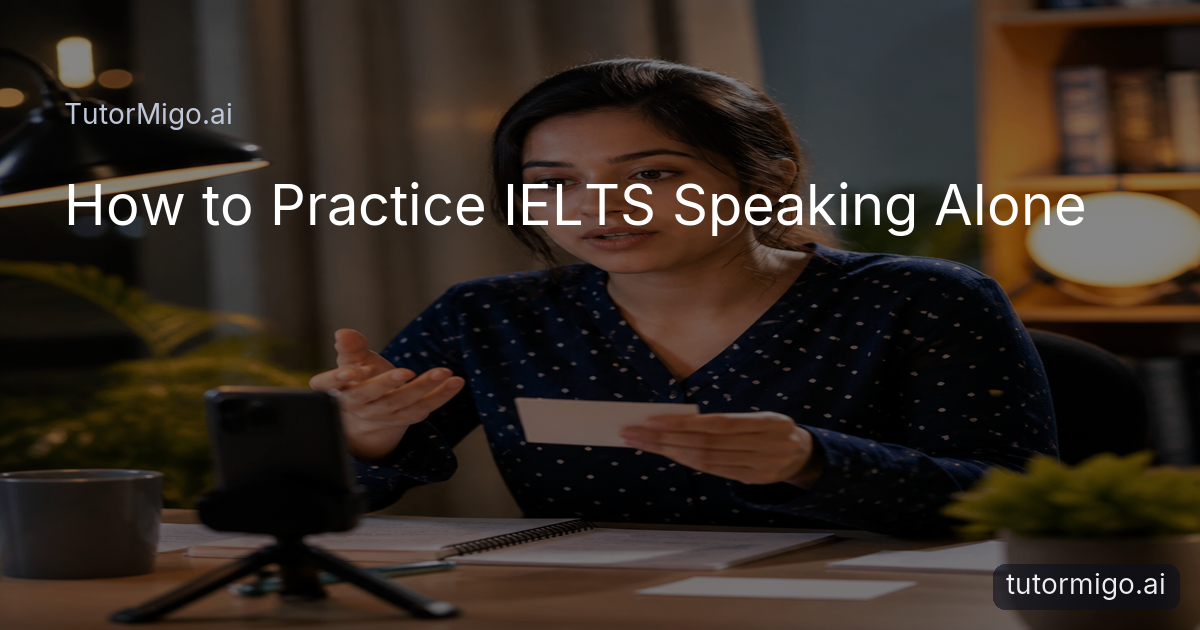
Record a full mock without restarting after mistakes. Then review it separately. This teaches you that a stumble is recoverable and does not end the conversation. For more practical routines, try these ways to practice IELTS Speaking alone.
Build a short practice loop that reduces pressure
Effective IELTS speaking practice online should leave you with a clear next action, not a folder full of recordings you never revisit. Try a twenty-minute session: spend two minutes choosing a task, six minutes answering and recording, seven minutes reviewing, and five minutes repeating one answer. Change only one or two things on the second attempt so the improvement is easy to notice.
On the first day, focus on extending short answers with a reason and example. On the next, work on organizing a longer response. Later sessions can target recurring tense errors, unnecessary repetition, or clarity of pronunciation. Include occasional full mocks, but avoid scoring every short practice attempt. Constant score-checking can turn rehearsal into another source of pressure.
Suppose your recording includes, “Last year I go to visit my cousin.” Note the past-tense error, practice the corrected phrase, and answer a different question about a past experience. That transfer matters more than perfectly repeating one corrected sentence. Use an AI Tutor to request fresh IELTS-style questions and discuss examples of more accurate phrasing, without treating its response as an official rating.
In TutorMigo.ai, structured IELTS practice and progress tracking can help organize your preparation. Keep a simple record of the task, the main difficulty, and the next practice goal. Measure progress through observable changes, such as clearer examples or fewer repeated errors, rather than confidence alone.
What to do next: rehearse recovery, not perfection
Your next session does not need to prove that you are ready for every possible question. Choose one familiar topic, record an answer, and identify one improvement using the official criteria. Repeat the answer once, then move on. A small completed practice cycle is more useful than an ambitious plan you avoid because it feels intimidating.
Build a recovery habit for moments when your mind goes blank. Pause briefly, breathe out slowly, and start with a simple point you can explain. If you cannot remember “commute,” say “the journey to work or school.” That kind of paraphrasing keeps communication moving. If you make a mistake, correct it briefly when useful rather than restarting your entire answer.
Parents, teachers, and tutors can help by letting you finish before offering feedback. Ask them to name one successful communication choice and one specific improvement. “Your example made the reason clear; next time, keep the past tense consistent” is more helpful than either blanket praise or a list of every error.
Before test day, rehearse a complete Speaking mock with someone unfamiliar when possible, and get expert feedback if your target band remains uncertain. Use your next week of IELTS preparation to make the format familiar, your practice repeatable, and your feedback specific. The goal is not to eliminate every nervous feeling. It is to keep speaking clearly while those feelings are present.
Frequently asked questions
Anxiety is not a scoring criterion, but it can affect how you demonstrate your skills through long pauses, short answers, or unclear delivery. Realistic mock practice helps you rehearse responding despite nerves.
No. Using official descriptors is helpful, but accuracy also depends on the evidence assessed and the quality of validation. A rubric label does not prove that an automated estimate matches examiner ratings.
Avoid memorizing complete scripts. Practice developing ideas, paraphrasing, and using flexible phrases so you can answer the actual question naturally.
Its described features include structured IELTS preparation, practice sets, and progress tracking. They do not establish validated audio-based band prediction or a guaranteed scoring margin.
Related reading
Enjoyed this read?
Like, share, or comment below.


Comments
0Sign in required · respectful discussion · replies supported
Loading comments…