

Why IELTS Preparation Alone Makes Speaking Practice So Difficult

You may understand grammar, recognize advanced vocabulary, and follow English conversations easily—then freeze when an IELTS Speaking question is directed at you. That gap is frustrating, especially when you do not have a native-speaking partner or regular tutor. The good news is that IELTS speaking practice alone can be highly effective when every session makes you produce language, notice a specific weakness, and try again.
Casual conversation is not automatically better preparation. A friend may kindly keep the conversation moving without noticing unclear pronunciation, repeated words, short answers, or weak explanations. IELTS examiners assess Fluency and Coherence, Lexical Resource, Grammatical Range and Accuracy, and Pronunciation. Your practice should therefore target those four areas rather than simply involve talking about anything.
Start by treating solo work as a small experiment. Choose one prompt, give yourself the same preparation time as the test, record your response, and review one measurable feature. You can also use the IELTS band score guide to connect your observations with the scoring criteria. The aim is not to sound perfect immediately; it is to make your next response clearer, longer, and more controlled.
Method 1: Record a Two-Minute IELTS Response

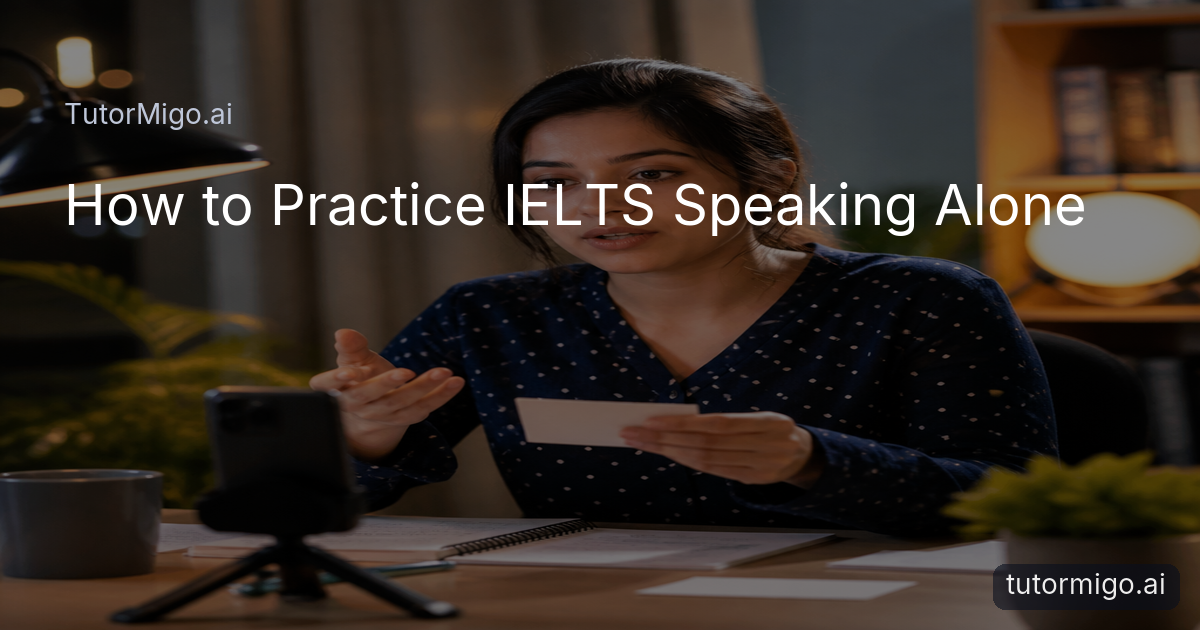
Recording yourself is the simplest way to create a baseline. Select an IELTS Speaking Part 2 cue card, allow exactly one minute to prepare, and speak for two full minutes. Do not stop the recording when you make a mistake. If you lose a word, explain the idea another way and keep going. This trains the recovery skill you need when an answer does not come out exactly as planned.
On your first review, listen only for fluency. Mark long pauses, repeated fillers such as “um” and “you know,” unfinished sentences, and moments when you restart an idea. On a second review, note repeated vocabulary. For example, if you say “interesting” five times, prepare alternatives such as “engaging,” “memorable,” or “thought-provoking,” but only use words you can control accurately.
Next, transcribe three or four sentences from the recording. Check whether your spoken grammar matches what you believe you said. This often reveals missing articles, incorrect verb tenses, or sentences that became too long to control. Recording cannot show every hidden error, and it cannot instantly supply a stronger Band 7 expression, but it gives you evidence. Keep a dated folder of responses so you can compare your pauses and development after two weeks.
Practice tip: Review one weakness at a time. Trying to fix pronunciation, grammar, vocabulary, and fluency in one listening session can make practice feel overwhelming.
Method 2: Use Shadowing to Improve Pronunciation
Shadowing develops your ear and mouth together. Use a short, clear model response at a level you can understand. Listen to one sentence, then repeat immediately after the speaker, copying the rhythm rather than simply repeating the words. Pay attention to sentence stress, connected speech, pauses, and intonation. The goal is not to imitate an accent; it is to make your meaning easier to follow.
Work in short sections of ten to fifteen seconds. First, listen without speaking. Second, repeat while looking at a transcript if one is available. Third, try again without looking. Record your version and compare the two recordings. If the model emphasizes a key content word, your version should not give every word equal weight. If the speaker pauses before an important explanation, copy that breathing pattern rather than rushing.
Shadowing is especially useful for candidates whose speech is accurate but sounds hesitant or flat. However, it has a clear limitation: repeating someone else’s language does not force you to create your own ideas under pressure. After shadowing, close the model and answer a related question in your own words for one minute. For example, after shadowing a response about public transport, explain whether your hometown should invest more in it. That final step connects pronunciation practice with spontaneous IELTS performance.
For a broader strategy, you can also review language-learning techniques for IELTS success and choose one technique to repeat consistently rather than collecting many disconnected tips.
Method 3: Add Structured AI Feedback to Solo Practice
Self-recording shows what happened, but structured feedback helps you decide what to change next. TutorMigo.ai can support this stage through its AI Tutor Workspace, where you can present an IELTS question, share a transcript or draft response, and ask for focused coaching on fluency, vocabulary, grammar, and answer development. This does not replace the official examiner or guarantee a band score. It gives you a repeatable way to question your choices and improve a second attempt.
Use the workspace with a precise request: “Identify two grammar problems in this Part 2 transcript, suggest natural corrections, and give me one follow-up question.” You can then answer the follow-up without looking at the correction. Ask for alternatives that are natural for your meaning, not impressive words to memorize blindly. A useful AI Tutor session should leave you with a small action, such as using clearer linking, extending an example, or reducing a repeated filler.
For candidates who feel nervous, private practice also lowers the social pressure of making mistakes in front of another person. You can pause to think, repeat an answer, and ask why a phrase sounds unnatural. Parents, teachers, and tutors can use the same transcript-based review to make feedback more specific without interrupting every sentence. The most effective cycle is simple: answer, review, revise, and answer again.
Keep your expectations realistic. Feedback is most valuable when you verify that a suggested phrase fits the question and your actual level. Use it to build control and confidence, not to memorize a script.
A Practical 20-Minute IELTS Speaking Routine
A short routine is easier to repeat than an occasional two-hour session. In minutes 1–5, warm up with three rapid Part 1 questions about familiar topics such as your hometown, work or study, and hobbies. Give each answer around twenty to thirty seconds, then identify one answer that was too brief. Add a reason or example to it. This helps you avoid responding with only “yes,” “no,” or a single sentence.
In minutes 6–12, complete one Part 2 cue card. Take one minute to prepare four keywords, not a memorized script, and speak for two minutes without stopping. Review the recording or transcript. Mark one pause, one repeated word, and one sentence you could make more precise. Ask TutorMigo.ai’s AI Tutor Workspace for targeted feedback, then repeat the weakest thirty seconds.
In minutes 13–20, answer two Part 3 questions that require an opinion, explanation, or comparison. Use a simple structure: state your position, explain why, give an example, and acknowledge another perspective. Connective devices such as “furthermore,” “for example,” and “on the other hand” can help, but do not add them mechanically. The relationship between ideas matters more than the number of linking phrases.
Track the date, topic, biggest problem, and next action. If your speaking practice forms part of a wider IELTS preparation plan, schedule it alongside reading, listening, and writing work without allowing those quieter skills to replace speaking production.
Turn Repetition into Higher-Band Progress
Improvement comes from comparing attempts, not from collecting recordings you never revisit. Consider this Band 6-style answer to “What kind of place do you like to visit?”: “I like parks because they are relaxing. I go there with my friends. It is good for health and we can talk. Sometimes there are many people, but I still enjoy it.” The meaning is clear, but the ideas are brief and the vocabulary is repetitive.
A more developed version might be: “I usually gravitate towards quiet parks on the edge of the city because they give me a break from traffic and screens. I often go there with friends at the weekend, and we walk while catching up. Even when the park is busy, the open space makes it feel less stressful than spending the afternoon indoors.” This answer adds a clear preference, reasons, a specific routine, contrast, and more precise language. Do not copy it as a script; use it as a model for developing your own answer.
Every week, choose one recurring issue and measure it. You might count long pauses in a two-minute response, record how often you extend a Part 3 answer with a reason and example, or review whether your verb tenses stay consistent when telling a story. If you want another perspective on using technology alongside human support, read this comparison of an AI Tutor and a human tutor for IELTS preparation.
Your next step is straightforward: choose one cue card today, record it, request focused feedback, and repeat the answer once. You do not need to wait for a partner to start moving from hesitant practice toward confident performance.
| Method | Best for | Strength | Limitation |
|---|---|---|---|
| Record and review | Building self-awareness | Reveals pauses, fillers, repetition, and answer length | You may miss grammar errors or lack ideas for improvement |
| Shadowing | Improving pronunciation and rhythm | Develops stress, pacing, and intonation | Does not fully train spontaneous idea formation |
| AI Tutor Workspace | Getting structured, repeatable feedback | Lets you ask focused questions about transcripts and revised answers | Feedback should be checked against IELTS criteria and natural usage |
| Human conversation | Practicing unpredictable interaction | Creates authentic back-and-forth communication | A partner may not understand IELTS band criteria or provide consistent feedback |
Pros and cons
Pros
- Solo practice can fit around work, study, or late-night schedules.
- Recording creates measurable evidence of pauses, repetition, and answer development.
- Shadowing supports clearer rhythm, stress, and intonation.
- Structured AI feedback provides a repeatable review cycle without social pressure.
Cons and limitations
- Self-review alone may not reveal every grammar or pronunciation issue.
- Shadowing does not automatically improve spontaneous answers.
- AI feedback is guidance, not an official IELTS score or examiner judgment.
- A full IELTS plan still needs attention to Listening, Reading, Writing, and Speaking.
Frequently asked questions
Yes. Recording, timed responses, shadowing, and structured feedback can improve fluency, vocabulary, grammar, and pronunciation. Solo practice works best when you review each attempt and repeat a revised answer.
Use official-style Part 1, Part 2, and Part 3 questions. Record your answers, listen for pauses and repeated language, shadow clear model speech for pronunciation, and use TutorMigo.ai’s AI Tutor Workspace for focused transcript-based feedback.
An AI Tutor can provide consistent practice and feedback, but it should complement—not replace—your full IELTS preparation. Continue developing listening, reading, writing, and speaking skills, and use reliable scoring criteria when reviewing progress.
A focused 20-minute routine is a strong starting point. Use five minutes for Part 1, seven minutes for Part 2, and eight minutes for Part 3, then record your main weakness and revisit it in the next session.
Related reading
Enjoyed this read?
Like, share, or comment below.


Comments
0Sign in required · respectful discussion · replies supported
Loading comments…