


Reduce information overload with a small source and clear outcome
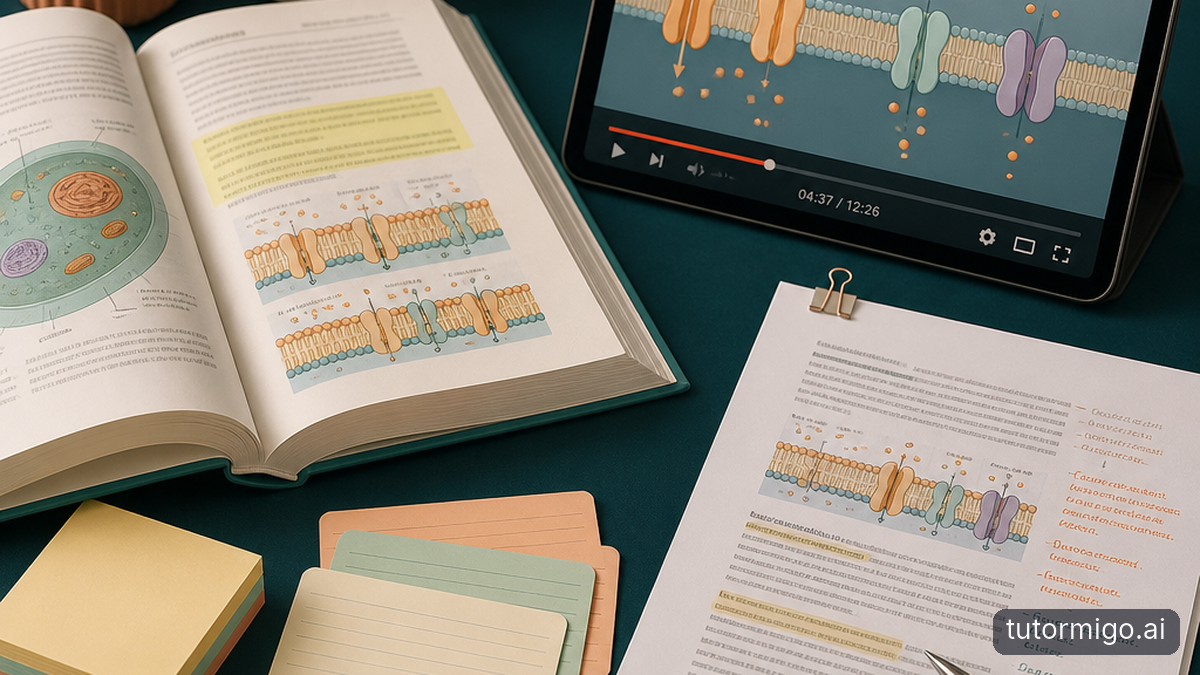
The appeal of dropping an entire PDF or YouTube URL into a tool is obvious: you want the important points without another evening of sorting. But check the actual workflow before choosing a service. Direct source import, automatic mind-map generation, and instant structured guides should not be assumed from the phrase “AI-powered.”
The supported capabilities discussed here are personalized tutoring and AI-assisted flashcard creation. Confirm current PDF and YouTube input options before relying on a source-to-study-material shortcut. No particular processing time is promised here.
Regardless of the input method available, begin with one coherent chunk: a textbook subsection or a lecture segment covering one idea. Keep the original source available, including page numbers or timestamps. These references let you check a definition, recover missing context, or revisit a diagram without searching the whole resource again.
For example, instead of tackling an entire chapter on cell transport, choose the section comparing diffusion and active transport. Set an outcome: “I want to explain the difference and recognize an example of each.” That narrow goal makes it easier to judge any generated explanation or question. You are looking for accurate, relevant practice—not simply a shorter version of everything.
Turn key ideas into questions you can answer

A summary helps you see the material. A question makes you retrieve it. Once you identify the main ideas, use AI-assisted flashcard creation to help turn them into prompts you can actually answer from memory. Review the wording and answers against your source before treating the deck as reliable.
Keep each prompt focused. “Explain cell transport” is too broad to diagnose a weak point. “Why does active transport require energy?” is more useful because it tests a specific relationship. Add a separate question asking you to classify an unfamiliar example, so your practice goes beyond repeating definitions.
For a lecture, avoid making a card from every sentence. Prioritize ideas the speaker explains repeatedly, distinctions that change an answer, and concepts needed to understand later material. A smaller, carefully checked deck is easier to review than a large collection of loosely worded prompts.
Spaced-repetition flashcards and review scheduling give that deck an ongoing role instead of leaving it as another saved document. Answer before revealing the explanation, and notice whether you genuinely recalled the idea or merely recognized it. If an answer feels fuzzy, return to the relevant source passage and improve the question rather than adding several near-duplicates.
Use explanations to repair gaps, not replace thinking
Sometimes a missed question does not mean you forgot a fact. It means the original explanation never clicked. That is where an AI Tutor can fit into your workflow: ask about the precise point of confusion instead of requesting another overview of the entire chapter.
A useful request sounds like this: “I understand that diffusion moves particles down a concentration gradient, but I cannot explain why active transport is different. Explain the distinction, then ask me to apply it.” This gives the conversation a clear target and leaves room for you to do the reasoning.
The AI Tutor Workspace supports personalized tutoring chat and session history. History gives you a record to revisit when a topic becomes confusing again. When returning, state what you previously covered and what still feels uncertain; do not assume every earlier detail has automatically carried into a new exchange.
You can also ask your AI Tutor to respond to your own attempted explanation. A concrete answer exposes missing steps that “I don't get it” cannot reveal. Check important factual claims against the textbook or lecture, especially when terminology matters. The aim is a clearer mental model, not unquestioning acceptance of a fluent response.
Make relationships visible and progress observable
Individual questions are useful, but some subjects also require a picture of how ideas connect. Sketch a small relationship map yourself: place the central concept in the middle, connect related ideas, and explain each connection aloud. This is a study technique, not a claim that the platform automatically generates mind maps.
For material that benefits from working things out, the Study Tools Hub includes an interactive whiteboard, code sandbox, and math step editor. Choose the relevant tool rather than opening everything. A problem that requires tracing a process needs a different kind of practice from remembering a definition.
Keep a simple record of what you can now do without help. For example: “Can distinguish the two processes; still struggles to classify unfamiliar examples.” That is more informative than counting pages read or minutes spent watching. It also gives your next study session a specific starting point.
When a parent or teacher is involved, that distinction matters. The Parent Dashboard provides visibility into a child's progress, while the Teacher Dashboard supports student monitoring and reporting. Use that visibility to discuss understanding and support needs—not to assume that time spent automatically equals learning.
What to do next: finish one learning loop
For your next study session, choose one subsection or one lecture segment rather than the whole resource. Write down the outcome you want, identify a few essential ideas, and attempt a question before polishing your notes. Your first answer establishes where the real work begins.
Then follow the gap. If you forgot a clear fact, make a focused review prompt. If you cannot explain a relationship, seek a targeted explanation and try again in your own words. If you understand the explanation but fail on an example, do another application task. Different problems need different responses.
When comparing tools, test this same learning loop rather than judging only how impressive a generated summary looks. General-purpose chatbots can also explain material and suggest questions. The practical distinction to evaluate is whether personalized tutoring, session history, and scheduled flashcard review fit together in a way you will actually use.
Finish by recording one thing you can now explain and one thing to revisit. Leave your source reference beside the unresolved point. You do not need to organize an entire textbook tonight. You need a reliable path from one difficult section to one demonstrated piece of understanding—and a clear place to resume.
Frequently asked questions
Check the platform's current input options before relying on direct PDF or YouTube import. Automatic source-to-guide or mind-map generation, including any processing-time promise, is not established by the capabilities covered here.
Usually, start smaller. Read one coherent section, identify its main purpose, and attempt a question. Use your answer to decide whether you need clarification, memory practice, or an application task.
Focus each prompt on one important idea. Check answers against the source, remove duplicates, and revise vague questions. A manageable collection you review is more useful than an exhaustive collection you avoid.
Enjoyed this read?
Like, share, or comment below.



Comments
0Sign in required · respectful discussion · replies supported
Loading comments…