


See ACT Science Biology Concepts in 3D
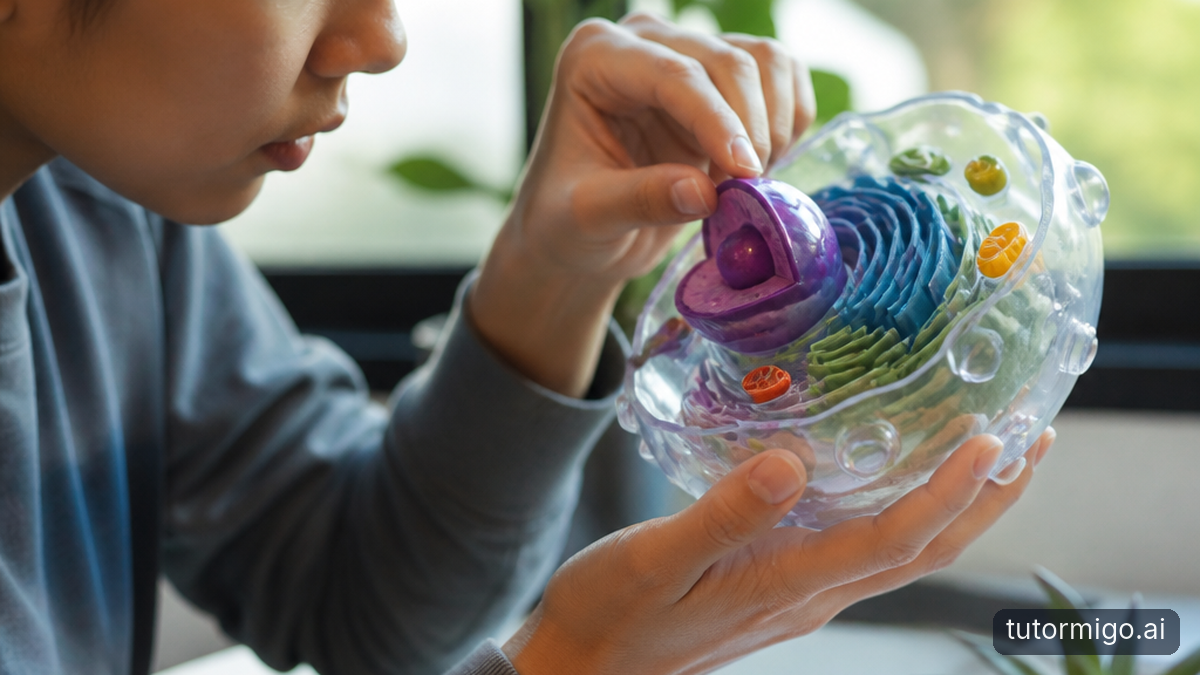
When a student reads a textbook paragraph about photosynthesis, the words can blur together. Seeing how light reaches a leaf, how chloroplasts fit into a cell, and how each step connects creates a more useful mental model. ACT Science rarely rewards memorizing a long definition by itself; it asks students to interpret an experiment, read a diagram, or connect evidence to a biological process. The goal is to make those relationships visible.
During ACT prep, turn biology review into an active explanation. Ask an AI Tutor to describe a process in plain language, then sketch the sequence on a whiteboard: light energy enters, a plant uses carbon dioxide and water, and glucose is produced. Next, cover the labels and explain the diagram from memory. If a passage presents two plant groups under different light conditions, practice identifying the independent variable, the measured result, and the conclusion before looking at the answer choices.
This approach changes review from rereading into retrieval and interpretation. A student who can explain why a result changes is better prepared for unfamiliar graphs than one who has only memorized vocabulary. Keep a short list of biology concepts that still feel unclear, and return to them through targeted ACT practice sets rather than repeating an entire chapter.
Visualize ACT Science Chemistry Without a Lab

ACT Chemistry questions often describe reactions, solutions, gases, or changes in temperature without giving students a chance to handle materials. That can make an abstract prompt feel harder than the underlying idea. Students do not need to perform every experiment to prepare, but they do need to picture what is changing, what is being measured, and which evidence supports the claim.
Use the TutorMigo.ai study tools to work through a passage visually. On a whiteboard, draw particles before and after a change in state, label the variables in an investigation, or organize a table of observations beside the question it answers. Then ask an AI Tutor to challenge the explanation: “What evidence would show that the reaction rate increased?” The follow-up matters because ACT questions often test whether a student can distinguish an observation from an interpretation.
Practice sets should include both familiar and unfamiliar chemistry contexts. After each set, mark whether the miss came from content knowledge, reading the figure, or rushing the question. If a student repeatedly confuses controls and variables, spend ten focused minutes rebuilding that distinction with a new example, then test it immediately. Safe, repeatable visualization makes review more deliberate without pretending that a digital study session replaces a real laboratory.
Make ACT Science Physics Concepts Click
Force, motion, energy, and electricity can seem like collections of formulas when students only see them in notes. On the ACT, however, the work is usually about interpreting a setup, comparing measurements, or predicting what happens when one condition changes. A useful study model lets a student connect the picture, the data, and the explanation instead of treating each question as an isolated calculation.
Start with a simple scenario from a practice passage. Sketch a ramp, mark the direction of motion, and list what the experiment changes and what it holds constant. Use the whiteboard to predict the trend before checking the graph. If the prediction is wrong, ask an AI Tutor to explain the mismatch one step at a time, then restate the idea without copying the response. The point is not to collect more notes; it is to make cause and effect easier to recognize under time pressure.
For electricity questions, students can draw a circuit relationship from the passage and annotate what happens when resistance or current changes, using the units and values provided. Keep the focus on interpretation first and arithmetic second. When a practice set reveals a recurring mistake, separate concept review from pacing practice: understand the model untimed, then answer a similar question with a realistic time limit.
Build ACT Science Timing and Pacing with Targeted Practice Sets
Knowing the science is only part of ACT performance. A student may understand a biology graph but lose points by spending too long on one dense passage. Build pacing gradually with targeted ACT practice sets instead of jumping straight into full-length tests. Begin with one passage and a clear time goal, then review every question before adding another passage. This makes it easier to see whether the problem is reading speed, data interpretation, or uncertainty about the content.
Use a three-pass routine. First, scan the introduction, figures, and question types so the passage has a structure. Second, answer questions whose evidence is easy to locate. Third, return to items that require comparison or calculation. If a question is consuming time without producing progress, mark it and move on. The exact pacing target should reflect the student’s official ACT format and current practice plan, but the habit is consistent: protect time for questions that can be answered with clear evidence.
After each set, record both accuracy and time. A student who gets eight of ten correct in twenty minutes needs a different plan from one who gets six correct in ten minutes. The first may need efficiency; the second may need more careful reading. Use exam preparation practice sets to repeat the weakest question type, then retest it later so improvement reflects a durable skill rather than familiarity with one passage.
Track ACT Section Progress Toward Your Score Goal
Score goals become useful when they are connected to specific actions. Instead of writing “improve Science,” identify a measurable target such as raising accuracy on experiment-design questions or reducing the number of rushed guesses at the end of a section. TutorMigo.ai’s exam preparation progress tracking can help organize practice results so students can see which areas are improving and which still need attention.
Review progress once a week with an adult supporting the ACT plan. Compare recent practice sets with earlier work, but do not focus only on the total score. Ask: Did biology accuracy improve? Are graph questions still taking too long? Did careful review reveal a vocabulary gap or a pacing mistake? A student might discover that the score is flat because chemistry questions improved while physics questions declined. That diagnosis leads to a better next session than simply assigning more questions.
Use the score goal as a direction, not a source of panic. Set a near-term objective for the next seven days, such as completing three focused sets and correcting every missed question in one category. An AI Tutor can help turn a missed answer into a short explanation and a similar practice prompt. Progress tracking then becomes a feedback loop: practice, analyze, adjust, and test the skill again under realistic timing.
Use tutormigo.ai’s ACT Exam Prep to Plan Your Next Steps
Start with a baseline ACT Science practice set completed under realistic conditions. Do not interrupt the set to look up every unfamiliar term; note uncertainty and finish the passage. Then sort missed questions into three buckets: content, evidence, and pacing. This simple review tells you what to do next. Content misses call for a short explanation and visual notes. Evidence misses call for more work with graphs, tables, or experimental design. Pacing misses call for timed repetitions and a decision about when to move on.
Schedule focused sessions rather than relying on last-minute cramming. For example, one session can use the AI Tutor Workspace to clarify a biology process, a second can complete a chemistry practice set, and a third can review physics trends while timing each passage. Use the study tools to draw relationships and explain them aloud. Then return to exam preparation for a fresh set that tests the same skill in a different context.
At the end of each week, compare the evidence with the score goal and adjust the plan. Keep successful strategies, replace activities that create little improvement, and leave time for full-section pacing checks as the test approaches. Science is not just something to read about for the ACT. With TutorMigo.ai, students can visualize relationships, practice deliberately, and turn uncertainty into a clear next step.
Next step: Complete one timed ACT Science practice set today, label each miss by cause, and choose one concept to review before your next set. Try tutormigo.ai now
| ACT Science need | Exam Preparation | AI Tutor Workspace |
|---|---|---|
| Targeted practice | Complete structured ACT practice sets by skill or section. | Ask for a new example that explains the underlying concept. |
| Pacing improvement | Track results across timed practice and review progress. | Discuss a decision rule for moving past a time-consuming question. |
| Missed-question analysis | Use progress tracking to identify recurring weak areas. | Work through why an answer is supported by the passage evidence. |
| Score-goal planning | Compare practice performance with the next milestone. | Turn the weakest area into a focused plan for the next study session. |
Pros and cons
Pros
- Connects ACT Science content review with graphs, diagrams, and evidence-based reasoning.
- Supports targeted practice sets and progress tracking toward a specific score goal.
- Combines structured exam preparation with personalized explanations.
Cons and limitations
- Digital visualization and AI explanations supplement, but do not replace, hands-on lab experience or teacher instruction.
- Students still need timed practice to develop real ACT pacing.
Frequently asked questions
They help students connect diagrams, data, variables, and explanations. A whiteboard or guided AI Tutor conversation can make a process easier to explain before the student applies it to an unfamiliar passage.
No. Learn and explain a difficult concept untimed first, then use timed practice sets to build pacing. Reviewing both accuracy and time shows whether the main issue is knowledge, evidence interpretation, or speed.
Break the goal into smaller targets, such as improving one question type or reducing rushed guesses. Review progress weekly and adjust the next practice session based on specific evidence.
Identify whether the miss came from content, reading the evidence, or pacing. Explain the correct reasoning, complete a similar question, and revisit the skill later under realistic timing.
Explore TutorMigo
Enjoyed this read?
Like, share, or comment below.



Comments
0Sign in required · respectful discussion · replies supported
Loading comments…