


Why Flashcards Study Methods Beat Textbook Staring
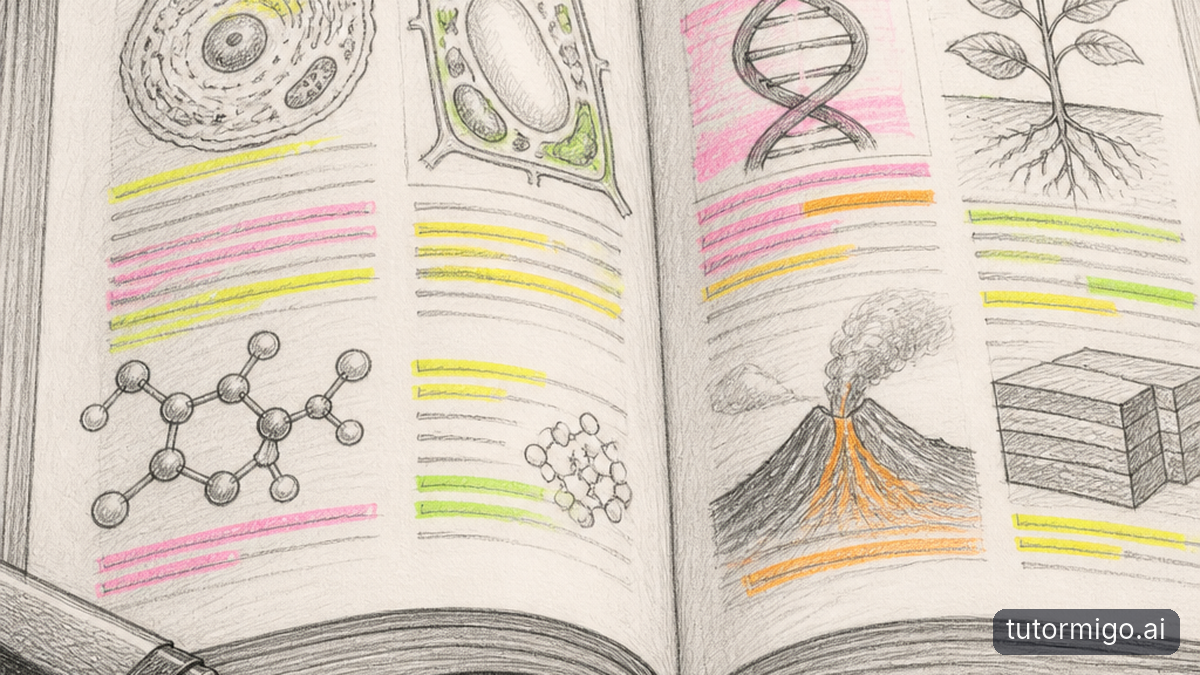
If you have spent an hour highlighting a science chapter and still felt unsure the next day, you are not failing at studying. You are relying on a method that creates familiarity, not reliable recall. When the page is open, the definition looks recognizable; when an exam asks you to explain a process without those words in front of you, the memory may disappear.
Science study requires more than spotting vocabulary. In biology, you need to connect structures with functions and explain mechanisms. In chemistry, you need to predict what changes when conditions shift. In physics, you need to select and apply the right relationship in a new situation. Rereading rarely gives you enough practice with those demands.
Try a simple test after one textbook page: close the book and write everything you can remember, then explain one idea in your own words. The gaps you find are useful. They show where your next review should focus, instead of letting another round of highlighting create a false sense of progress.
Study actively before you feel ready. The effort of retrieving an answer is what helps make that answer easier to retrieve later.
Turn Every Chapter Into a Retrieval Deck

Build a flashcards study deck as you read, rather than waiting until the night before a test. Treat each section heading, diagram, worked example, and concept callout as a possible question. A paragraph about cellular respiration might become: “What are the main stages of cellular respiration, and where does each occur in the cell?” That prompt makes you reconstruct the process instead of recognizing it on the page.
Prefer questions that ask how or why. For enzyme activity, ask why increasing substrate concentration eventually stops increasing the reaction rate. For genetics, ask how a change in DNA could affect a protein’s function. These questions test relationships and mechanisms, which are more useful than isolated definition cards.
Use diagrams actively, too. Cover the labels on a cell diagram, sketch the organelles from memory, and label your attempt before checking the answer. Keep each card focused on one idea. If a card asks for five unrelated facts, split it into smaller prompts so a missed answer tells you exactly what needs work.
TutorMigo’s spaced-repetition flashcards can support this workflow with AI-assisted card creation and scheduled reviews, helping you turn static chapter notes into a reviewable question deck.
Use Spaced Repetition Instead of Cramming
A long cram session can make information feel available for a few hours, but science courses build from one unit to the next. If you forget foundational ideas about forces, bonding, or cell structure, later topics become harder than they need to be. Spaced repetition protects those foundations by bringing information back at increasing intervals.
Start with a short review soon after learning the material. Then revisit difficult cards before they vanish from memory, while allowing more time between successful recalls. A practical schedule might be Day 1 for the first test, Day 3 for cards you missed, Day 7 for a mixed chapter review, and Days 14 and 30 for quick refreshers. Adjust the timing when a card remains difficult.
Do not review only the cards you enjoy getting right. Mark challenging prompts, answer before revealing the back, and say the explanation aloud when the idea involves a process. A fifteen-minute daily routine is usually easier to sustain than a three-hour emergency session, and it gives you repeated opportunities to notice confusion while there is still time to fix it.
For more ideas about combining scheduled reviews with active recall, explore this guide to AI flashcards and study plans.
Use an AI Tutor When Recall Reveals a Gap
A good card does more than show you that an answer is wrong. It reveals the exact point where your understanding breaks down. Perhaps you can name the steps of balancing a chemical equation but do not know why coefficients change. Perhaps you can state that mitosis and meiosis differ but cannot explain how their purposes shape the outcomes.
When that happens, use an AI Tutor for a patient explanation rather than copying the answer and moving on. Ask for a real-world analogy, a step-by-step breakdown, or a simpler explanation that keeps the scientific accuracy. You can also ask for a few new practice questions focused only on the subtopic you missed. That turns one incorrect card into a targeted learning opportunity.
Try Socratic prompts when you want to do the thinking yourself: “What should I identify first?” or “What evidence supports that step?” A personalized AI Tutor can guide your reasoning with questions instead of immediately giving away the solution. After the explanation, return to the original card and answer it without looking. If you still miss it, rewrite the prompt so it is clearer and more specific.
For practical examples of using tutoring to identify and address weak spots, read about how an AI Tutor adapts to learning gaps.
Make Difficult STEM Ideas Interactive
Science becomes easier to remember when you use an idea, not just read about it. After reviewing a physics concept, calculate what happens in a realistic scenario, such as how changing the mass of a vehicle would affect its motion. In chemistry, draw a molecule, predict how a bond might behave, and explain what evidence would support your prediction. In biology, trace a process from cause to outcome without referring to the diagram.
Use the Feynman technique when a concept feels familiar but unstable. Explain it aloud to an imaginary beginner using plain language. If you cannot describe why an enzyme’s active site matters, return to that exact gap and create a new question card. Teaching also exposes missing links that rereading can hide.
Interactive tools can add another layer of practice. A digital whiteboard gives you room to sketch cycles, label pathways, and work through relationships. A math step editor can help you inspect the reasoning behind quantitative science problems, while a code sandbox can support computational examples when coding is part of the activity. TutorMigo’s Study Tools Hub brings these interactive options together for problem-solving practice.
Connect a topic to a real event, experiment, or observation when possible. A news story about climate, medicine, or energy can give a textbook mechanism a memorable context without replacing the core scientific explanation.
A Simple Plan for Your Next STEM Test
Begin by auditing your current routine. For one study session, record how much time you spend rereading and how much time you spend answering questions without help. If most of the session involves looking at the page, change the balance gradually rather than trying to rebuild everything overnight.
Build your deck during the first days of a unit. Add questions from headings, diagrams, processes, and difficult examples. Spend about fifteen minutes each day on scheduled reviews, then reserve another short block for problems or explanations. When you miss a card, do not just repeat it immediately; identify the misunderstanding, get a clear explanation, and test yourself again later.
Before the test, mix topics instead of reviewing one chapter in isolation. A mixed session might ask you to explain a cell process, interpret a chemistry scenario, and choose a physics relationship. This feels harder because you must decide what knowledge applies, but it better matches unfamiliar exam prompts.
Next time you open a science textbook, read a small section, close it, and create three questions from memory. Review those questions on a spaced schedule, use an AI Tutor when an answer exposes a gap, and solve at least one applied problem. That is how reading becomes durable science study.
| Method | What you do | Best use | Main limitation |
|---|---|---|---|
| Rereading and highlighting | Review the same textbook pages repeatedly | Build initial familiarity with a new topic | Recognition can feel like mastery, but recall may remain weak |
| Retrieval flashcards | Answer focused questions before checking the answer | Remember definitions, mechanisms, diagrams, and formulas | Cards must be written clearly and reviewed consistently |
| Spaced-repetition flashcards | Revisit cards at increasing intervals, prioritizing difficult ones | Keep foundational science knowledge available over time | Requires a regular review habit rather than one long session |
| Interactive problem-solving | Explain, sketch, calculate, or apply a concept in a new scenario | Test whether you can transfer knowledge beyond the textbook | Can feel difficult before the underlying concept is secure |
Frequently asked questions
Convert headings, diagrams, processes, and worked examples into concise questions. Focus on how and why prompts, keep each card to one concept, and use diagrams as blank-label or sketch-from-memory challenges.
Start with a review on the day you learn the concept, then revisit difficult cards after a short interval and mix the full deck about a week later. Add longer refreshers around two and four weeks afterward.
Find the specific misunderstanding instead of repeatedly guessing. Ask an AI Tutor for a simpler explanation, analogy, or targeted practice, then rewrite the card and test yourself again later.
Yes, but use it briefly to build context or check an explanation after attempting recall. Rereading should support questioning, problem-solving, and spaced review rather than replace them.
Related reading
Enjoyed this read?
Like, share, or comment below.



Comments
0Sign in required · respectful discussion · replies supported
Loading comments…