

8:15 PM: When Homework Takes Over the Kitchen Table

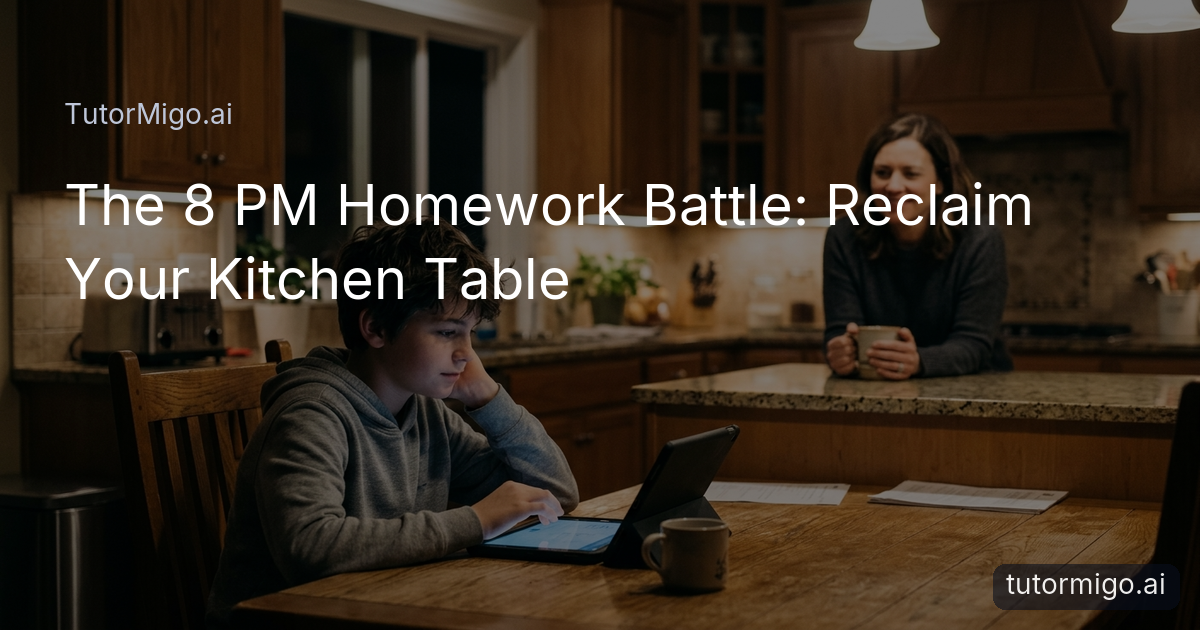
The clock on the kitchen wall ticks with a heavy, rhythmic thud that seems to grow louder with every passing second. It is 8:15 PM. The dinner plates have been cleared, but the scent of roasted chicken still lingers in the air, now mixed with the sharp, metallic smell of pencil shavings and the ozone hum of a laptop fan. Sarah sits at the island, her third cup of coffee—now stone cold—resting untouched beside her. Across from her, the kitchen table is a chaotic landscape of crumpled worksheets, scattered colored pencils, and an open algebra textbook that looks more like an ancient, undecipherable manuscript than a 7th-grade learning tool.
Her son, Leo, is slumped in his chair, his chin nearly touching the wood. He has been staring at the same problem for twenty minutes: a complex equation involving variables that seem to mock him from the page. His defensive slouch is a physical wall he’s built between himself and the math. Sarah can see the tension in his shoulders, the way his knuckles are white as he grips his pencil. She’s exhausted after a nine-hour workday and a commute that felt like a marathon. She just wants the day to be over. She wants to tuck him in, read a chapter of a book, and finally sit down herself.
Then, it happens. The snap. Sarah hears her own voice, sharper than she intended, cutting through the silence: "Leo, it’s not that hard! We just went over this three times. You just need to move the 'x' to the other side. Why aren't you listening?" Leo’s head drops further. A single tear hits the worksheet, smudging the graphite. The kitchen table, once a place for family meals and laughter, has officially become a war zone. This isn't just about math anymore; it’s about a relationship fraying under the weight of a curriculum neither of them fully understands in this moment of fatigue.
Why the 8 PM Homework Battle Is About More Than Algebra
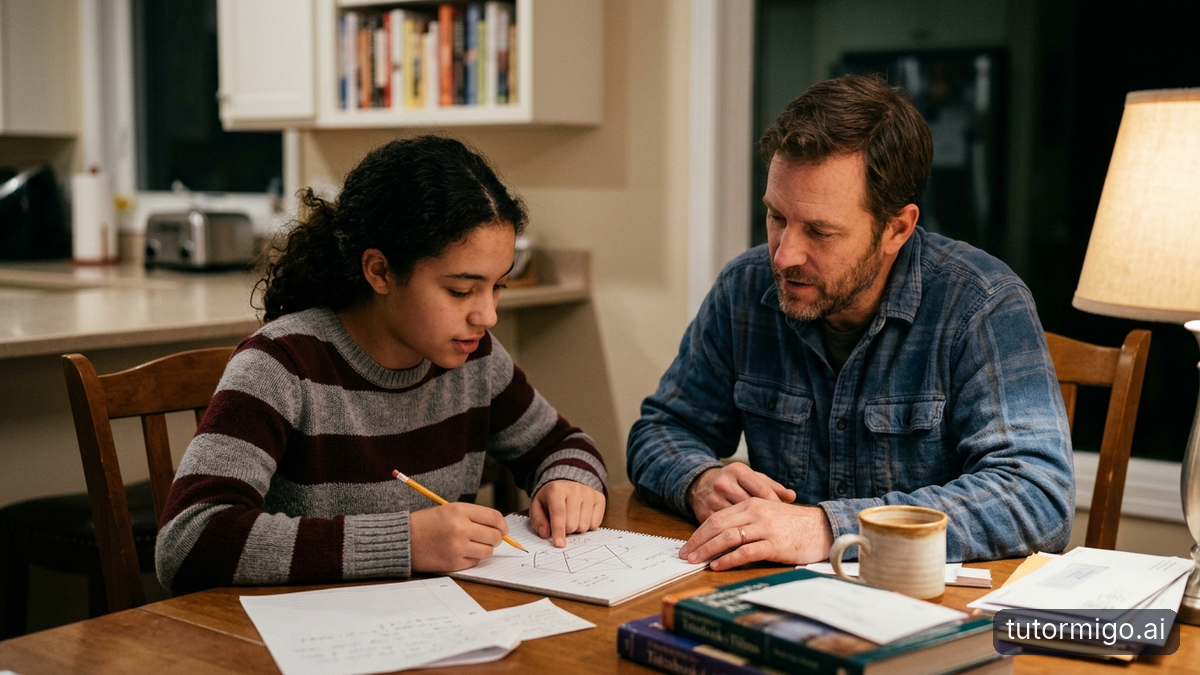
It is a common misconception that homework battles are caused by a lack of discipline or a "difficult" subject. In reality, the 8 PM explosion is the result of a perfect storm: cognitive fatigue meeting emotional friction. By the time the sun goes down, both the parent and the child have exhausted their "executive function" reserves. This is the part of the brain responsible for problem-solving, impulse control, and emotional regulation. When Leo stares blankly at a problem, it’s not because he’s being lazy; it’s because his brain is literally too tired to process the logic required for abstract algebra.
For parents like Sarah, the frustration stems from a place of love and high stakes. We want our children to succeed, to keep up, and to feel confident. When they struggle, we feel a secondary sense of failure. This pressure creates a "performance anxiety" environment at home. Instead of the kitchen table being a sanctuary—a place where a child feels safe and relaxed—it becomes an extension of the high-pressure classroom. When a parent becomes the "enforcer" of schoolwork, the traditional roles of nurturer and protector are temporarily suspended, replaced by a dynamic of critique and correction.
This emotional friction is why even the most patient parents find themselves snapping. We aren't trained as educators, and we certainly aren't trained to teach after a full day of professional and domestic labor. When our children sense our frustration, their brains enter "fight or flight" mode. Once the amygdala is hijacked by stress, all logical learning stops. You can explain the Pythagorean theorem ten different ways, but if the child is crying or defensive, they are biologically incapable of absorbing the information. The battle isn't over the math; it's over the loss of peace in the home.
The Parent-and-Teacher Trap: When Helping Starts to Hurt
Modern education has changed significantly since most parents were in school. The introduction of Common Core and new pedagogical standards means that the "way" students are taught to solve problems is often entirely different from the methods we learned twenty years ago. Sarah remembers "carrying the one," but Leo is being asked to "regroup" using a visual number bond that looks like a foreign language to her. When she tries to help, she accidentally confuses him further, leading to the dreaded phrase: "That’s not how my teacher told us to do it!"
This is the "Parent-and-Teacher Trap." We feel obligated to be the primary source of academic support, yet we lack the specific training to deliver the curriculum in the way the school expects. This creates a cycle of "un-teaching" and "re-teaching" that wastes time and fuels resentment. Furthermore, there is a unique psychological pressure when a child learns from a parent. Children are often more sensitive to the judgment—perceived or real—of their parents than they are to a teacher or a third-party tutor. They want to please us, and when they can't grasp a concept, they feel they are letting us down.
When helping starts to hurt, it manifests as a breakdown in communication. The parent feels like they are talking to a brick wall, and the student feels like they are being interrogated. This trap is particularly dangerous because it turns the home into a place of stress. The sanctuary is gone. If every evening is defined by a struggle over worksheets, the child begins to associate learning with conflict and their parents with pressure. Breaking this cycle requires a shift in perspective: recognizing that being a great parent doesn't have to mean being a perfect tutor.
The Moment You Choose Empathy Over Another Explanation
The turning point often comes in a moment of quiet clarity, usually right after a particularly loud outburst. Sarah sees the smudge on Leo's paper and the way he’s trying to hide his face. She takes a deep breath, letting the cold coffee sit. She realizes that no amount of shouting about fractions is worth the look of defeat on her son's face. She chooses empathy. She walks over, puts a hand on his shoulder, and says the most powerful words a parent can say in that moment: "I’m sorry I snapped. This is hard, and we’re both tired. Let’s take five minutes."
This pivot is the first step toward reclaiming the evening. It’s the realization that the relationship is more important than the assignment. But the assignment still exists. The deadline is still tomorrow. This is where the shift to modern tools becomes essential. What if Sarah didn't have to be the one to explain the variables? What if she could go back to being the person who provides the snack, the hug, and the encouragement, while someone—or something—else handled the technical "how-to" of the homework?
Choosing empathy means acknowledging our own limitations. It means admitting that we don't have to be the expert in everything. By stepping back from the role of the frustrated tutor, we allow our children to take more ownership of their learning. We move from being the "enforcer" to being the "facilitator." This shift creates space for a new kind of support—one that is patient, consistent, and free from the emotional baggage of the parent-child dynamic. It’s the moment you decide that your kitchen table should be a place of peace again.
Meet TutorMigo.ai: A Patient, Personalized Co-Pilot for Stuck Students
Imagine a tutor that never gets tired, never has a long day at the office, and never loses patience when a student asks the same question for the tenth time. This is the role of TutorMigo.ai. It isn't just a search engine or a calculator; it is a sophisticated, gentle co-pilot designed to sit across from your child on their tablet or laptop. Acting as a dedicated AI Tutor, the platform provides a calm, non-judgmental space where students can express their confusion without fear of "disappointing" anyone.
When Leo logs into the AI Tutor Workspace, he isn't met with a wall of text or a cold "incorrect" message. Instead, he finds an interface designed for interaction. He can type in the problem he’s struggling with, or even describe his confusion in plain language: "I don't get why the 'x' moves." TutorMigo.ai doesn't just bark back the answer. It uses a Socratic approach, asking guiding questions like, "What do you think would happen if we tried to get all the numbers on one side first?" It breaks the mountain of a problem into tiny, manageable baby steps.
For Sarah, the presence of TutorMigo.ai changes the entire atmosphere of the kitchen. She is no longer the one hovering over the table, trying to remember 7th-grade math. Instead, she’s across the island, finally sipping a fresh cup of tea. She watches as Leo engages with the screen. There is no shouting. There are no tears. There is only the soft clicking of keys and the occasional "Oh, I get it now!" from her son. The platform acts as a buffer, absorbing the academic frustration so the family can focus on being a family.
How TutorMigo Benefits Families With Guided Steps, Session Continuity, and Interactive Study Tools
One of the primary TutorMigo benefits is the way it integrates specialized tools into the learning process. While a standard chat interface might struggle with complex notation, TutorMigo.ai features a dedicated math step editor and an interactive whiteboard. If Leo is struggling with a geometry proof, he can visualize it on the digital whiteboard, making the abstract concepts concrete. These tools are designed to mimic the best parts of an in-person tutoring session, providing a multi-sensory approach to learning that caters to different student needs.
Another critical feature is session continuity. In the heat of an 8 PM battle, it’s easy to forget what was learned the night before. TutorMigo.ai maintains a complete session history, allowing Leo to pick up exactly where he left off. If he mastered one type of equation on Tuesday but is struggling with a variation on Wednesday, the AI remembers his previous breakthroughs and uses them as a foundation. This continuity builds confidence, as the student can see their own progress documented over time. It also helps with long-term goals, such as IELTS preparation or SAT practice, where tracking improvement is vital.
Beyond the immediate homework help, the platform offers spaced-repetition flashcards and structured exam prep. This means that the learning doesn't stop once the worksheet is done. If Leo finds a particular concept tricky, he can instantly create a flashcard deck to review later. For parents, the Parent Dashboard provides total visibility. Sarah can log in and see exactly what Leo has been working on, where he’s excelling, and where he might need a little more support from his teacher. It’s visibility without the hovering, support without the stress.
TutorMigo.ai vs. General AI Chatbots: What Changes During Homework Time
In the age of generative AI, it might be tempting to think that any chatbot can help with homework. However, there is a profound difference between a general-purpose AI and a specialized AI Tutor like TutorMigo.ai. General chatbots are designed to provide answers as quickly as possible. If you give them a math problem, they give you the solution. While this might help a student finish their homework faster, it does nothing to help them actually learn the material. In fact, it can lead to a "dependency trap" where the student becomes unable to solve problems without the bot's help.
TutorMigo.ai is built with pedagogical integrity. Its primary goal isn't to give the answer; it’s to teach the process. It is programmed to be a "guide on the side," not a "sage on the stage." If a student asks for the answer, the platform will gently redirect them back to the logic of the problem. This ensures that when the student sits down for a test in the classroom, they actually have the skills to succeed. It mimics the behavior of a high-quality human tutor who knows when to give a hint and when to let the student struggle just enough to make a breakthrough.
Furthermore, general chatbots lack the interactive study tools that make TutorMigo.ai effective. A standard text box cannot provide a code sandbox for a computer science student or a math editor for a calculus student. TutorMigo.ai also offers a safe, controlled environment tailored for education. Parents don't have to worry about their children stumbling into inappropriate content or receiving hallucinated facts that aren't aligned with their curriculum. It is a tool built specifically for the kitchen table, designed to handle the unique pressures of the 8 PM homework hour.
From Tears to Confidence: Reclaim Your Evenings With TutorMigo.ai
The transformation of the 8 PM hour is one of the most rewarding experiences for a TutorMigo family. Imagine the scene again: it’s 8:45 PM. In the old reality, Sarah and Leo would still be locked in a stalemate, both of them miserable and exhausted. In the new reality, the kitchen is quiet. Leo has finished his algebra, not because someone did it for him, but because he had a patient co-pilot to guide him through the fog. He closes his laptop with a sense of accomplishment, his "performance anxiety" replaced by genuine confidence.
Sarah is no longer the "Homework Enforcer." She’s just Mom. She can spend those last fifteen minutes before bed talking to Leo about his day, his friends, or the movie they want to see this weekend. The "war zone" has returned to being a kitchen table. By outsourcing the academic friction to a specialized AI tool, the family has reclaimed their evening. They have protected their relationship and ensured that learning remains a positive, empowering experience rather than a source of domestic strife.
Reclaiming your evenings starts with a simple choice to change the dynamic. You don't have to do this alone, and your child doesn't have to feel stuck. With TutorMigo.ai, you can provide your child with world-class, personalized support while you get back to being the parent they need. Try TutorMigo.ai for free today and see how quickly the 8 PM battle can turn into a 8 PM victory. Your kitchen table—and your peace of mind—will thank you.
| Feature | TutorMigo.ai | General AI Chatbots | Traditional Tutors |
|---|---|---|---|
| Pedagogical Approach | Socratic/Step-by-Step Guidance | Direct Answer Generation | Variable/Human-led |
| Availability | Instant 24/7 Access | Instant 24/7 Access | Scheduled Appointments Only |
| Parent Visibility | Real-time Dashboard & History | None/Private History | Occasional Progress Reports |
| Interactive Tools | Math Editor, Whiteboard, Code Sandbox | Text-only Chat | Physical/Manual Tools |
| Cost Efficiency | Affordable Monthly Subscription | Free or Subscription | High Hourly Rates (150/hr) |
Pros and cons
Pros
- Provides instant, 24/7 support exactly when students get stuck.
- Removes emotional friction between parents and children over schoolwork.
- Features specialized interactive tools like math editors and whiteboards.
- Offers parent visibility into learning progress and session history.
Cons and limitations
- Requires reliable internet access for real-time tutoring.
- Does not replace the social benefits of in-person classroom interaction.
Frequently asked questions
Unlike general chatbots that often just provide the final answer, TutorMigo.ai is designed with a Socratic approach. It asks guiding questions, breaks complex problems into smaller steps, and uses interactive tools like the math editor to ensure the student actually understands the concept rather than just copying a result.
Absolutely. Through the Parent Dashboard, you can see exactly what topics your child is working on, review their session history, and track their progress over time. This allows you to stay informed without having to hover over their shoulder during the actual study session.
TutorMigo.ai is built to support a wide range of grade levels and subjects, from middle school math and science to advanced high school subjects. It also includes structured preparation for major exams like the SAT, ACT, AP, and IELTS.
Explore TutorMigo
Enjoyed this read?
Like, share, or comment below.



Comments
0Sign in required · respectful discussion · replies supported
Loading comments…