


Find the sticking point in math homework before using AI

When your child says, “I don’t get any of it,” it is tempting to paste the whole assignment into an AI chat. Start with a smaller question: “Show me where you stopped knowing what to do.” That separates a confusing instruction from a missing skill, a calculation slip, or simple tiredness. Each needs a different response, and none becomes clearer when a screen delivers an entire page of solutions.
Ask your child to read one problem aloud and explain what it asks. If the task is , do they understand that they are finding how many equal groups fit, or how much belongs in each group? If they understand the task but cannot recall the fact, they need different help from a child who does not understand division.
Look at their class example before asking AI anything. A teacher may be using drawings, grouping, or a particular written method. Starting there avoids introducing a second approach just when your child is trying to understand the first. You can tell the AI, “Explain this using equal groups, matching the method in this example.”
If the same difficulty appears across several assignments, save a sample to discuss with the teacher. This guide to homework help versus tutoring can help you distinguish an occasional sticking point from a recurring learning gap.
Ask for one hint, then hand the thinking back
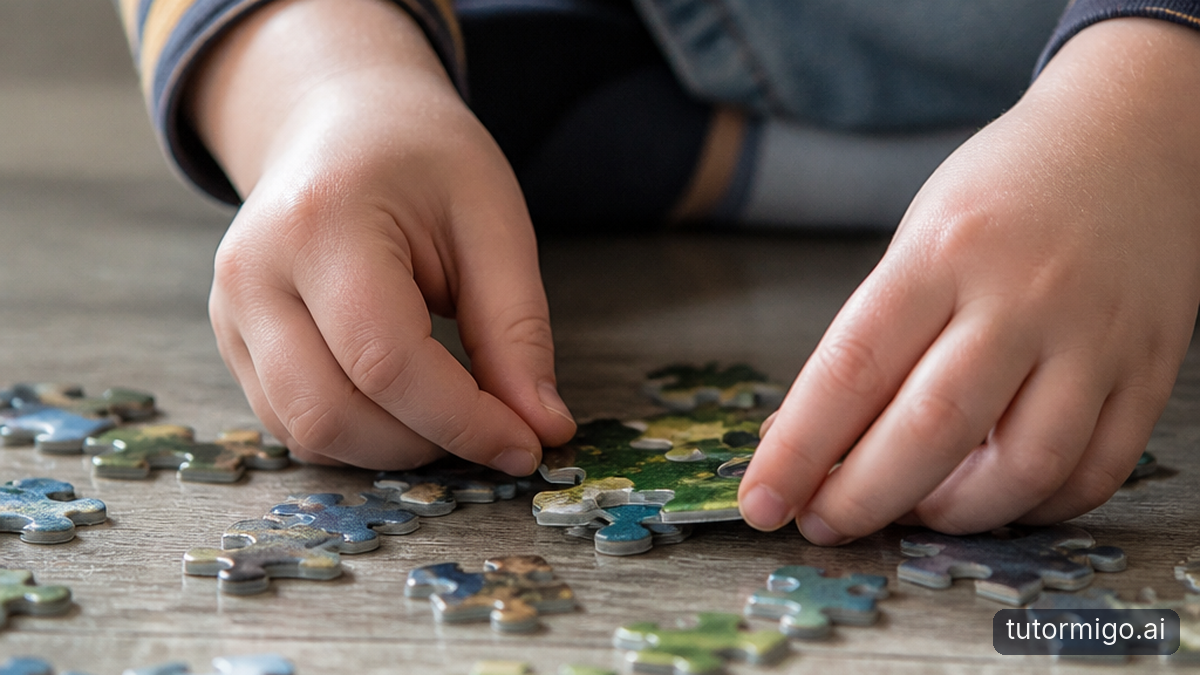
A useful AI prompt sets boundaries before asking for help. Try: “My child is working on subtraction with regrouping. Ask what they have tried, then give one hint at a time. Do not give the final answer. Wait for their response.” Include the actual problem and the method used in class, but leave out identifying information.
For , a useful first hint might ask whether there are enough ones to subtract. Your child should answer that question before receiving the next explanation. If the AI immediately supplies a complete solution, stop reading it aloud. Ask it to return to the first unfinished step, or close the response and discuss that step yourselves.
Keep the conversation active by having your child explain the hint in their own words. “What does regrouping change?” tells you more than “Do you understand?” A child may agree with a polished explanation without being able to use it. Let them write the next line or move the counters rather than watching you do it.
After a hint, give them quiet thinking time. Avoid filling every pause with another question. The goal is not to finish a conversation with AI; it is to make the next piece of the homework possible. For more on this boundary, see using AI without letting it do the homework.
Turn explanations into something your child can test
If an explanation is not landing, ask for a different representation rather than a longer version of the same wording. You might request a number-line explanation, an equal-groups example, or instructions for using household objects. Then move away from the screen and try it. Counters, dried beans, and folded paper make an abstract explanation easier to inspect.
Suppose your child thinks is larger than because the denominator is larger. Ask AI for an explanation using two identical paper strips. Fold one into thirds and the other into quarters, then compare one piece from each. The important detail is that the wholes must be the same size. Otherwise, the demonstration can accidentally reinforce confusion.
Next, ask your child to connect the model to the written problem: “Which strip shows each fraction? Why is one piece smaller?” An explanation becomes useful when they can point to what it means, not simply repeat the phrase “larger denominator.” Keep the language close to the terms their teacher uses.
Finally, test the idea on a nearby example, such as comparing with . Do not introduce several new difficulties at once. One similar problem shows whether the explanation transferred; a much harder problem may only show that your child needs help with something else.
Check the reasoning instead of trusting the screen
AI can produce incorrect arithmetic, skip a necessary step, or confidently explain a method that does not fit the question. Treat its response as something to examine together, not an answer key. Asking the same tool whether it is certain is not an independent check; it may simply repeat its original mistake more confidently.
Teach your child a check they can perform themselves. For , addition provides a useful check: . Estimation offers another clue. Since , subtracting a little less should produce a result a little greater than . These checks connect the answer to meaning rather than to the authority of a screen.
Word problems need a separate sense check. Ask, “What does this answer describe?” If the question asks how many bags are needed, an answer describing the number of objects in each bag may be numerically tidy but solve the wrong problem. Have your child finish a sentence explaining the result in context.
If the AI’s explanation conflicts with a class example, pause and compare the steps. A different valid method is not automatically wrong, but it may be unhelpful tonight. When neither of you can resolve the disagreement, mark the question for the teacher instead of drilling a doubtful explanation.
Protect confidence, privacy, and independent practice
Homework help works better when mistakes feel safe to discuss. Say, “That step tells us what to look at next,” rather than treating an error as evidence that your child was not listening. Praise something specific: noticing a mismatch, trying a drawing, or explaining why an answer cannot be right. Those are habits your child can repeat.
If you notice tears, guessing, or repeated requests for the answer, stop adding explanations. Take a short break, then return to one manageable step. More AI interaction is not always more learning. A tired child may need rest or a note to the teacher explaining where they became stuck, not another version of the same lesson.
Set practical boundaries before using a tool. Follow the school’s rules about AI, check the service’s age requirements, and supervise use as appropriate. Type only the problem or remove names, school details, and other identifying information from anything you share. Do not assume a homework photo contains nothing private.
End each supported example with a similar attempt without AI. You can stay nearby, but let your child choose the first step and explain their check. If they still need help, note which part remains difficult. Independence grows through supported attempts followed by opportunities to try alone, not through removing help all at once.
Try a simple routine on the next assignment
For the next homework session, choose one problem rather than changing your whole evening. Ask your child what they already know, look at the classroom method, and identify the exact sticking point. Only then open AI and request a single hint. This keeps the tool in a supporting role from the start.
Let your child act on that hint on paper or with objects. Ask them to explain what changed, then check the result using estimation, an inverse operation, or the original question. Finish with one similar problem without the screen. You are looking for evidence that they can take the next step, not that the chat produced an impressive explanation.
Afterward, ask, “What helped you understand?” Their answer might be the paper strips, a simpler question, or having time to think. Use that information tomorrow. If the same obstacle returns, share the example and what you tried with the teacher so you can agree on a consistent approach.
If you want a place to continue these guided conversations, TutorMigo.ai offers a personal tutoring workspace with chat and session history. Whichever tool you choose, keep the same rule: your child attempts, explains, and checks the work, while AI supplies only the support they need.
Frequently asked questions
Avoid starting with a finished solution. Ask your child to attempt the problem first, then request a hint for the specific step that caused difficulty.
Ask it to follow the classroom example. If the methods still conflict or the explanation seems doubtful, save the question for the teacher rather than insisting on the AI’s approach.
Ask them to explain their reasoning and try a similar problem without AI. A correct answer alone does not show whether they can repeat the process independently.
Yes, it can suggest explanations and questions to ask. Check its reasoning against class materials, use concrete examples, and involve the teacher when you cannot resolve a disagreement.
Explore TutorMigo
Enjoyed this read?
Like, share, or comment below.



Comments
0Sign in required · respectful discussion · replies supported
Loading comments…