

When Homework Help Isn’t the Answer

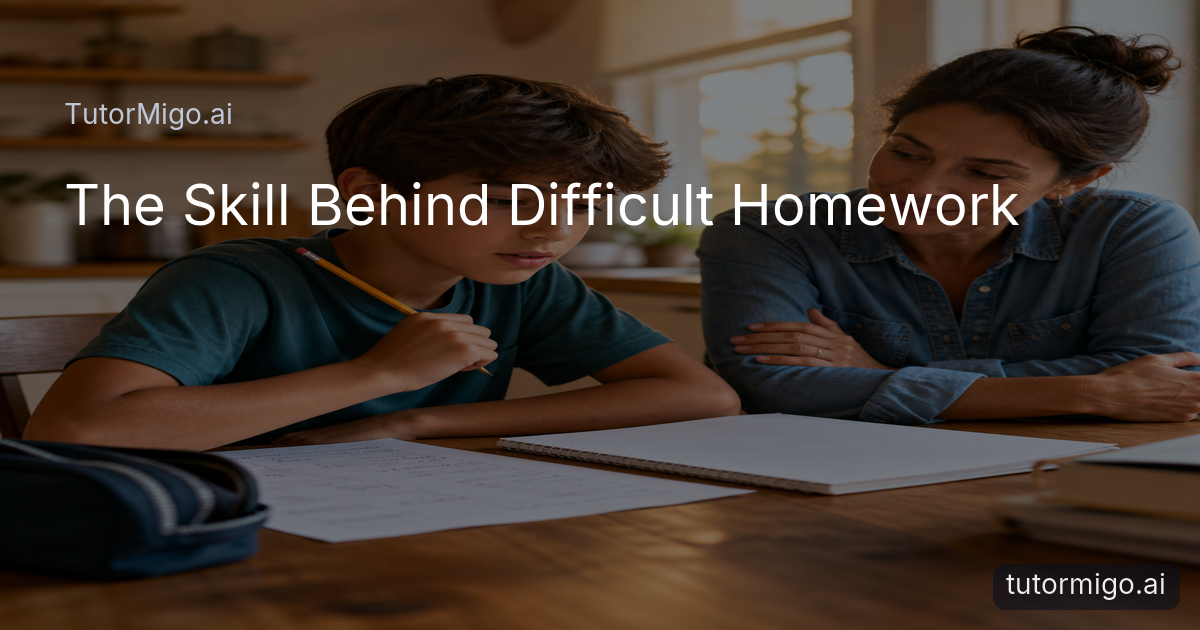
“I can’t do this” does not always mean “I don’t know the answer.” Sometimes it means, “I don’t know how to begin.” A student may understand the words in a homework question, recognize the topic, and still sit with a blank page because the first move is unclear. That pause can feel like failure even when it is really an approach problem.
Consider a student reading a science question about how changing one variable might affect an experiment. They may know the relevant vocabulary, but not know whether to define the variable, draw a diagram, recall a class example, or start with a prediction. The difficulty is not only remembering information. It is deciding what to do with it.
That distinction matters for homework help. If support supplies only a finished response, it may remove the immediate discomfort without helping the student recognize a useful starting point next time. More useful support can make the opening move visible: identify what is known, clarify what is being asked, and choose a reasonable first action. Knowing where to start is not a minor study trick. It is part of learning how to solve problems.
Why Starting Can Feel Harder Than Solving

Difficult homework problems often ask students to make several decisions before they can use any subject knowledge. Which details matter? Which concept from class fits? Is there one expected method or several? What would count as evidence that the first step is working? When several possibilities seem plausible, choosing one can feel riskier than doing nothing.
Information overload adds to the friction. A word problem may include numbers, conditions, background context, and a question that appears at the end. A history prompt may contain a broad topic but require a narrow claim. A coding task may describe an outcome without showing how to divide it into smaller operations. In each case, the student has to sort the task before answering it.
Prior experience also varies. One learner may have practiced identifying the relevant concept many times, while another may still be learning how textbook language maps to classroom methods. That does not mean every student needs the same intervention. Some need a reminder, some need a worked example, and some need reassurance that a tentative first step can be revised.
For parents and teachers, the key observation is simple: a long pause at the beginning is information. Asking, “What part feels unclear—the content or the first move?” can reveal more than asking whether the student knows the answer.
Turn One Large Problem Into Smaller Questions
A practical way to get moving is to translate a large question into a short sequence of smaller ones. Start with: What do I know? List the facts, definitions, measurements, instructions, or evidence provided. Next ask: What am I being asked to find or explain? Put the goal in your own words. Then consider: Which concept might apply? Finally ask: What could I try first?
Imagine a mathematics problem that describes the cost of several notebooks and asks for the price of one notebook. Before calculating, a student might underline the total cost, note the number of notebooks, restate the goal, and decide that a relationship between the total and the number of items is relevant. The important learning moment is not the arithmetic alone. It is sorting the information and selecting an entry point.
These questions also work beyond mathematics. For a literature response, the student can identify the passage, name the claim the prompt requires, select a relevant detail, and draft one observation. For a science task, they can identify the variables, state what changes, and predict what the comparison should show.
Try this before asking for a solution: write one sentence for what you know, one sentence for what you need, and one possible first action. A tentative beginning is often easier to improve than a blank page.
Why a Full Answer Is Not Always the Best First Step
A complete solution has a legitimate place in learning. If a student has attempted the problem, checked their work, and still cannot see the connection, a carefully explained solution can clarify the method. It may also help after an assignment, when the student is comparing approaches or correcting a misunderstanding. The issue is not that answers are always harmful; it is what happens before and after the answer appears.
When a finished response arrives immediately, the student may copy the sequence without learning how to recognize a similar problem. The next question can feel just as unfamiliar because the crucial decisions—what matters, which concept fits, and why the first operation comes first—were made by someone else.
A better sequence is often proportional support. First, ask the learner to identify the goal. Then offer a concept reminder or a simpler example. If that is not enough, show one step and ask the student to continue. Only after a genuine attempt should a full worked solution become the main focus, with attention to the reasoning rather than the final line.
This is also where adults can avoid turning homework into a test of endurance. The goal is not to withhold help until frustration peaks. It is to give enough guidance for the student to participate in the thinking.
What Helpful AI Tutoring Can Do at the Starting Point
AI tutoring for homework can be useful when a student needs support at an inconvenient moment but is not ready to hand over the whole task. An AI Tutor can invite the learner to describe what they understand, restate the question in simpler language, or explore which concept seems connected. It can also explain a term, provide a comparable example, or ask the student to propose the next step. These forms of homework assistance can make the beginning less intimidating while keeping the learner involved.
That support still requires judgment. A student should attempt something, inspect the explanation, and ask follow-up questions when the reasoning does not make sense. An AI tutor for students should be treated as a learning partner, not an automatic answer key. Responses can require checking, especially when the task depends on a teacher’s instructions, a particular source, or a specific method taught in class.
The most useful interaction may be small. A student might say, “I know the total and the number of items, but I do not know what relationship to use.” The tutor can help clarify the choice without pretending that uncertainty is a problem to hide. Over time, repeated practice with these opening questions can make problem solving for students more deliberate and less dependent on immediate answers.
For families and educators comparing online tutoring options, look for support that keeps the student’s attempt visible and makes explanations easier to revisit. That is a more meaningful measure than whether a tool can produce a polished response quickly.
TutorMigo.ai and the Reusable First Step
TutorMigo.ai offers an example of how a dedicated AI tutoring platform can fit into this process. Its AI Tutor Workspace provides personalized tutoring chat with expert personas and session history, so a learner can return to an earlier conversation instead of starting from zero. That continuity may be useful when a student is working through the same kind of confusion across several assignments.
The platform also includes interactive study tools, such as a whiteboard, code sandbox, and math step editor, which can give a learner a place to represent an idea rather than only read an explanation. After a concept has been clarified, spaced-repetition flashcards and scheduled review can help the student revisit key terms or methods. Those tools do not replace the student’s judgment, but they can support the broader process of attempting, checking, and remembering.
When comparing TutorMigo benefits with a general-purpose generative chatbot, the practical question is not simply which system can answer a question. Ask whether the learning experience helps you preserve context, work with the problem, and return to ideas later. TutorMigo.ai is best understood as one option for guided learning with AI, not as a guarantee of correct work or a substitute for a teacher’s expectations.
The next time a difficult homework problem stops you, pause before searching for the final answer. Write down what you know, name what you need, and choose one action you can check. The move from “I don’t know where to start” to “I know what I can try first” is a small result, but it is a reusable one.
Frequently asked questions
They may not know which information matters, which concept applies, or how to divide a large task into smaller steps. Uncertainty about whether a first move is correct can also create hesitation.
Ask what is known, what must be found or explained, which concept may apply, and what first action could be tried. Write each answer down before solving.
It can provide explanations, examples, and guided discussion that help a student identify a starting point. Students should still attempt, check, and understand the work themselves.
A complete solution can help after a real attempt or when an explanation is needed, but immediate answers may bypass the reasoning students need to recognize similar problems later.
Enjoyed this read?
Like, share, or comment below.


Comments
0Sign in required · respectful discussion · replies supported
Loading comments…