


Why different learning speeds call for personalized learning

Learning speed is not a simple measure of ability. What you already know changes how much new information you need to handle. If you understand fractions securely, a lesson on ratios may feel familiar. If fractions still require careful thought, that same lesson asks you to learn something new while managing an unfinished foundation. More time may be exactly what you need, not evidence that you cannot learn.
Your circumstances matter, too. Tiredness, stress, unfamiliar vocabulary, and interruptions can make an explanation harder to follow. You might explain a scientific idea confidently in conversation but struggle with a densely written question about it. That difference points toward a useful adjustment: unpack the wording before repeating the entire lesson. For more context, explore why students need different learning speeds.
Different needs also do not mean you belong to a fixed learning-style category. A diagram may help with one topic, while a worked example helps with another. Instead of deciding that you are simply a slow learner, ask a narrower question: what is getting in the way right now? The answer might be missing background knowledge, unclear language, insufficient practice, or needing a break.
Adapt the explanation, not just the amount of work
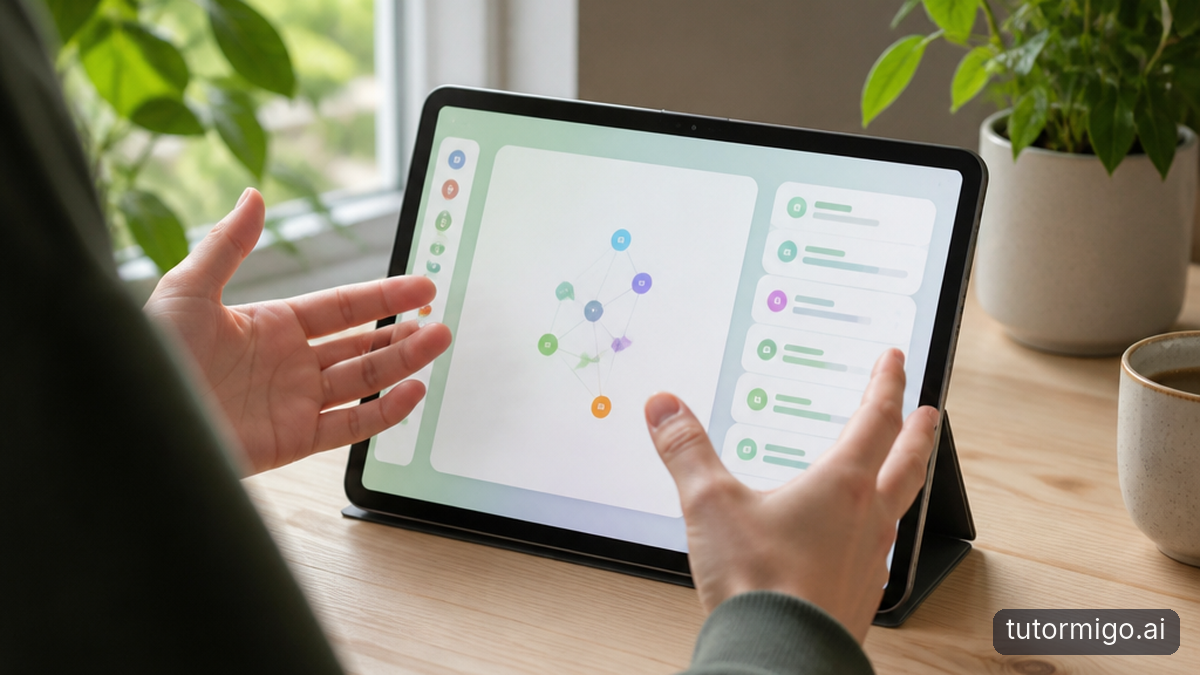
Adaptive learning means changing the support in response to what you understand. It should involve more than assigning extra questions after an error. If you keep confusing area with perimeter, another nearly identical question may reinforce the confusion. A better response is to contrast covering a surface with measuring its boundary, then ask you to explain the difference using a familiar object.
A Tutor can help you explore those alternative explanations. In TutorMigo.ai’s personal tutor workspace, you can describe the precise sticking point and request a simpler explanation, a contrasting example, or a question that checks your reasoning. Try: “I can follow your example, but I cannot explain why that step works. Ask me one question at a time.” Your answers give the conversation a clearer direction than “I don’t get it.”
Session history also gives you a record to revisit instead of relying entirely on memory. Open an earlier exchange, identify the explanation that helped, and use it as your starting point. Do not assume that saved conversations prove mastery or automatically diagnose gaps. Check your understanding with a fresh question, without looking at the earlier solution, and use the result to decide what support comes next.
Turn explanations into interactive practice and recall
An explanation can feel clear while you are reading it, yet disappear when you try the task alone. Interactive practice exposes that gap. TutorMigo.ai’s Study Tools Hub includes a whiteboard, code sandbox, and math step editor, giving you different ways to work through a problem rather than only discussing it. Choose the tool that fits the task, not the one that looks most impressive.
For example, use the whiteboard to sketch how parts of a process connect. With the math step editor, work through an algebra problem and identify the first step you cannot justify. In the code sandbox, try changing a condition and compare what happens with what you expected. Bring that specific observation back to the tutoring conversation. “This change produced a different result than I predicted” is a much more useful starting point than asking for another complete explanation.
Flashcards serve a different purpose: retrieving knowledge after time has passed. TutorMigo.ai offers spaced-repetition decks, AI-assisted card creation, and review scheduling. After practicing a topic, create focused cards for ideas you need to remember. A card might ask you to distinguish two easily confused terms. Check generated cards for accuracy, and keep solving unfamiliar problems as well; remembering a definition does not necessarily mean you can apply it.
Use self-paced study with checkpoints, not endless repetition
Self-paced education gives you room to pause, revisit foundations, or move ahead when you are ready. But controlling the pace works best when you have a way to decide what “ready” means. Before studying, choose an observable goal: explain a concept without notes, solve an unfamiliar problem, or describe why an incorrect answer is wrong. Finishing a conversation is not the same as meeting that goal.
Imagine you have limited time to review a difficult topic. Start with an unaided attempt, spend the main part of the session addressing the first clear gap, and finish with a different question. If you succeed only when copying the example’s structure, you probably need another kind of practice. If you can explain your reasoning independently, move forward and schedule a later review instead of repeating comfortable tasks indefinitely.
For exam preparation, TutorMigo.ai provides structured practice sets and progress tracking. Use those records to guide your next session rather than treating one score as a permanent judgment. Repeated difficulty with a topic suggests revisiting the underlying concept; a stronger result is a reason to test your understanding again later. This makes pacing deliberate: slow down for a specific reason, then move on when the evidence supports it.
Compare tools by the support you can check and share
When comparing TutorMigo.ai benefits with a general-purpose chatbot, look beyond whether both can produce an explanation. General-purpose tools may also explain concepts, ask practice questions, and retain conversations, depending on the product and settings. The practical question is how easily you can connect tutoring, hands-on work, scheduled review, and progress information in your actual study routine. A useful answer alone is not the whole learning process.
TutorMigo.ai brings a personal tutoring workspace, interactive study tools, flashcards, and structured exam preparation into one platform. Evaluate those features against a real task: can you revisit your earlier reasoning, practice independently, and find what to review next? An AI Tutor remains a source of assistance, not an unquestionable authority. Check important explanations against trusted materials, especially when the answer conflicts with your course resources or seems inconsistent.
For parents, the Parent Dashboard provides visibility into a child’s progress, learning controls, and co-learning features. Teachers have class management, student monitoring, knowledge base assignment, and reporting through the Teacher Dashboard. Use that visibility to start a conversation, not label someone by their pace. Ask what felt difficult and what helped. A progress record provides context, but the learner’s explanation can reveal whether the obstacle was understanding, confidence, wording, or something outside the lesson.
What to do next: try one focused learning cycle
Start with one topic you can name precisely. “Understand chemistry” is too broad; “explain why this reaction behaves differently under these conditions” gives you something to investigate. Attempt a question before asking for help, then write down where your reasoning stops. That first attempt gives you a baseline and prevents an apparently fluent explanation from hiding what you still need to practice.
Next, use TutorMigo.ai’s tutor workspace to explore that sticking point. Request a different example or a question that tests the missing idea. Where useful, move into an interactive tool to make your reasoning visible. Then close the explanation and try a fresh task independently. If it remains difficult, change the support rather than simply rereading the same answer. You might need clearer vocabulary, a smaller intermediate step, or a return to prerequisite knowledge.
Finally, choose what deserves a later flashcard review and note what you want to revisit in your session history. If you are supporting someone else, ask them to describe what changed in their understanding. Judge the tool by that evidence: clearer reasoning, more independent practice, and a useful next step. The goal is not to make everyone learn at one speed, but to make your next study decision better informed.
Frequently asked questions
No. Pace can reflect prior knowledge, unfamiliar language, stress, or practice needs. Identify the specific obstacle rather than treating speed as a measure of potential.
No. Choose explanations and activities that fit the topic and your current difficulty. Your most useful approach can change from one task to another.
TutorMigo.ai combines personalized tutoring chat and session history with interactive study tools, spaced-repetition flashcards, structured exam preparation, and parent and teacher visibility.
Explore TutorMigo
Enjoyed this read?
Like, share, or comment below.



Comments
0Sign in required · respectful discussion · replies supported
Loading comments…