


Find the exact point where mathematics stops making sense
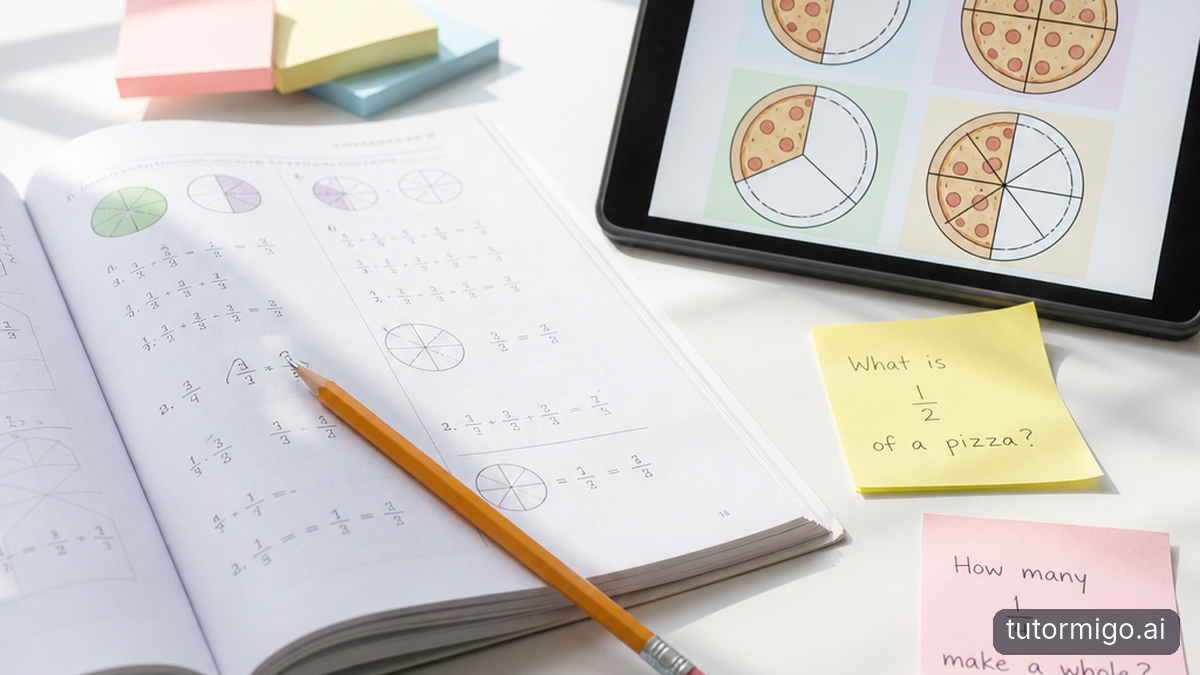
You follow a mathematics example, then freeze when the next question looks slightly different. The problem often isn't your memory: it's a missing connection. AI-powered learning tools can help you uncover that gap, work through the reasoning, and practise until you can explain the method without copying an answer.
Start by naming the difficulty as precisely as possible. Are you unsure what the question asks, why a rule works, or which operation comes next? Those are different problems. “I don't understand fractions” gives a tutor less to work with than “Why do the denominators need to match before I add fractions?”
In TutorMigo.ai, you can use the AI Tutor Workspace to discuss that specific sticking point. Ask for a concrete explanation before a symbolic one. For fractions, imagine cutting equally sized pizzas into different numbers of slices: the pieces need a common size before you count them together. Then connect that picture to the written calculation.
An AI Tutor is most useful when you keep questioning the explanation rather than accepting the first response. Try: “Explain that another way, then ask me to explain it back.” If finding the question is difficult, this guide to turning confusion into useful questions offers a practical starting point.
Work through the reasoning, not just the answer

A completed solution can look obvious even when you couldn't reproduce it yourself. To avoid that trap, ask for one step at a time and attempt the next move before requesting more help. The goal is to understand why each change is allowed, not simply to collect a sequence of instructions.
Consider solving . First, ask what the equation says: three equal groups together make eighteen. Dividing both sides by three gives . Subtracting two from both sides gives . Each operation preserves equality because you apply it to both sides.
Now check the result by substitution: . That check matters because it connects your final answer back to the original problem. Ask yourself whether you could explain why subtracting two immediately would require more care with the grouped expression.
In your tutoring conversation, request a hint rather than a full solution: “I think division comes first. Is my reasoning sound?” TutorMigo.ai's session history lets you revisit earlier conversations instead of treating every question as an isolated event. Return to a previous explanation, identify the step you still find difficult, and continue from there.
Before revealing the next step, write your prediction and one sentence explaining why it should work.
Use practice questions and interactive tools together
Understanding an explanation is only the beginning. You also need practice choosing and applying the method yourself. Ask for a small set of questions that changes one feature at a time: an equation with whole-number answers, one involving a negative value, and one with brackets. Attempt each before looking at a solution.
For example, compare with . They look similar, but the grouping changes what the expression means. Explain that difference before solving either question. This helps you notice structure rather than react to familiar-looking numbers.
TutorMigo.ai's Study Tools Hub includes a whiteboard and a math step editor. Use the whiteboard to sketch equal groups, draw a geometry diagram, or organise a word problem. Use the math step editor to lay out your working in manageable stages. These are ways to make your thinking visible, not reasons to skip checking it.
After a mistake, compare the first incorrect step with the last correct one. Did you misread the question, change only one side, or apply a rule in the wrong situation? Keeping that distinction clear makes your next attempt more purposeful. For more on this approach, explore why learning from mistakes improves understanding.
Make flashcards test understanding, not answer recall
Some mathematical knowledge needs to become easy to recall: vocabulary, relationships, and conditions for using a method. But memorising a finished answer rarely helps when the question changes. Good flashcards ask you to retrieve an idea and explain how you would use it.
Instead of making a card that only asks for the answer to a familiar equation, ask: “Why must you perform the same operation on both sides?” Another useful prompt is: “What is the difference between an expression and an equation?” Your answer should include an explanation or example, not just a label.
TutorMigo.ai's Flashcards feature offers AI-assisted card creation, spaced-repetition decks, and review scheduling. Use those tools to revisit important ideas across separate study sessions. Check AI-assisted cards for accuracy and clarity before relying on them, particularly when a rule has exceptions or depends on a condition.
Pair each review with a fresh problem. After recalling the distributive property, expand and explain why the result is . Then try a different example without consulting the card. Spaced review supports recall; applying the idea shows whether that recall is useful. You need both to build understanding that lasts beyond today's homework.
Track progress through explanations as well as results
Progress in mathematics is not only a higher score. It also means needing fewer hints, choosing an appropriate method, and explaining why an answer makes sense. Keep a short record after practice: what you attempted, where you got stuck, and what you can now do independently. That gives your next session a clear purpose.
If you are preparing for a mathematics assessment covered by TutorMigo.ai, its Exam Preparation feature provides structured practice sets and progress tracking. Use that structure to organise practice, then look closely at the reasoning behind missed questions. A better result on a familiar set is encouraging, but a new question is a stronger test of whether you can transfer the method.
Parents can use the Parent Dashboard for visibility into their child's progress, alongside learning controls and co-learning features. A useful conversation starts with “Show me a step you understand better now,” rather than only “How many answers were correct?” This keeps attention on learning without turning every session into a performance check.
Teachers can use the Teacher Dashboard's student monitoring and reporting to inform follow-up conversations. Dashboard information is a starting point: asking a learner to explain a fresh example helps distinguish independent understanding from successful completion with assistance.
Choose a learning workflow, then take one small next step
General-purpose generative chatbots can explain concepts, suggest questions, and discuss solutions. The practical comparison is not whether they can help with mathematics, but how well a tool supports your study routine. Look at session continuity, interactive working space, scheduled review, and any progress visibility you actually need.
The most useful TutorMigo.ai benefits come from connecting those activities: discuss a confusing idea in the tutor workspace, work through examples with study tools, and revisit key concepts through flashcards. An AI Tutor should support your reasoning rather than become the place you go to avoid doing it. Whatever tool you choose, verify important results and question explanations that seem inconsistent.
For your next session, choose one problem you couldn't finish independently. Write down the exact point where you stopped. Ask for a hint, attempt the next step yourself, and explain why it works before moving on. Finish with a similar but unfamiliar problem, without referring to the worked example.
Save one useful concept for later review and return to the conversation if confusion remains. You don't need to master an entire topic in one sitting. A successful session leaves you able to do something specific—and explain it more clearly—than you could when you started.
Frequently asked questions
Ask for hints before solutions, attempt each step yourself, and explain the reasoning aloud. Finish with a new problem without looking back at the example.
The AI Tutor Workspace includes session history, so you can revisit earlier conversations and use them as the starting point for follow-up questions.
Yes, when they test concepts, conditions, and explanations. Combine spaced review with fresh problems so you practise applying what you remember.
Yes. Substitute answers into the original problem, check the reasoning, and compare uncertain explanations with trusted learning materials or a teacher.
Explore TutorMigo
Enjoyed this read?
Like, share, or comment below.



Comments
0Sign in required · respectful discussion · replies supported
Loading comments…