

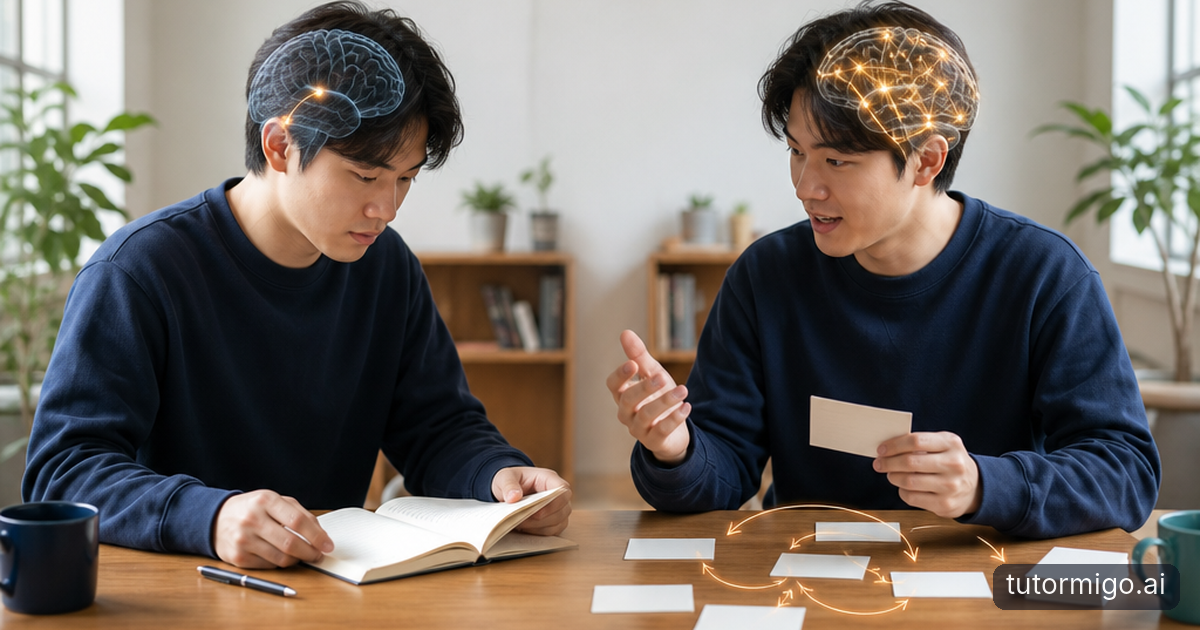
What are active recall study techniques AI can support?

Active recall means retrieving knowledge from memory before checking your notes. AI can help you create practice prompts and review explanations, while spaced repetition schedules later retrieval. The learning benefit comes from your attempted answer and corrective feedback, not from generating more study materials.
Passive input and active output feel different. Reading an explanation of inflation lets you follow someone else's reasoning. Closing the page and explaining why prices might rise forces you to reconstruct that reasoning. This cognitive effort exposes missing links that familiarity can hide.
The testing effect describes the learning advantage of retrieving information rather than only studying it again. In Roediger and Karpicke's 2006 research in Psychological Science, one experiment found roughly 61 percent recall after a week with repeated testing, versus 40 percent with repeated study. Those results concern specific prose-learning conditions, not a guaranteed improvement for every learner or an AI product.
Retrieval supports long-term memory formation, but the useful challenge is remembering—not simply struggling. Try an answer, inspect accurate feedback, and correct the gap. A blank response followed by no correction is not the goal. AI should help organize that cycle, rather than replace your thinking with an instantly visible explanation.
Why can AI-generated quizzing outperform static practice sheets?

AI-generated quizzing can outperform a repeatedly used worksheet when it introduces relevant variations, targets missing understanding, and preserves independent retrieval. Its advantage is not novelty alone. Questions must remain accurate, appropriately challenging, and aligned with your material, followed by feedback you can verify.
A static practice sheet is not inherently weak. A carefully designed sheet with worked feedback can be excellent. The problem appears when you remember that the answer to question three is “B” without remembering why. Recognition of the sheet starts replacing retrieval of the concept.
Adaptive difficulty means changing the challenge in response to demonstrated understanding. You can request this conversationally: “I explained the definition correctly. Now ask me to apply it to an unfamiliar example.” If you struggle, request a narrower question rather than immediately requesting the answer. This is a prompting strategy, not a claim that every AI tool automatically measures mastery.
For example, move from defining a historical cause to comparing two causes and defending which mattered more. General-purpose chatbots can also generate such variations. The relevant TutorMigo benefits are its personalized tutoring workspace, session history, and spaced-repetition flashcards—not an exclusive ability to ask questions. Always check unfamiliar claims against your course material.
Highlighter Revision vs. Manual Self-Testing vs. AI Active Retrieval
Compare study methods by whether they require an unaided answer, how much preparation they demand, and how they support later review. Retrieval generally improves delayed learning, but no credible universal percentage describes fourteen-day retention for highlighting, manual testing, or AI-assisted practice across subjects.
The comparison distinguishes learning mechanisms from convenience. “Neural effort” is used here as shorthand for retrieval demand, not as a measured brain-activation score. More mental effort is not automatically better: confusing questions, exhaustion, and unsupported guessing can consume effort without producing useful learning.
Highlighting can identify a passage worth revisiting, but it does not show whether you can reconstruct its argument. Manual self-quizzing provides that evidence with nothing more than paper. AI-assisted retrieval can reduce question-writing effort, although checking generated questions still takes time. None of these labels, by itself, establishes a fourteen-day retention rate.
Spacing also matters. The Leitner system moves flashcards between review groups according to whether you recall them successfully. Digital spaced repetition follows the same broad principle of revisiting material over time, though scheduling methods differ. Choose a workflow you will actually repeat: ten checked questions reviewed across several days can be more useful than an enormous deck you never revisit.
Supercharging Active Recall via TutorMigo.ai
Use TutorMigo.ai to support a repeatable retrieval loop: prepare a short source summary, attempt questions without looking, check your explanation, and review spaced flashcards. Its tutoring workspace and AI-assisted card creation support this workflow, but your independent answers remain the essential learning activity.
Inverting the Dynamic: Teaching the Concept via the Switch-Role Tutor
Treat “switch-role tutor” as an exercise you request, not a separate product mode. In the AI Tutor Workspace, ask: “Act as a curious learner. Ask me to explain this concept, then question one missing connection. Wait for my response.” Teaching from memory makes omissions visible. Session history lets you return to the conversation and revisit those gaps.
Diagnostic Note-to-Flashcard Practice
Use AI-assisted flashcard creation to prepare a manageable review deck. Flashcard automation can reduce preparation work, but generated cards still need checking. Do not assume chapter uploads, automatic diagnosis, or open-ended grading are available; those capabilities are not established by the listed features.
Prepare the source. Take a short chapter summary, remove personal information, and paste the relevant text into your tutoring conversation. This workflow does not require a file-upload feature.
Request retrieval questions. Ask your AI Tutor for three source-based questions, presented individually without answers. Include one explanation question, not just definitions.
Answer with the source closed. Explain your reasoning before requesting feedback. Then reopen the summary and check factual accuracy.
Create and review cards. Use the Flashcards tool's AI-assisted creation, verify each card, and follow its review schedule. Separate mixed ideas into focused prompts.
If your summary is unwieldy, use this approach to turn long sources into study material. If a question feels impossible, break one big question into three smaller ones before answering again.
Your Next Five Minutes
Try active recall study techniques AI can support on your latest lecture notes: choose one concept, close the notes, answer three questions, and correct one gap. Finish by scheduling another review. Judge the session by what you can explain unaided—not how polished the generated material looks.
Frequently Asked Questions About Active Recall AI
Active recall works best when effort stays manageable, feedback corrects mistakes, and reviews recur over time. AI can help prepare prompts and organize practice, but learners should verify content and assess answers against reliable criteria. The method applies to explanations and arguments, not only facts.
The practical questions below address four common sticking points: fatigue, review timing, written-answer checking, and essay subjects. All four depend on the same distinction: completing a study activity is not the same as demonstrating knowledge. Keep your notes closed during the attempt, then use them deliberately during correction.
You should also match the question to the performance you need. If you must write an argument, recalling isolated dates is only a starting point. Practice choosing evidence, explaining relationships, and acknowledging a counterargument. For factual material, short cards can work well; for extended reasoning, add spoken explanations or brief written responses.
Finally, use difficulty as information rather than a verdict on ability. If every attempt fails, shorten the source or add a small cue. If every answer is effortless, increase the delay or change the example. A sustainable routine gives you repeated chances to retrieve, correct, and try again.
| Method | Neural Effort | Prep Time Required | 14-Day Knowledge Retention |
|---|---|---|---|
| Highlighter revision | Low retrieval demand when used alone; not a brain-activation measurement | Low initial preparation | No universal rate; highlighting alone does not demonstrate delayed recall |
| Manual self-testing | Requires unaided retrieval when answers remain hidden | Time needed to write questions and check answers | No universal rate; retrieval practice supports delayed retention |
| AI-assisted active retrieval | Requires retrieval only if you answer before viewing feedback | AI can assist question creation; source checking remains necessary | No universal rate or established AI-specific advantage over equivalent manual retrieval |
Frequently asked questions
Re-reading supplies cues that make information feel familiar. Active recall requires you to reconstruct it without those cues, which demands more attention. Use short sessions and manageable questions. If you repeatedly draw a blank, review a small section, then attempt retrieval again.
Start early and spread practice across days rather than concentrating it into one sitting. As a starting example, revisit material the next day, several days later, and the following week. Shorten the interval after errors and extend it after successful recall; no schedule suits everyone.
Some AI tools offer written-answer feedback, but you should not assume that every flashcard system grades open-ended responses. TutorMigo.ai's listed flashcard features establish AI-assisted creation and review scheduling, not automatic written-answer evaluation. Check your response against a trusted model answer or marking criteria.
Yes. Retrieve arguments, evidence, definitions, and relationships rather than only isolated facts. Close your notes and outline a response, explain why a quotation supports a claim, or compare interpretations. Then check accuracy and reasoning against your sources; recall complements, rather than replaces, essay practice.
Related reading
Enjoyed this read?
Like, share, or comment below.



Comments
0Sign in required · respectful discussion · replies supported
Loading comments…