

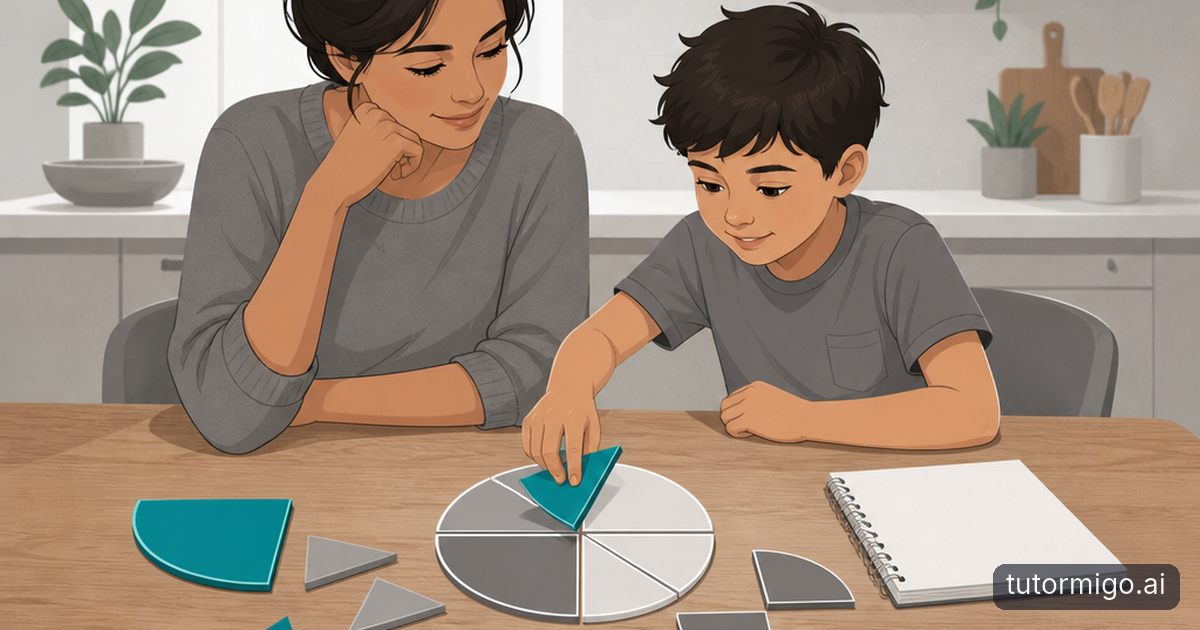
Build math confidence with one small success

Before you explain a problem, ask your child where it started feeling confusing. “Was it the instructions, choosing a method, or checking your answer?” is more useful than “Why don’t you understand?” You’re helping them identify a specific obstacle instead of treating the whole subject as something they cannot do.
Then shrink the task. If adding fractions feels overwhelming, start by drawing two equal-sized rectangles and shading different parts. Ask your child what they notice before introducing a calculation. A useful goal might be explaining why the pieces need to be the same size, rather than finishing a page of questions.
Praise something observable: “You checked whether the parts were equal,” or “You tried another drawing when the first one didn’t help.” That gives your child a strategy they can repeat. For more language you can use in difficult moments, read how to respond when your child says they’re bad at math.
Use tutoring conversations to build independence
An AI Tutor can support confidence when your child uses it to explore a step, not simply collect an answer. In TutorMigo.ai’s personal tutor workspace, you can start with a specific request: “Help me understand this fraction problem. Ask me what I would try before showing a solution.” Read the response together and check that the explanation matches what your child is learning.
Session history gives you a way to return to earlier conversations. At the next practice session, revisit an explanation that helped and ask your child to describe it in their own words. You don’t need to rely on the tutor automatically knowing what happened elsewhere; bring the relevant problem or previous explanation back into the conversation.
General-purpose chatbots can also explain math and respond to follow-up questions. The practical comparison is how well the learning setup supports your routine. Look for an accessible conversation history, useful study tools, and appropriate parent visibility—not just a confident-sounding answer. Check important steps against class materials, because AI explanations can contain mistakes.
Combine hands-on reasoning with spaced review
Confidence needs both understanding and chances to remember. Use an interactive whiteboard to sketch a problem, or a math step editor to work through a calculation carefully. For example, your child could draw equal parts before writing . Ask them to explain how the picture and calculation show the same idea.
Then use flashcards for small pieces of knowledge worth revisiting. A card might ask, “What does the denominator tell you?” Put an explanation on the back, not just a label. TutorMigo.ai offers spaced-repetition decks, AI-assisted card creation, and review scheduling. Check newly created cards together for accuracy before using them.
Keep the review short enough that your child finishes with some energy left. If a card keeps causing trouble, return to a drawing or tutoring conversation rather than repeating the answer faster. An AI Tutor can offer another explanation, while your child’s own example helps you check whether the idea has actually clicked.
Notice progress together, then choose the next step
Progress is not always a higher score. Your child might begin a problem without reassurance, explain a mistake, or ask a more precise question. After practice, ask, “What feels clearer now?” Record one specific example in a notebook so you can revisit it when your child feels stuck again.
TutorMigo.ai’s Parent Dashboard provides visibility into child progress, learning controls, and co-learning features. Use that visibility to start supportive conversations rather than turn every session into a performance review. If you’re coordinating with a teacher, share a concrete observation: “Drawing the fractions helped, but choosing a common denominator still feels confusing.” Educators also have a Teacher Dashboard for student monitoring and reporting.
Your next step can be small: choose one confusing idea, spend a few calm minutes exploring it, and let your child explain something back to you. Finish by naming a strategy they used successfully. Tomorrow, revisit that same idea before adding something harder. A repeatable routine matters more than a demanding first session.
Frequently asked questions
Acknowledge the frustration, then make it specific: “This feels hard right now. Which part is confusing?” Focus on one manageable step rather than arguing with the feeling.
Start together so you can model asking for explanations and checking answers. Adjust your involvement to your child’s needs and your household’s learning rules.
No. Flashcards support recall, but children also need to explain ideas and apply them. Combine spaced review with drawings, worked steps, and discussion.
Related reading
Enjoyed this read?
Like, share, or comment below.



Comments
0Sign in required · respectful discussion · replies supported
Loading comments…