


Build study habits with small starts and clear restart points
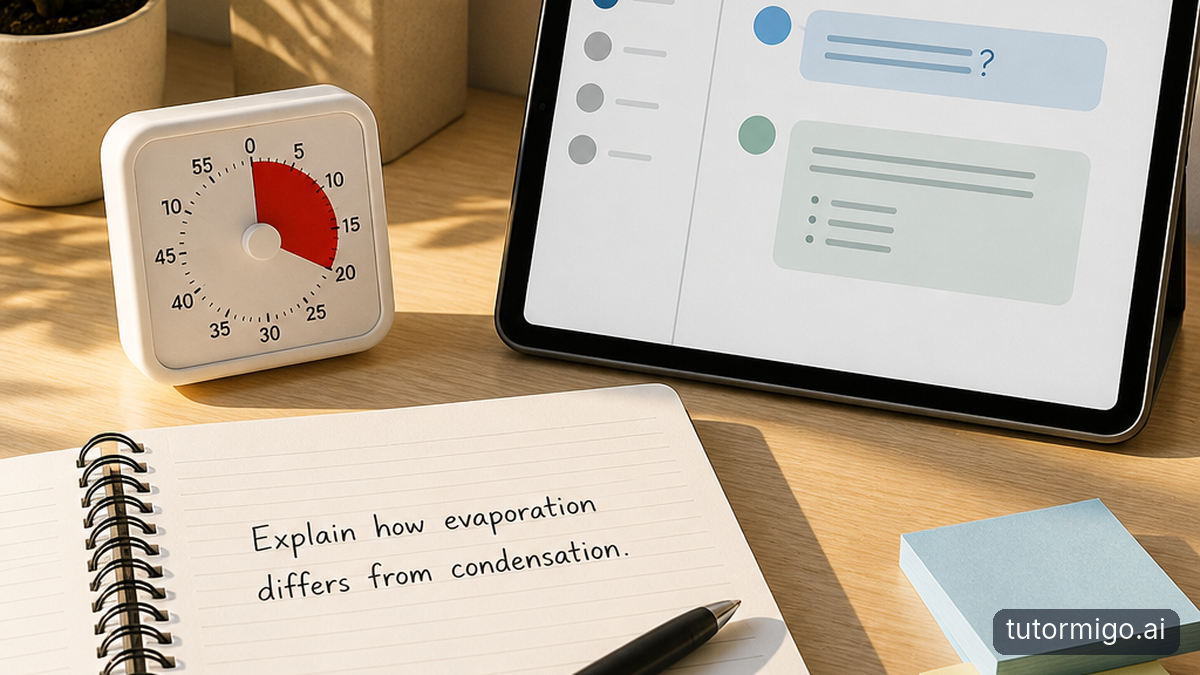
Before you open your notes, choose one task you can finish in a short session. “Study science” is hard to act on. “Explain how evaporation differs from condensation, then check two examples” gives you a finish line. Try twenty minutes of focused work, followed by a brief break. Adjust the length if your attention starts slipping; consistency matters more than an ambitious schedule you avoid.
Use an AI Tutor to work through that specific goal rather than requesting a complete topic summary. In TutorMigo.ai’s personal tutor workspace, personalized chat and session history can support an ongoing routine. End by recording what you understood and what still needs work. Next time, revisit that conversation and begin with the unresolved question. This approach to building an ongoing study workflow gives each session a useful starting point.
Recall first, then review what you missed
Reading a familiar page can feel like knowing it. Test that feeling before you look: close the book and explain the main idea aloud, sketch the process from memory, or answer a short question. If you cannot explain why condensation happens, that gap tells you what to review. Checking your answer afterward keeps retrieval practice from becoming repeated guessing.
Turn useful questions into flashcards, with one clear idea per card. TutorMigo.ai offers spaced-repetition decks, AI-assisted card creation, and review scheduling. Check generated cards against your learning materials, then use scheduled reviews instead of saving everything for one long session. For example, ask what causes condensation on one card and request an everyday example on another. Say your answer before revealing it, and revisit shaky explanations rather than simply recognizing the wording.
Use AI help to practice, not just collect answers
When you get stuck, ask for the smallest helpful nudge: “Point out my first mistake without finishing the problem.” Then attempt the next step yourself. An AI Tutor is most useful when the conversation leads back to something you do—explain, solve, compare, or test—not just another explanation you read. Check important answers against your course materials, especially when a response seems surprising.
Choose a tool that matches the task. TutorMigo.ai’s Study Tools Hub includes a whiteboard for working visually, a code sandbox for trying code, and a math step editor for working through mathematical steps. General-purpose chatbots may also explain concepts and support practice. The practical comparison is how well each tool fits your routine: look for relevant working spaces, accessible session history, and review tools you will actually use, rather than judging only the first answer.
Track a useful signal and share the right information
Track what you can do without help, not just how many minutes you spent. After a session, note one skill you demonstrated and one mistake to revisit. For structured exam preparation, TutorMigo.ai provides practice sets and progress tracking. Use those results to choose your next practice target rather than repeatedly working on the questions that already feel comfortable. A single strong attempt is encouraging; checking again later gives you better evidence of learning.
If you are supporting a learner, turn visibility into a conversation rather than constant checking. The Parent Dashboard provides visibility into a child’s progress, learning controls, and co-learning features. The Teacher Dashboard supports student monitoring and reporting. Ask, “Which part can you explain now?” and “Where would a hint help?” These questions keep attention on understanding while giving students room to describe their own difficulties.
What to do next: try one manageable routine
For your next session, choose one topic and one finish line. Spend a few minutes recalling what you already know, work through a small task, and check your understanding without looking at the answer. If you need help, ask a focused question and attempt the next step yourself. Finish by making a few useful flashcards and writing down exactly where you will restart.
Repeat that routine across several sessions before adding more tools. If you keep skipping reviews, make the review smaller. If explanations seem clear but independent practice falls apart, spend more time attempting questions before requesting help. You do not need every TutorMigo.ai feature at once. Start with the support that addresses your biggest obstacle, then judge it by whether you can explain and apply more on your own.
Frequently asked questions
Start with about twenty focused minutes and adjust to the task and your attention. Choose a specific finish line instead of measuring success only by time.
No. Flashcards suit focused recall questions. Combine them with explanations, worked practice, and tasks that require applying what you know.
Compare the study workflow: TutorMigo.ai combines a personal tutor workspace and session history with spaced-repetition flashcards, interactive tools, and structured exam preparation.
Explore TutorMigo
Turn your ACT score goal into a practice target
If your study routine feels steadier but your ACT results are not improving, the next step is making each session more specific. Effective ACT prep connects a score goal to the section, question type, and pacing problem holding you back. Here is how to turn those habits into a practical plan.
Start with the current ACT requirements for your intended colleges or programs, then choose a target that reflects your starting point and available preparation time. Check the official details for your test date and format, including whether you will take science or writing. Your practice plan should match the test you actually intend to sit.
Use a recent, representative practice test to establish a baseline. Record section results separately rather than looking only at the overall score. A stronger English result can hide a reading pacing problem; an uneven math result might reflect a few unfamiliar skills rather than difficulty with everything.
Translate the gap into one actionable target. Instead of “raise my math score,” try “identify when to use a linear equation and solve those questions accurately without hints.” Keep your eventual score goal visible, but give your next session a finish line you can directly control.
Build pacing around your actual test format
Before setting a timer, confirm the official question counts and time limits for your ACT administration. Do not borrow a pacing chart from an older guide without checking it. Your test format, selected sections, and any approved accommodations determine the conditions you should eventually rehearse.
Start with a short timed set rather than demanding full-test stamina immediately. Afterward, separate questions you answered incorrectly from questions you never reached. Those are different problems. If you finish with frequent errors, slowing down slightly may help. If accurate work leaves too many unanswered questions, examine where your time goes.
Choose a checkpoint tied to a manageable chunk of the section, such as a passage or a small group of questions. Use practice to find a workable pace, then check whether that pace preserves accuracy. A rigid seconds-per-question rule can be misleading because some questions naturally require more work than others.
Also rehearse moving on. When you notice yourself rereading the same sentence or repeating an unproductive calculation, make your best choice and return if the format permits and time remains. Check the official guessing policy, and practice your end-of-section routine before test day rather than improvising it under pressure.
Choose practice that fits each ACT section
For English, review the reason behind an answer rather than memorizing its wording. If you miss a punctuation question, identify the sentence structure and explain why the correct choice works. On the next set, look for that same structure in a different sentence. This tests whether you learned a rule instead of recognizing an example.
For math, separate setup errors from calculation errors. Suppose you can solve an equation once someone supplies it, but struggle to build it from a word problem. Spend your next practice block identifying quantities and relationships before calculating. More arithmetic drills will not directly address that bottleneck.
For reading, connect every answer to evidence in the passage. When two options seem plausible, explain what makes one too broad, too strong, or unsupported. Time a passage-sized set, then examine whether lost time came from reading, searching for evidence, or repeatedly debating answer choices.
If you are taking science, practice interpreting graphs, comparing experiments, and finding the information a question actually requires. Distinguish unfamiliar vocabulary from a genuine reasoning gap. If you have chosen writing, rehearse planning a clear position, addressing another perspective, and leaving time to revise. Give each selected section its own practice target instead of treating all ACT work as interchangeable.
Use practice sets to diagnose, then repair
A practice set becomes useful when you do something with the mistakes. After checking your answers, label each miss with a brief cause: missing knowledge, misread wording, weak evidence, calculation slip, or time pressure. Choose the most common actionable cause for your next session rather than reviewing every topic equally.
In TutorMigo.ai, Exam Preparation provides structured ACT prep with practice sets and progress tracking. Use that support to organize practice, while keeping official ACT materials as your reference for current test specifications and representative conditions. Do not assume that any practice result automatically predicts your official score.
When an explanation still does not make sense, ask an AI Tutor a narrow question: “I chose this answer because of this sentence. Which part of my reasoning fails?” Share the relevant question and your attempt, then verify important explanations against a trusted solution. Try the problem again without looking.
Use the AI Tutor to help you articulate a repair rule, not simply collect the correct answer. For example: “Before choosing punctuation, check whether both sides can stand as complete sentences.” Then attempt a fresh question that tests the same idea. Success on an unfamiliar example is better evidence than remembering yesterday’s solution.
Track score trends without chasing every fluctuation
Review progress across comparable practice, not isolated highs and lows. A short untimed set and a full timed section answer different questions. Record the source, section, timing conditions, accuracy, and whether you used help. That context prevents an easier set from looking like a sudden breakthrough or a harder one from looking like failure.
Use official scoring guidance when converting an appropriate practice test to a score. For smaller practice sets, track accuracy and error patterns instead of inventing a scaled ACT score. Keep both kinds of evidence: scores show movement toward your goal, while error patterns tell you what to practice next.
Look for changes you can explain. Perhaps you are reaching more reading questions without losing accuracy, or making fewer math setup errors across several sessions. Those improvements can justify keeping your current approach even before a larger score change appears. One unusually strong attempt is encouraging, but repeatable performance matters more.
If a parent or another adult is supporting you, agree on a brief weekly check-in. Share one result, one recurring obstacle, and one next target. Ask for practical help, such as protecting a timed practice slot, rather than turning every study session into a score discussion.
What to do next: plan one focused ACT week
Choose one priority section for the coming week and write down why it deserves attention. Use your baseline, recurring mistakes, and score goal to make that choice. You can maintain other sections with brief practice, but avoid changing your main target every time a difficult question appears.
Begin with a short set under clear conditions. Review it carefully, practice the skill behind the most useful mistake, and attempt a fresh set later in the week. Keep the timing conditions comparable when you want to judge improvement. If accuracy is still fragile, rebuild the skill before adding more pressure.
Write a restart note after each session: the question type, the mistake you noticed, and the next task. TutorMigo.ai’s personal tutor workspace includes session history, which can help you return to an earlier discussion. Keep your own concise takeaway so you know what to attempt before requesting another explanation.
At the end of the week, ask whether you can now answer similar questions more accurately or at a more workable pace without help. If so, maintain that skill and choose the next bottleneck. If not, narrow the task further. A useful ACT plan changes in response to evidence, not frustration.
Establish a baseline that matches your ACT
Use a recent, representative ACT practice test to find out why your score is falling short of your goal. More studying will not necessarily fix the problem. Your ACT prep needs to distinguish missing knowledge from rushed decisions, slow passage reading, and questions you understand but cannot yet finish efficiently.
Choose practice materials that match your planned test format and current official section requirements. Follow the published timing, use only permitted tools, and take breaks where the test allows them. Include science or writing if you plan to take those sections. An interrupted attempt can still provide useful practice, but it is not a reliable pacing baseline.
Record each section result separately, using the scoring guidance supplied with that practice test. Then inspect the pattern underneath it. Did you leave several math questions unanswered? Did English errors cluster around sentence boundaries? Were reading mistakes spread throughout the section or concentrated in the last passage?
Connect your overall score goal to one immediate practice target. For example, your first target might be to reduce sentence-boundary errors while maintaining your English pace. That is more actionable than trying to improve every section at once. Keep the larger goal visible, but let the evidence decide what you practice next.
Give English and math different practice targets
For English, sort missed questions by the decision they required. Sentence structure, punctuation, word choice, and passage organization call for different kinds of review. If you keep choosing an answer because it sounds polished, explain what the sentence actually needs before comparing options. A shorter answer is not automatically correct; it must preserve meaning and fit the passage.
Try a small practice set focused on one recurring error. After each answer, name the rule or purpose behind your choice. For a sentence-boundary question, identify the complete thoughts and explain how the punctuation connects them. Then return to a mixed passage to check whether you can recognize that same issue without being told what to look for.
For math, separate a missing concept from an execution mistake. If you cannot decide how to begin, review the underlying skill and attempt a similar problem. If your setup was sound but you copied a value incorrectly, work on your checking routine rather than rereading an entire chapter.
An AI Tutor can help you inspect your reasoning: ask, “Which step first becomes incorrect? Give me a hint, not the solution.” After the hint, finish independently. Later, attempt another question testing the same skill without reopening the explanation. That second attempt shows whether the help transferred.
Practice reading and science with evidence
In reading, identify whether the difficulty is understanding the passage, locating evidence, or choosing between plausible answers. These problems can look similar in your score report, but they need different responses. After a missed question, find the specific passage detail that supports the correct answer and explain why your chosen answer goes beyond, contradicts, or misses that evidence.
Suppose you repeatedly miss questions about the author's purpose. Before looking at the explanation, describe what the relevant paragraph does: introduce a disagreement, provide an example, or qualify an earlier claim. This keeps review focused on the question's actual demand rather than a vague instruction to read more carefully.
If science is part of your planned ACT, practice extracting information from figures, tables, and experiment descriptions. Before interpreting a graph, check what each axis represents, which quantities are being compared, and whether the question asks for an observation or an inference. A missed unit or reversed comparison can derail an otherwise sound answer.
Review a few questions without timing first, then use a timed set to test whether your process remains workable. Do not assume faster reading alone will solve the problem. Your goal is to locate and use the right evidence efficiently, not to race through every sentence and then reread everything.
Build pacing checkpoints from your own attempts
Use the official time limit and structure for your test format to plan a few checkpoints in each section. Avoid borrowing a pacing chart without checking whether it matches your version of the ACT. A checkpoint should tell you whether your current approach leaves enough time for the remaining work, not interrupt you after every question.
During a timed attempt, note where you first fall noticeably behind. Perhaps you spend too long comparing two English answers, or one math problem consumes time you needed for several later questions. That pattern gives you a specific adjustment to test. It does not mean you must hurry equally on everything.
Set a practical move-on rule. When you have reread a question, tried a reasonable approach, and still have no productive next step, make your best available choice and move on. If your test format allows you to flag questions, use that option. Return only after protecting your chance to attempt the rest.
Compare timed and untimed performance on similar material. Strong untimed accuracy with weaker timed results suggests that pacing or fluency deserves attention. Weak performance in both conditions points toward a knowledge or reasoning gap. Keep some untimed work in your plan so that faster practice does not become repeated, hurried guessing.
Turn practice results into the next session
A useful ACT prep cycle is attempt, inspect, repair, and retest. After a practice set, review uncertain correct answers as well as mistakes. Getting a question right through guessing is different from being able to explain the answer. Record the skill involved, what went wrong, and what you will do differently on the next attempt.
TutorMigo.ai's Exam Preparation provides ACT practice sets and progress tracking. Use those results to choose a narrower target rather than repeatedly selecting comfortable work. For example, if a set exposes trouble interpreting experimental comparisons, make that the focus of your next session before returning to mixed science practice.
In the personal tutor workspace, ask an AI Tutor to examine your attempted reasoning and question your next step. Session history lets you revisit that discussion when you retry the skill. Check important explanations against your practice materials, and do not treat a convincing response as proof that your understanding is secure.
Choose your support according to the task, as the comparison below shows. Practice sets give you questions to attempt; a tutoring conversation helps you examine reasoning. Neither replaces a later independent attempt under appropriate conditions. The strongest evidence of progress is handling a fresh question correctly and explaining why your approach works, not merely recognizing an answer you recently reviewed.
What to do next: plan one focused week
Choose one priority section and one recurring problem for the coming week. Keep the plan small enough to complete alongside schoolwork. Your first session might review a baseline and repair one weakness. The next could use a short, focused set. A later session should test that skill within mixed, timed practice.
For example, if you understand math concepts but leave questions unfinished, practice recognizing when to move on and checking your progress at planned checkpoints. If English accuracy is the bigger obstacle, work on one error category before adding timing pressure. These are different problems; giving both students the same schedule would miss the point.
Ask a supporting adult to help protect the agreed practice time and discuss one weekly result. A useful question is, “What can you do independently now that was difficult last week?” Avoid turning every session into a score inspection. Short practice sets can guide decisions without being treated as predictions of your final ACT result.
At the end of the week, repeat a comparable task and inspect both accuracy and pacing. Keep the approach if the evidence improves; adjust it if the same obstacle remains. Write down your next section, question type, and timing target before stopping. Your next session should begin with a clear task, not another search for what to study.
Enjoyed this read?
Like, share, or comment below.



Comments
0Sign in required · respectful discussion · replies supported
Loading comments…