


1. Turn your daily learning goal into a small, clear task
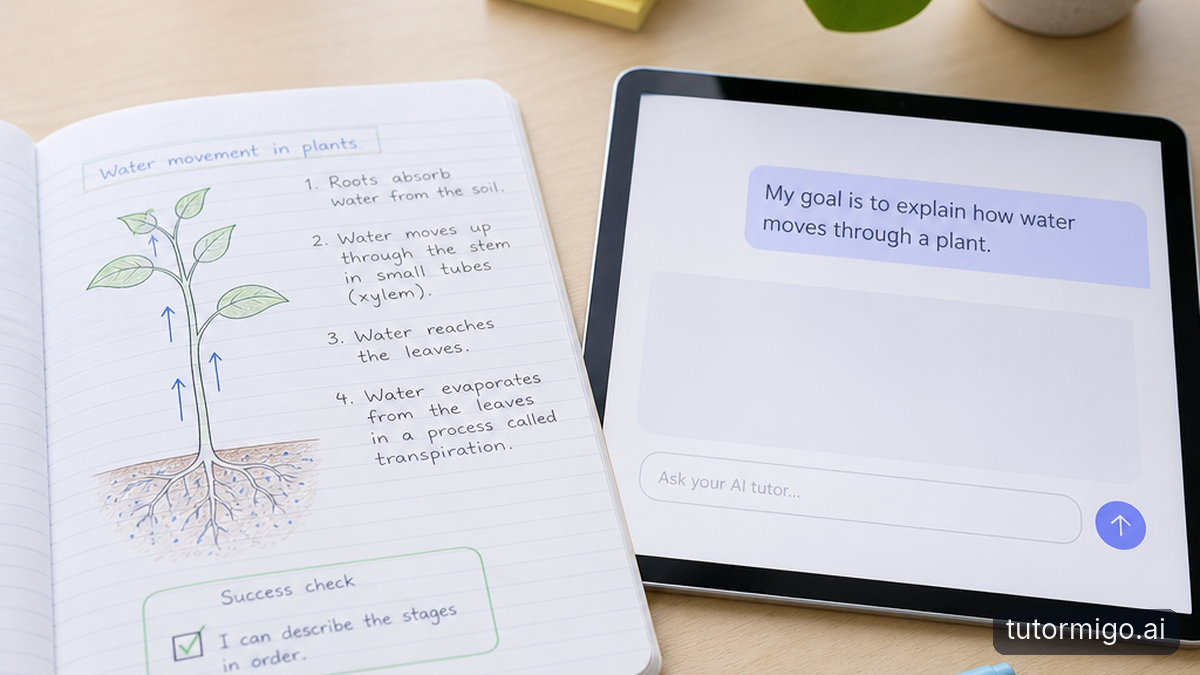
“Study science” sounds productive, but it gives you no clear finish line. Before opening your materials, choose something you should be able to do by the end. For example: “Explain how water moves through a plant without checking my notes.” A useful goal names an action you can demonstrate, not just a chapter you intend to read.
Keep the goal realistic for the time you actually have. A twenty-minute session might include a brief review, one focused explanation, and a few independent questions. If you have several assignments, choose the most urgent task and one older topic that needs attention. This keeps your routine useful even on busy days, rather than making every session an ambitious catch-up plan.
In TutorMigo.ai ’s AI Tutor Workspace, give your tutor the topic, your current difficulty, and your goal. Try: “I understand the main idea, but I mix up the stages. Ask what I already know before explaining.” An AI Tutor is more useful when you provide this context. End by writing a simple success check in your notebook: “I can describe the stages in order.” That gives you something concrete to test later.
2. Use homework help to get unstuck, not skip the thinking

Start each homework task yourself before asking for help. Read the question, make an attempt, and identify the exact point where your reasoning breaks down. Instead of requesting a finished answer, explain what you tried: “I chose this approach because of the example in class, but I don’t know what comes next. Give me one hint.” This makes the support specific while keeping you responsible for the work.
Use interactive tools when the difficulty needs more than a written explanation. TutorMigo.ai ’s Study Tools Hub includes a whiteboard, code sandbox, and math step editor. You might sketch a process on the whiteboard, test a short program in the sandbox, or work through a calculation in the math editor. Choose the tool that helps you examine your thinking, rather than switching between tools just because they are available.
After receiving help, close the explanation and try a similar task independently. If you still cannot begin, ask your AI Tutor to explain the missing idea differently. Check important details against your course materials, and follow your teacher’s rules on AI use. For families, this approach also supports moving homework support toward progress coaching: ask what the learner tried and learned, not simply whether the assignment is finished.
3. Build revision into the week with spaced flashcard reviews
Revision works better as a regular appointment than an emergency response to forgetting. Reserve a small part of each session for older material before starting something new. For example, review yesterday’s difficult vocabulary at the start of today’s session, then revisit earlier topics during the week. You do not need to reread every page each time; focus on recalling the ideas you are most likely to lose.
TutorMigo.ai’s flashcards offer spaced-repetition decks, AI-assisted card creation, and review scheduling. Use these to turn important concepts into short recall prompts. A useful card might ask, “What distinguishes evaporation from boiling?” rather than copying a whole paragraph onto the front. Check AI-assisted cards against your notes before relying on them, especially when your course expects particular terminology or a precise definition.
Answer each card before revealing the other side. If you recognise the answer only after seeing it, treat that as something to review again, not proof of mastery. Keep card creation modest so that maintaining your deck does not replace studying. One of the practical TutorMigo benefits is having a dedicated review workflow alongside tutoring: use the conversation to clarify an idea, then use flashcards to practise remembering it over time.
4. Check understanding with short practice quizzes
Feeling familiar with a topic is different from being able to answer a question about it. Add a short, closed-notes quiz after focused practice. Ask for a few questions that cover the day’s goal, including one that requires an explanation rather than a single fact. You can ask for questions in the tutoring chat, then write your answers separately before requesting feedback. Keep the first attempt independent.
Suppose you studied persuasive writing. Your check might ask you to identify a claim, choose relevant evidence, and explain why another piece of evidence is weaker. If you can name a definition but cannot apply it, your next session needs more examples rather than more rereading. Ask the tutor to discuss one error at a time, and explain the correction back in your own words.
If you are preparing for an exam supported by TutorMigo.ai, its Exam Preparation feature provides structured practice sets and progress tracking. Use that structure instead of choosing unrelated questions every day. Whether you use exam practice or a short tutoring-chat quiz, compare attempts of similar difficulty. A stronger result on an easier set does not necessarily mean the underlying skill improved. For everyday habits, the important question is what you can now do without help.
5. Track useful progress and make check-ins supportive
Keep a simple study log with four details: your goal, what you attempted, where you needed help, and what to do next. “Reviewed biology” tells you little. “Explained the process independently but confused two stages” gives tomorrow’s session a starting point. You can keep this log in a notebook; you do not need an elaborate tracking system to notice patterns.
TutorMigo.ai’s session history lets you return to earlier tutoring conversations instead of reconstructing every previous question. Begin a returning session by checking the earlier explanation and stating what you want to practise now. For structured exam work, use the available progress tracking alongside your own notes about mistakes. These TutorMigo.ai benefits support continuity, but your independent attempts remain the clearest evidence that you understand something.
Parent and teacher visibility can make check-ins more specific. The Parent Dashboard provides visibility into a child’s progress, learning controls, and co-learning features; the Teacher Dashboard supports student monitoring and reporting. Agree on a manageable check-in rather than treating every difficulty as an alarm. Ask, “Which task became easier, and where do you still need support?” Adults studying independently can ask themselves the same questions. The aim is to identify the next useful action, not turn study time into constant surveillance.
6. Review your routine weekly, then choose tomorrow’s first step
Once a week, pause to assess both your knowledge and your habits. Choose a previously difficult task and attempt it without notes or tutoring help. Then compare the result with an earlier attempt. Can you explain your choices more clearly? Do you need fewer hints? Those observations tell you more than simply counting completed sessions or measuring how long you kept a study tool open.
Review what made the routine easy or difficult to repeat. Perhaps an evening session regularly clashes with other commitments, or your flashcard deck has grown too large. Change one thing for the following week: shorten the session, move it earlier, or focus your reviews on the most important gaps. If you keep falling into rereading without testing yourself, this guide to common study mistakes and better habits offers another way to examine the pattern.
When comparing TutorMigo.ai with a general-purpose generative chatbot, compare the workflow rather than assuming either tool guarantees learning. General chatbots can explain concepts and suggest practice questions too. TutorMigo.ai brings tutoring history, scheduled flashcard review, interactive tools, and structured exam practice into a learning-focused platform. Try one small routine tomorrow: set a goal, attempt the work, review a few cards, and record your next step. Keep what helps you learn independently.
Frequently asked questions
Start with a session you can repeat, even if it is only twenty minutes. Include a clear goal, independent practice, a brief review, and a note about what comes next.
Attempt the task first, ask for a hint or explanation, and then solve a similar task without help. Follow your teacher’s AI rules and verify important details against your course materials.
Record whether you needed hints, could explain your reasoning, and could complete a similar task later. These observations help distinguish short-term familiarity from more dependable understanding.
Use it to support independent study, not replace it. Tutoring, flashcards, and practice tools are most useful when you still recall information, attempt questions, and assess your own understanding.
Explore TutorMigo
Enjoyed this read?
Like, share, or comment below.



Comments
0Sign in required · respectful discussion · replies supported
Loading comments…