


Why mathematical reasoning matters when questions change
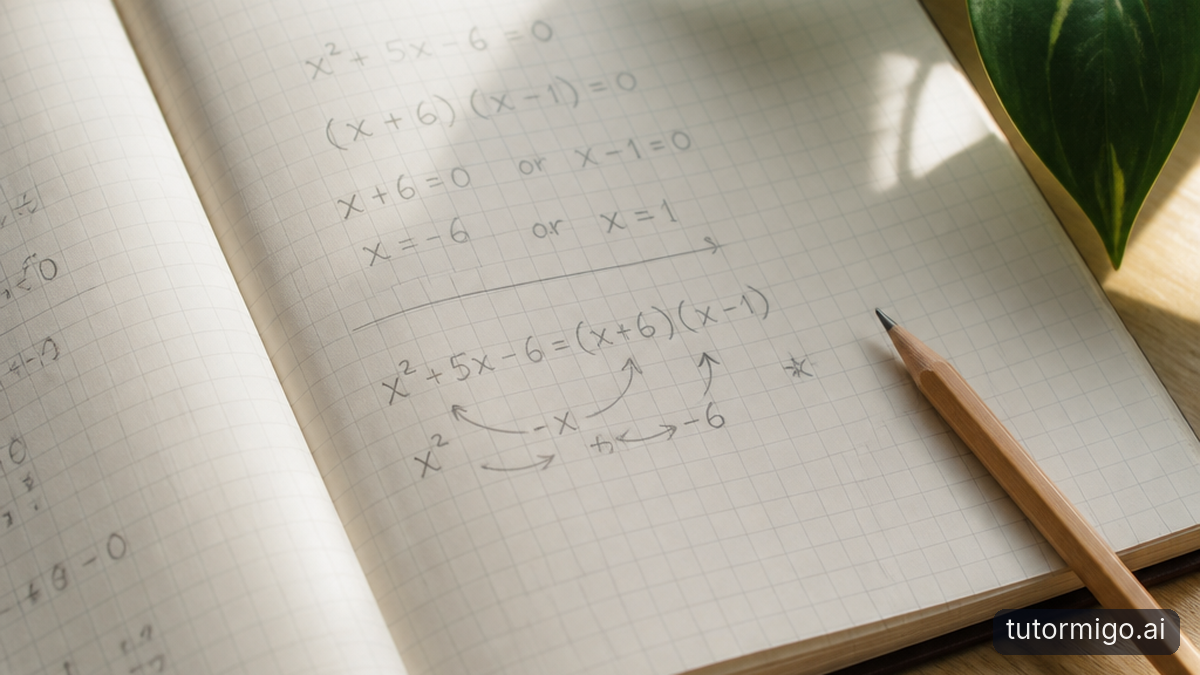
You follow a worked solution and every line seems obvious. Then the next question changes slightly, and you cannot see where to start. The way forward is to explain what each step preserves, then test that explanation on a variation. Understanding means having a reason you can reuse, not just a sequence you recognize.
A familiar example gives you more help than you might notice. The order is already chosen. Someone has decided what to subtract, what to divide by, and when to stop. Following those decisions can feel like making them yourself, especially when the arithmetic is comfortable.
When the question changes, those hidden supports disappear. Perhaps the unknown appears on both sides instead of one. Your remembered instruction, “subtract, then divide”, no longer tells you exactly what to do. That does not mean you are incapable of understanding algebra. It means the example taught you a route without necessarily showing you what makes that route valid.
The useful shift is from asking “What comes next?” to asking “What am I trying to achieve, and what am I allowed to change?” You still need practice and accurate calculation. But now practice has a purpose: connecting each action to a reason. That connection gives you something dependable when the surface details change.
Do You Understand or Just Remember? Test What You Can Explain Without Looking
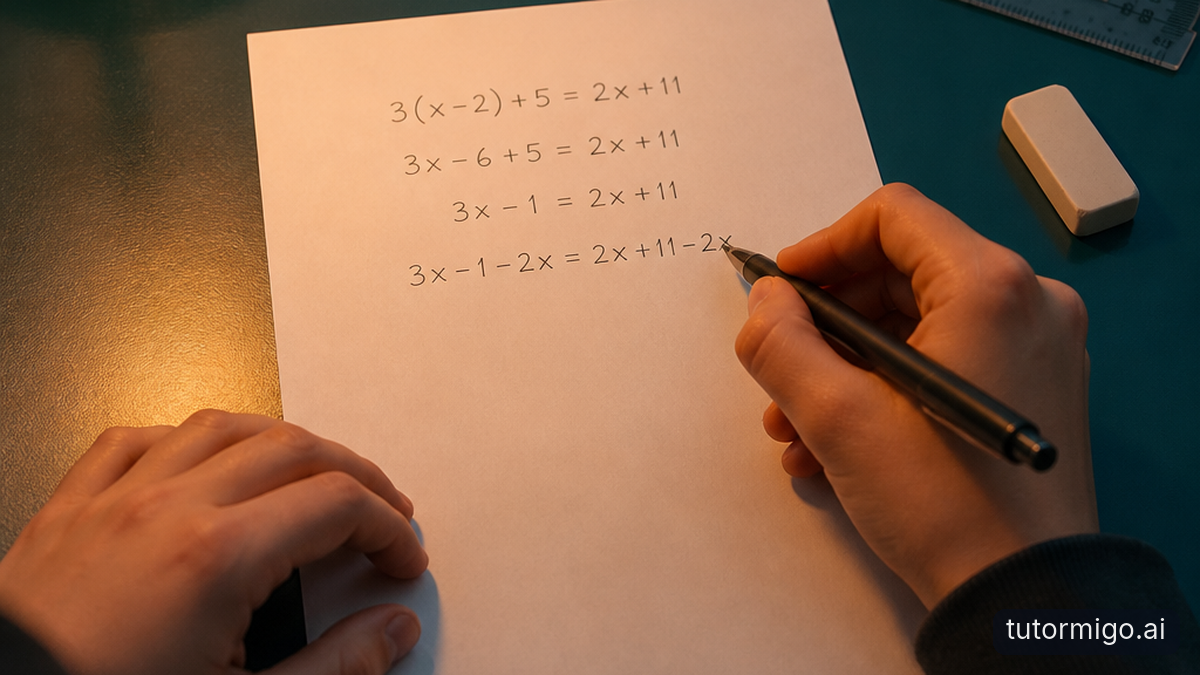
Close the worked example and explain its goal before reproducing its steps. In an equation, you are looking for a value that makes both sides equal. A strong explanation connects the operations you choose to that goal. “That is what the example did” describes a memory, not a mathematical reason.
Next, choose one line and ask, “Why does this step follow?” Suppose a solution subtracts the same amount from both sides. Can you explain why that keeps the equation equivalent? If two quantities are equal, reducing both by the same amount leaves them equal. You are preserving the possible solution while making the relationship easier to read.
Try explaining why an incorrect move fails, too. What if you subtract from only one side? You have changed one quantity without making the corresponding change to the other, so the original equality is no longer preserved. Spotting that difference reveals more than reciting “do the same to both sides”.
Finally, predict what a small change would require before calculating. If the unknown appears on both sides, what new obstacle must you handle? You do not need polished language or instant answers. Hesitation can reveal a useful gap. Understanding shows up when you can justify, check and adapt a step, even if you do so slowly.
Work Through 3x + 4 = 19: “Why Does This Step Follow?”
Consider the equation below. Your goal is to find the value of the unknown that makes the statement true. The left side describes multiplying that value by three, then adding four. To uncover the value, begin by undoing the addition.
Subtract four from both sides, not because four must “move across”, but because equal quantities remain equal when you subtract the same amount from each. On the left, the added four and the subtracted four cancel. On the right, calculate the difference.
Now ask what the remaining expression means. Three times the unknown equals fifteen. Dividing both sides by three preserves equality and leaves one copy of the unknown. This division is valid because the divisor is not zero.
Check the result in the original equation: three lots of five, plus four, equals nineteen. Substitution checks whether your answer actually satisfies the question, rather than merely looking like the last line of a familiar method.
The transferable idea is not simply “subtract four, then divide by three”. It is “use operations that preserve equality to isolate the unknown”. You chose subtraction because it undoes the addition, then division because it undoes multiplication. Those reasons explain both the order and the validity of your steps.
Try 3x + 4 = x + 14: “What Stays the Same?”
Now consider a slightly altered question. The unknown appears on the right as well as the left. Before calculating, pause and ask, “What stays the same?” You still want a value that makes both sides equal. You can still apply the same valid operation to both sides.
What has changed is the obstacle: the unknown is spread across both sides. Subtract one copy of it from each side. This is allowed for the same reason subtracting four was allowed earlier. For any value satisfying the equation, you are subtracting equal quantities.
The equation now resembles the earlier example. Subtract four from both sides, then divide both sides by two. Each step preserves equality while making the unknown easier to identify.
Check against the changed question, not the earlier one. Substituting five gives nineteen on each side, so the value works here too. The matching answer is a coincidence of these chosen numbers, not a rule about similar-looking equations.
You could also subtract four first, then collect the unknown terms. That route is valid too. Understanding lets you recognize different workable routes because you judge each move by its effect on equality, not by whether it matches a memorized order. The first step changed; the underlying reasoning did not.
How to Start an Unfamiliar Problem Before Looking Up the Answer
When a question looks unfamiliar, give yourself a small starting task rather than demanding a complete solution. State what you need to find and what information you have. For an equation, that might be: “I need a value that makes these two expressions equal.” This turns a vague feeling of being stuck into a specific goal.
Then compare the question with something you understand. Ask, “What stays the same?” and “What is different?” Perhaps the equality rule is unchanged, but there are brackets or unknown terms on both sides. Name the difference precisely. “There are brackets to handle” gives you more direction than “This looks harder”.
Choose one move you can justify. Before writing it, finish the sentence, “This is allowed because…” Afterwards, ask, “Did that make the problem simpler?” A valid move does not always help, and noticing that distinction is useful. You can return to the previous line and try another route without treating the attempt as wasted.
If you remain stuck, seek the smallest useful hint: a reminder about expanding brackets, or a check on whether your first transformation preserves equality. Then hide the help and continue yourself. Looking up a full answer is not forbidden, but copying it cannot show you what you can do independently. After reading help, close it and rebuild the reasoning from a blank page.
Build Quiet Confidence: Explain One Solution, Then Try a Variation Independently
For your next practice session, focus on the quiet confidence of knowing why a move is valid. Choose one solved equation and cover the explanation. Reconstruct it aloud or on paper, giving a reason for every line. If you hear yourself say “you just do this”, pause there. That is the step worth examining.
Use three prompts: “What am I trying to achieve?”, “Why does this step follow?” and “How can I check it?” Your explanation does not need to sound like a textbook. “I subtract the same amount from both sides so they stay equal” is clear and useful. Aim for an explanation you could understand tomorrow without the original example beside you.
Then put the solution away and attempt a variation independently. Try the equation below, which changes the coefficients and places the unknown on both sides. Decide on your first move, justify it, and check your final value in the original question.
For more on keeping practice manageable, see building learning confidence one problem at a time. If you want an interactive place to work, TutorMigo.ai’s Study Tools Hub includes a whiteboard and math step editor.
Start with one solution you can explain. Then try one changed question without looking back. Let the reasoning, rather than recognition, carry you forward.
Frequently asked questions
Cover it, explain why each step is valid, and attempt a slightly changed question. Reproducing the original is useful, but adapting the reasoning provides stronger evidence of understanding.
No. Different routes can work if every transformation is valid. Explain your choices and check your result in the original equation.
After identifying the goal and trying a move you can justify, ask for a targeted hint if you remain stuck. Then continue independently rather than copying the complete solution.
Enjoyed this read?
Like, share, or comment below.



Comments
0Sign in required · respectful discussion · replies supported
Loading comments…