


The Shock Behind Widening Math Learning Gaps
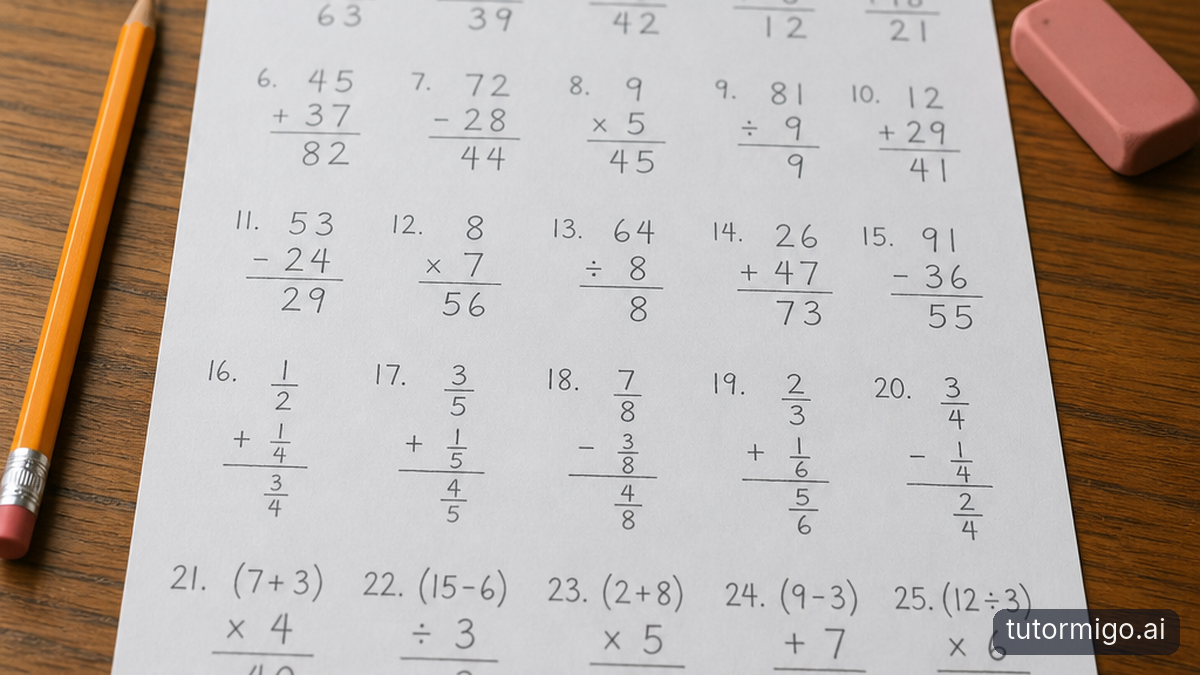
You may know the scene: your child brings home weeks of strong math grades, then struggles badly on a cumulative test. It is tempting to blame nerves or a difficult unit, but sometimes the deeper problem is that correct answers have been hiding incorrect reasoning. A lucky guess, a memorized shortcut, or copying a familiar pattern can look like mastery when a worksheet checks only the final result.
This is especially worrying when you suspect your child is falling behind in math but cannot see exactly where the slide began. The missed concept may be small today and disruptive later. A student who never built a clear understanding of place value may find decimals confusing. A student who memorized one fraction procedure may freeze when the numbers or wording change.
The goal is not to turn every homework problem into an investigation. It is to notice the difference between an answer your child can explain and one they happened to reach. That distinction gives you a practical starting point instead of another vague request to “practice more.”
Why Accidental Correctness Is So Risky
Imagine a fourth grader adding multi-digit numbers by lining up digits inconsistently. On one short worksheet, the numbers may happen to produce a correct answer because the relevant digits are small or repeated. The same habit can fail when regrouping appears. A basic grading platform may mark both attempts the same way: correct or incorrect. It usually does not reveal whether the child understood place value or relied on visual guessing.
Similar traps appear in later units. A child may call the longer side of a shape its “area” because the diagram looks wide, then choose the right answer on a familiar rectangle question. Another child may divide by a fraction using a memorized rule without understanding why the result can be larger than the starting number. When the context changes, the shortcut breaks.
That is why a pattern of high homework marks can coexist with hidden math learning gaps. Look for explanations, not just scores. Ask, “How did you decide what to do first?” and “Can you show me a different way?” If the explanation changes each time, the correct answer may be accidental. For a closer look at this pattern, read about how lucky guesses hide math learning gaps.
What a Math Misconception Journal Reveals
A math misconception journal is a simple record of the reasoning mistake behind an answer. It is not a list of everything your child got wrong. Instead, each entry captures the concept, the visible clue, and the next question to ask. For example: “Confuses area with perimeter; counted the outside edges when asked how much surface is covered.” That note is more useful than “missed rectangle problem.”
Use a second example to make the record precise: “Dividing by a fraction; repeated the numerator and denominator rule but could not explain the meaning of the result.” Then add a small prompt such as, “Show this with a drawing or real objects.” Over time, repeated entries reveal whether the issue is calculation accuracy, vocabulary, visual interpretation, or a missing foundation.
TutorMigo’s personalized AI Tutor workspace can support this review by giving your child a place to work through explanations and retain session history. You can compare an early explanation with a later one rather than relying on a single score. The point is not to label your child. It is to identify the exact mental model that needs rebuilding before it becomes a larger STEM roadblock.
Replace More Problems With Better Interventions
When a child makes a conceptual mistake, serving another nearly identical problem may create repetition without understanding. A better intervention pauses the lesson loop. If your child confuses area and perimeter, put the numbers aside briefly. Sketch a rectangle, trace its boundary, shade its inside, and ask which quantity changes when the shape gets wider. The visual distinction can make the vocabulary meaningful.
For fraction division, use a story or model before returning to symbols. Ask how many one-half servings fit into three wholes, then connect the drawing to the calculation. Your child does not need a long lecture. They need a chance to predict, explain, notice a contradiction, and revise the idea. That sequence builds intuitive reasoning instead of another fragile shortcut.
This is the practical promise behind adaptive STEM learning for kids: the next activity should respond to demonstrated understanding. For families comparing tools, TutorMigo adaptive pacing is best viewed as a useful standard to look for—the learner’s explanation should influence what happens next, not just the answer box. The AI Tutor experience is most valuable when it helps a child slow down, explain, and continue from the repaired concept.
How Parents Can Check the Reasoning at Home
You can spot logic traps without becoming your child’s full-time math teacher. Once or twice a week, choose one completed problem and ask your child to solve it again without looking at the original work. Then ask for a drawing, an estimate, or a real-world example. If the answer changes, listen for the moment the reasoning shifts. That moment belongs in your misconception journal.
Keep your questions neutral. “What made you choose that operation?” is more helpful than “Why did you do it wrong?” If your child cannot explain a step, do not immediately supply the rule. Ask what the numbers represent and whether the result seems reasonable. A product smaller than both starting quantities, for example, may deserve a second look depending on the operation and values involved.
Session continuity can make this routine easier. In TutorMigo’s tutor workspace, your child can return to earlier work and continue a learning thread instead of starting from zero each time. A parent can then discuss the pattern rather than hovering over every problem. If homework conversations regularly become tense, these practical ways to reclaim the kitchen table can help create a calmer routine.
Turn a Good Grade Into Durable Understanding
A good grade is useful evidence, but it is not the whole picture. Durable understanding shows up when your child can explain a method, recognize when it applies, estimate whether an answer makes sense, and use the idea in a new situation. Those skills matter more than repeating a procedure perfectly on familiar homework.
Start with one small diagnostic session. Bring three recent problems: one correct answer, one incorrect answer, and one problem your child solved slowly. Ask your child to explain each choice aloud. Record the repeated confusion, then use an interactive math step editor or whiteboard to represent the idea in a new way. Return to the same concept later rather than treating one successful attempt as proof that the gap is closed.
TutorMigo benefits are easiest to judge through this kind of visible progress: clearer explanations, fewer repeated misconceptions, and more confidence when the format changes. Explore a TutorMigo session to identify your child’s conceptual blind spots before they compound. The aim is not perfect work every night. It is a stronger foundation your child can carry into the next unit.
Frequently asked questions
Yes. Homework may reward familiar procedures, partial understanding, or lucky guesses. Ask your child to explain the method, draw a model, and solve a changed version of the problem to check whether the idea is secure.
Record the concept, the reasoning clue, and a follow-up prompt. For example, note that a child confused area with perimeter, then write a question that asks them to trace the boundary and shade the inside.
A personalized AI Tutor can give students a workspace for explanations, interactive practice, and session continuity. Parents should still review the reasoning patterns and use the tool to support conversation, not replace it.
Act when the same misconception appears across different assignments, your child cannot explain correct answers, or new units depend on the shaky concept. Early support is usually easier than waiting for cumulative tests to expose the gap.
Related reading
Enjoyed this read?
Like, share, or comment below.



Comments
0Sign in required · respectful discussion · replies supported
Loading comments…